Food in Shikiori

Food in Shikiori

I did not plan to start another food sketchbook so soon. I said at the end of the last one that I’d be folding food sketching into my regular daily sketchbook going forward. But then I didn’t. Ha! I grabbed this Delta thinking it has fewer pages, and would be great for March. Also, tracking my allergens is genuinely easier in a dedicated book, and here we are. Food Sketchbook No. 6.

This one is a Stillman & Birn Delta, softcover, 5.5 × 3.5 inches, 270gsm cold press in ivory. I’ve tried the Delta paper before, one year ago exactly! I did not love it for watercolor. However, for ink it’s been great. Very wet ink washes with loads of water, it doesn’t even buckle!

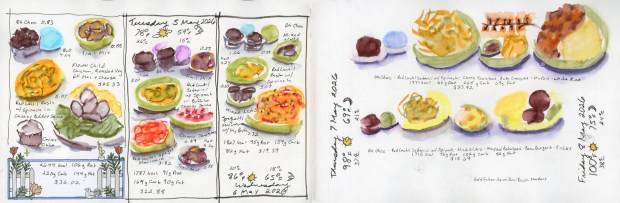
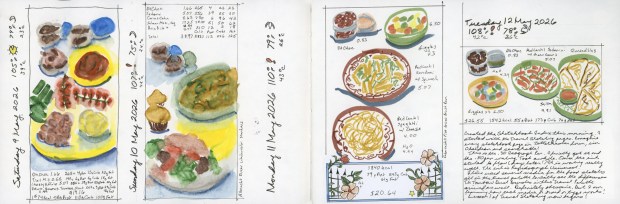
I book started on March 9th, intending to keep going through the month. But then those allergens hit, and I only got two days done. Both are done in Shikiori markers, because I was thinking markers would be fast and I was worried about not keeping up.

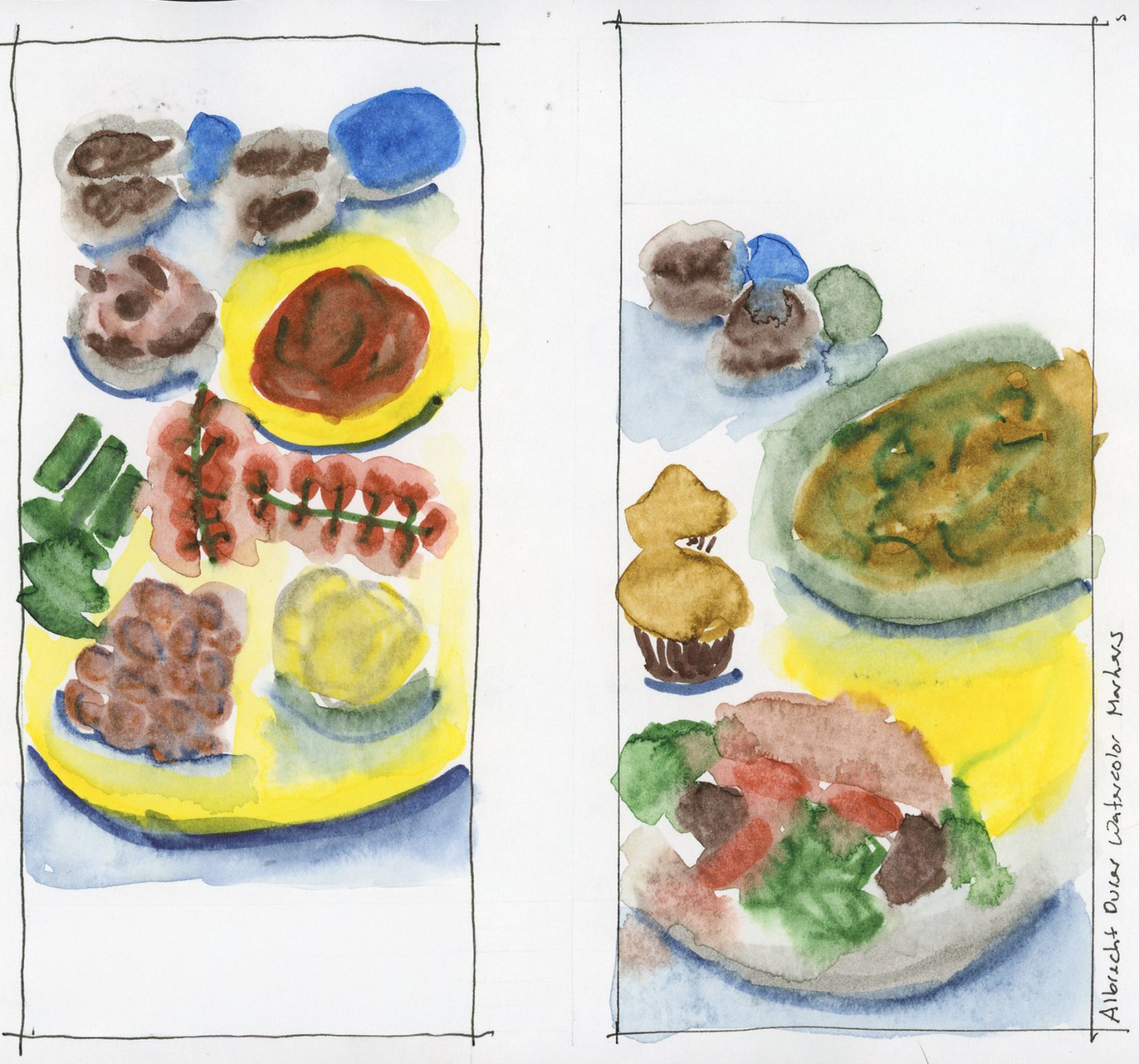
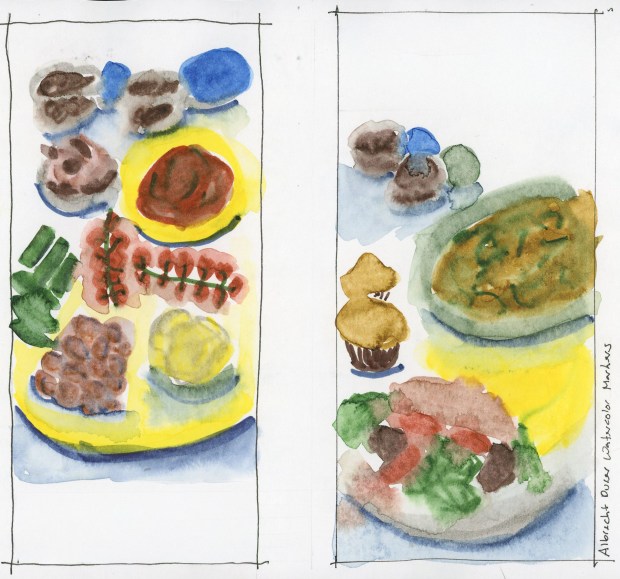
Watercolor food sketch on a double page spread, Monday 9 March 2026. Individual food portraits include dark chocolate, trail mix, a large green plate of yellow pasta with vegetables, cherry tomatoes on the vine, and a bean burger on a green plate. Handwritten food names, costs, and nutrition data fill the margins. Sailor Shikiori markers.
Monday 9 March 2026 — Food Diary in Sailor Shikiori markers
Watercolor food sketch on a double page spread, Tuesday 10 March 2026. On the left, pumpkin granola in a red bowl, dark chocolate, a green oval, and a large plate of red lentil sedanini with green beans in cheesy buffalo sauce. On the right, spaghetti marinara with a bean burger, and a large trail mix bowl in a red-rimmed dish. Handwritten food labels and a nutrition and cost summary box. Sailor Shikiori markers.spaghetti marinara with a bean burger, and a large trail mix bowl in a red-rimmed dish.
Tuesday 10 March 2026 Food diary in Sailor Shikiori markers

These are Sailor Shikiori markers. Japanese brush markers that take water beautifully. I do love that watery look. I had used Faber-Castell watercolor markers for food a few years ago and loved how they looked. I had these close by, so they were the obvious choice when I started this new book, hoping using marker would be a fast and easy method.

I got two days in. Once almost three weeks has passed, I knew I wouldn’t be able to catch-up, so I decided to jump in with my birthday. But I also knew I needed a fast method this busy week. One of my favorite sketches previously was a monochrome silhouette style, but I couldn’t remember if I’d done it in the 023 ink, or the Doyou ink. Obviously this means I had to both this week!

A fast way to record, and then the fun comes in the lovely ink washes as the dark lines are diluted.

Ink wash food diary spread on a double page, Monday 30 March 2026. Food items rendered as purple silhouettes along a horizon line, with "Happy Birthday" lettered in the center. Handwritten food names and costs below, including dark chocolate, Mexican wedding cookies, sparkling water, red lentil pasta bowl, glow bowl, lemonade, lemon olive oil cake, and baby brie peanut butter cups. Sailor 023 Shikiori marker.
Monday 30 March 2026 Food Diary in Shikiori marker 023.
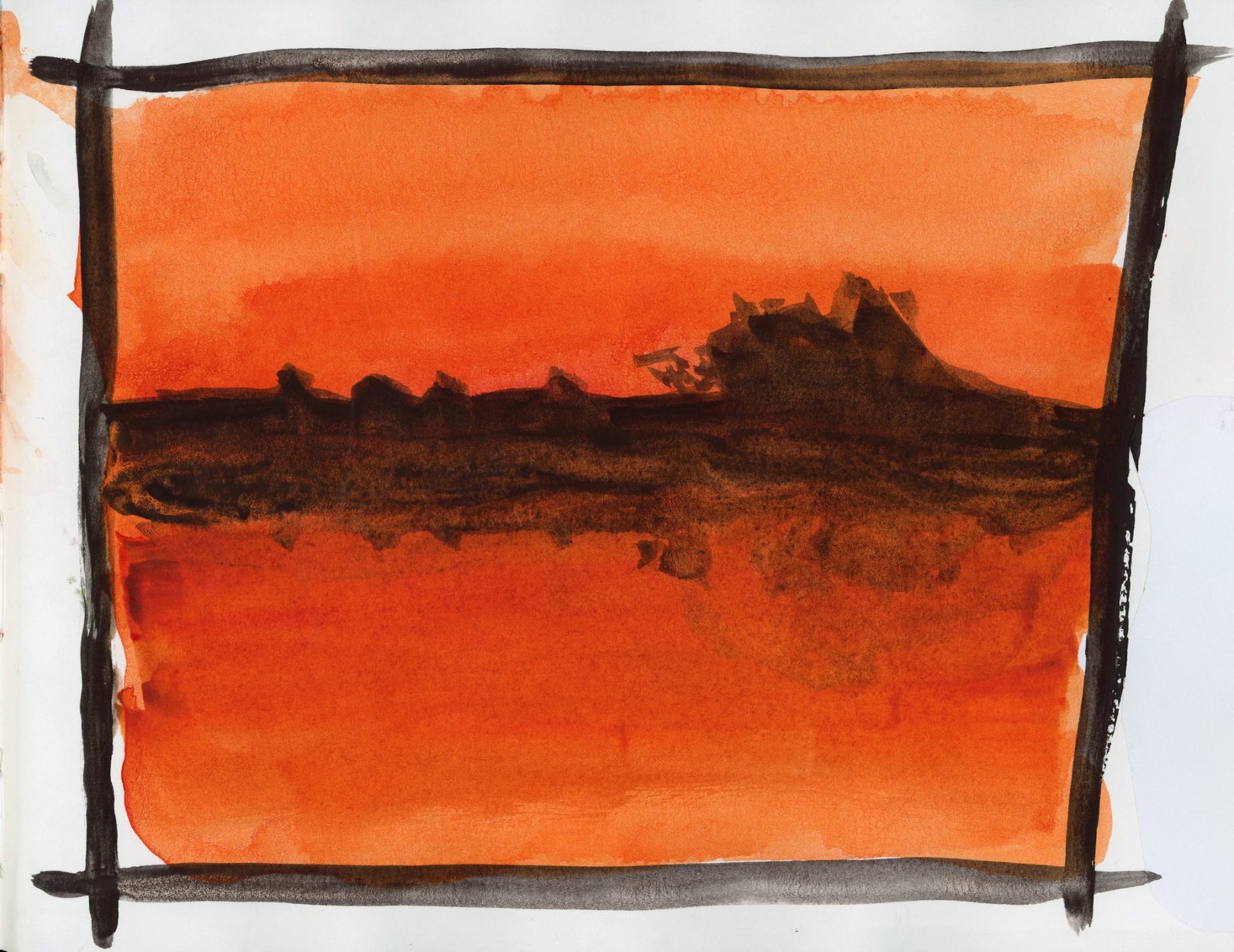
Ink wash food diary spread on a double page, Tuesday 31 March 2026. Food items rendered as warm reddish-brown silhouettes along a horizon line, including dark chocolate, Biggles, red lentil pasta bowl, lemonade, lemon cake, poke bowl, and cherry tomatoes. Handwritten food names and costs below. Sailor Doyou Shikiori marker.
Tuesday 31 March 2026 Food Diary in Shikiori marker Doyou.

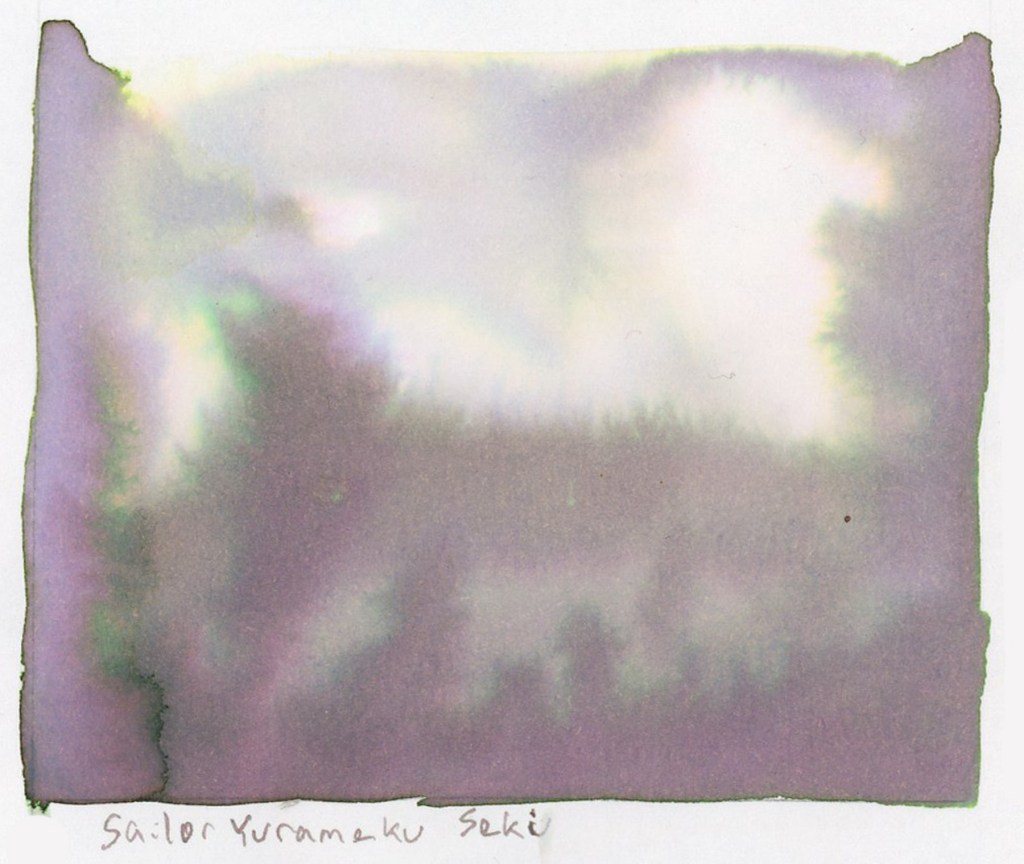
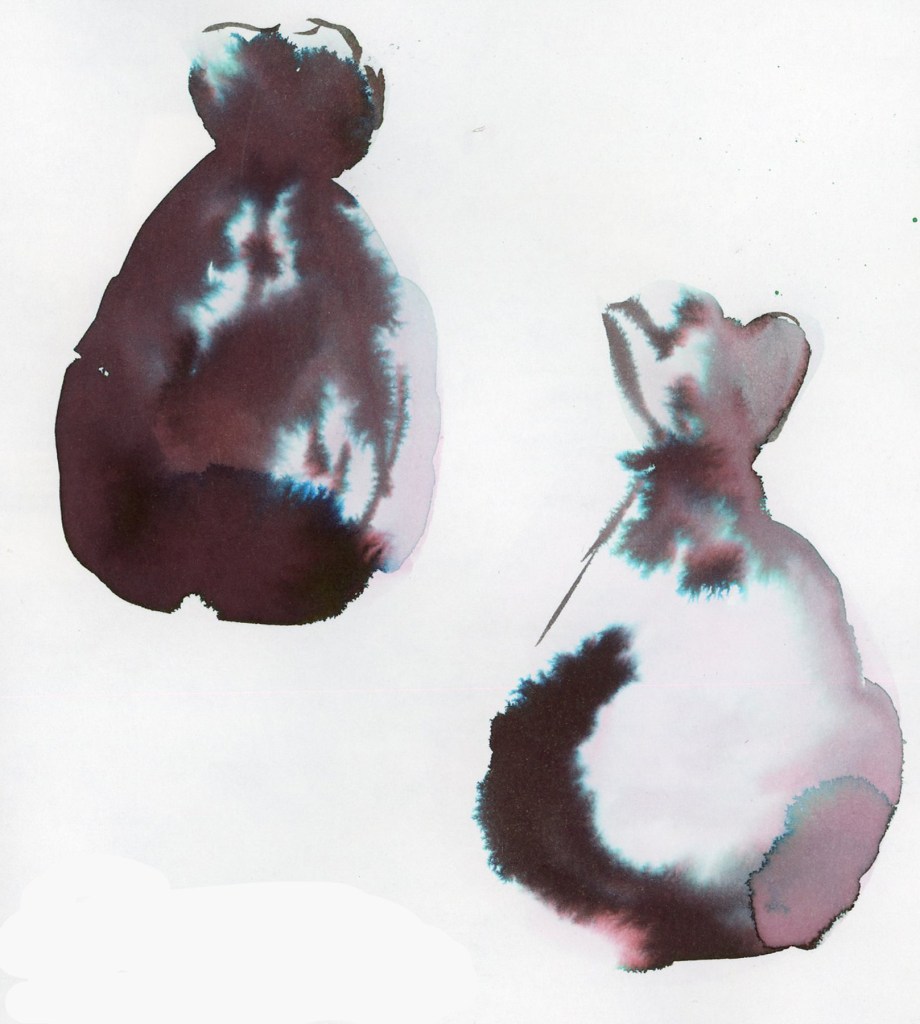
The 023 has the deeper purple undertones, while the Doyou leans toward the browns. Both work beautifully in the silhouette format, and the way the marker ink blooms into the wet wash below is very much what I was going for here.

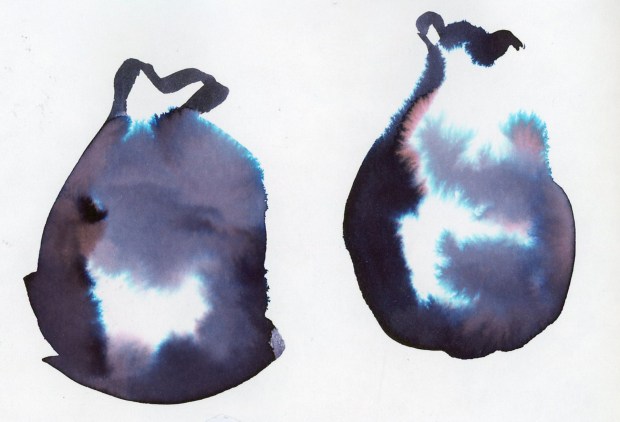
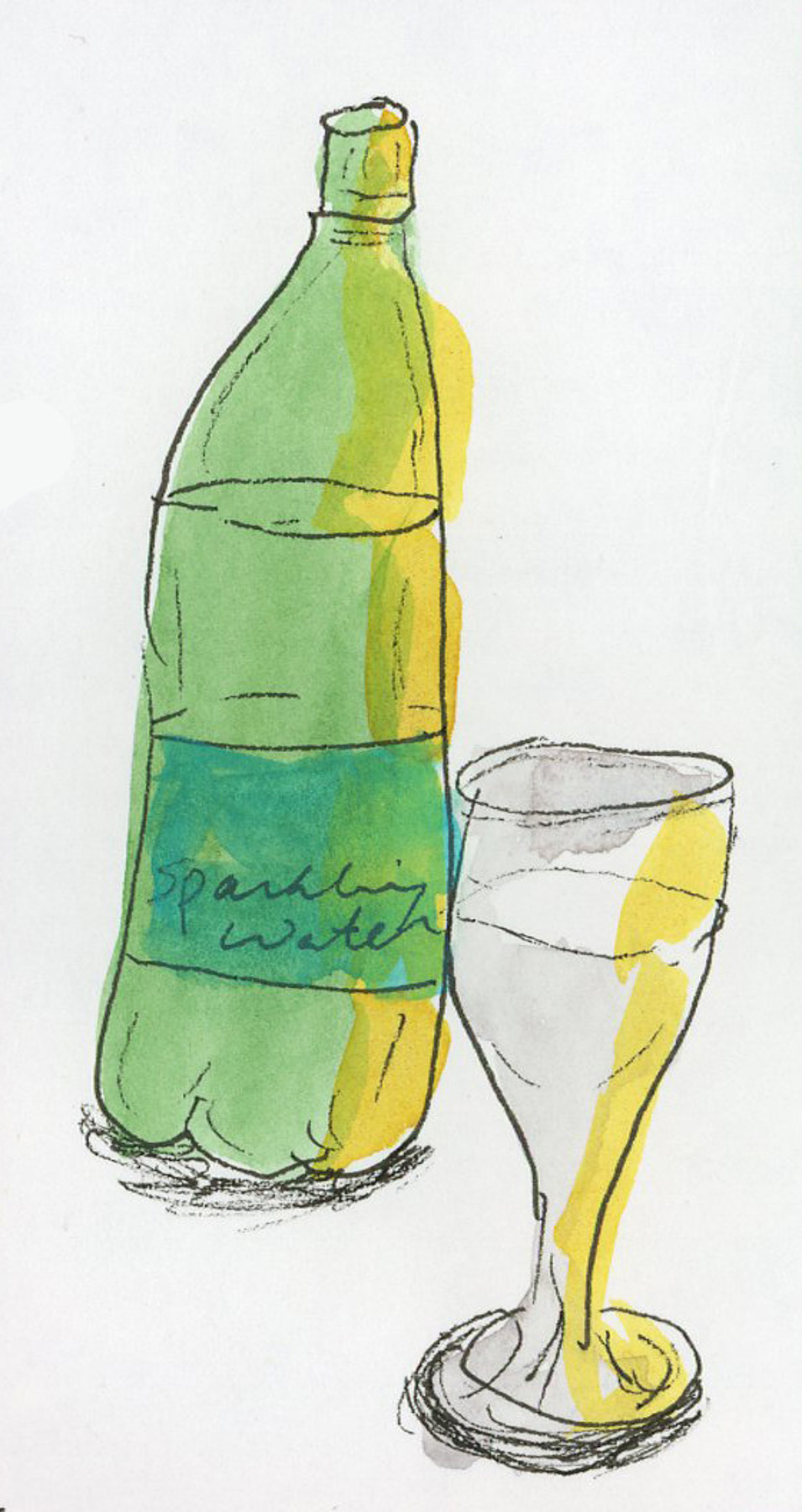
Ink wash food diary spread on a double page, Wednesday 1 April 2026. Food items rendered as near-black silhouettes against a deep blue-violet pooling wash below, including dark chocolate, sparkling water, red lentil pasta bowl, sparkling water, rice with carrots and pulled pork teriyaki, and sparkling water. Handwritten food names and costs. Diamine Good Tidings ink.
Wednesday 1 April 2026 Food Diary in Diamine Good Tidings Ink wash.

I wanted to keep going with the black inks, and I had the Diamine Good Tidings nearby. I really need to write the inks higher on the page, because doing it near the margin, they get cut off when I scan! I loved the color bleed on this ink so much!

I remembered the Udemy course on fountain pen ink art by Nick Stewart that I’d dabbled with back in January — specifically his chromatography exercises, which are all about how inks separate and bloom when water is introduced. That’s exactly what was happening in these food spreads. One of the inks he uses in that course is Noodler’s Rome Burning, so I knew what ink I was going to do next!

Ink wash food diary spread on a double page, Thursday 2 April 2026. Food items rendered as warm golden-brown silhouettes along a horizon line, with a yellow ink wash below. Items include dark chocolate, sparkling water, red lentil pasta bowl, Ciao, poke bowl, summer strawberry water, lemon cake, and trail mix. A bright yellow element appears on the right side. Handwritten food names and costs. Noodler's Rome Burning ink.
Thursday 2 April 2026 Food Diary in Noodler’s Rome Burning Ink wash
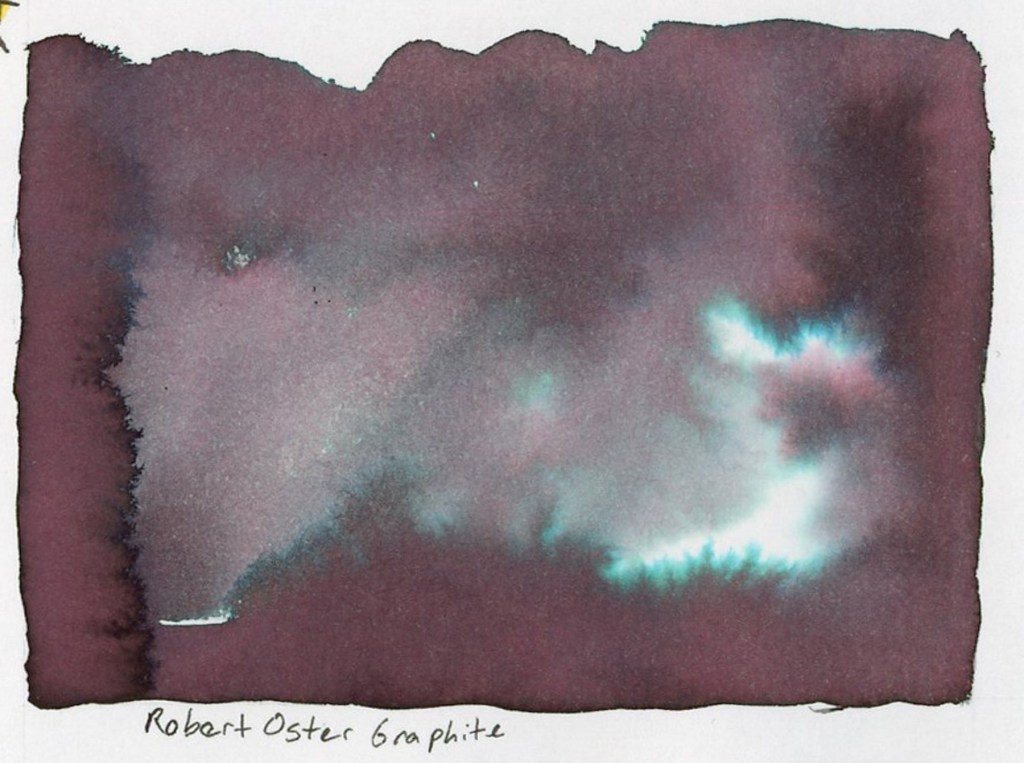
Ink wash food diary spread on a double page, Friday 3 April 2026. Food items rendered as deep plum-grey silhouettes along a horizon line, with a soft blue-violet blooming wash below. Items include dark chocolate, red lentil pasta bowl, Ciao, sparkling water, quesadilla with enchilada sauce, sparkling water, trail mix, and sparkling water. Handwritten food names and costs. Robert Oster Graphite ink.
Friday 3 April 2026 Food Diary in Robert Oster Graphite Ink wash

The Robert Oster Graphite is also used in Nick Stewart’s course, and I can see why! Look at those colors! Deep plum-to-grey shift with the blue bloom and pink undertones in the wash is doing a lot of atmospheric work for what is essentially a record of sparkling water and a quesadilla.

From Shikiori markers to fountain pen inks. Now I’m energized to get back to the exercises in that Udemy course, and see what these inks can do!

Sketchbook: March 2026

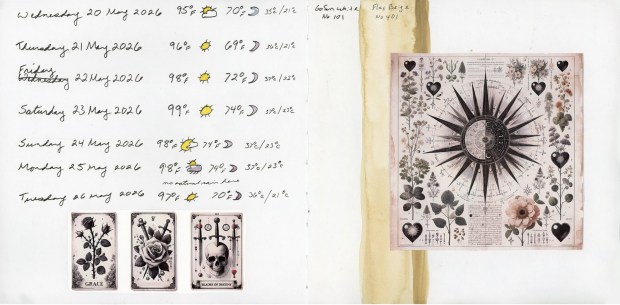
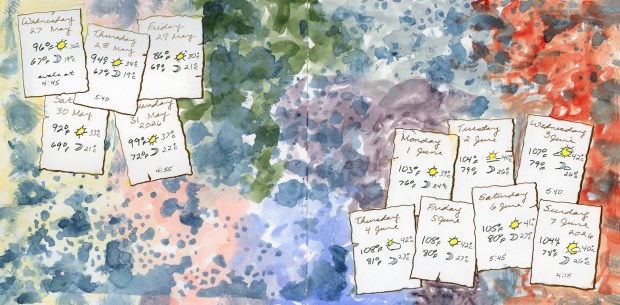
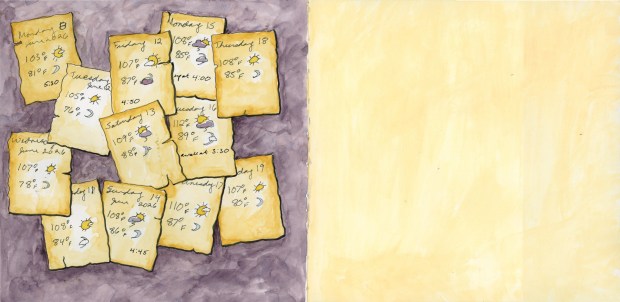
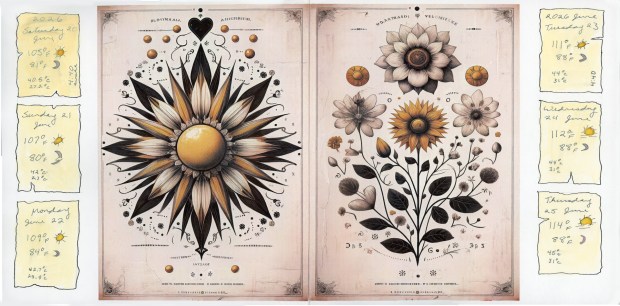
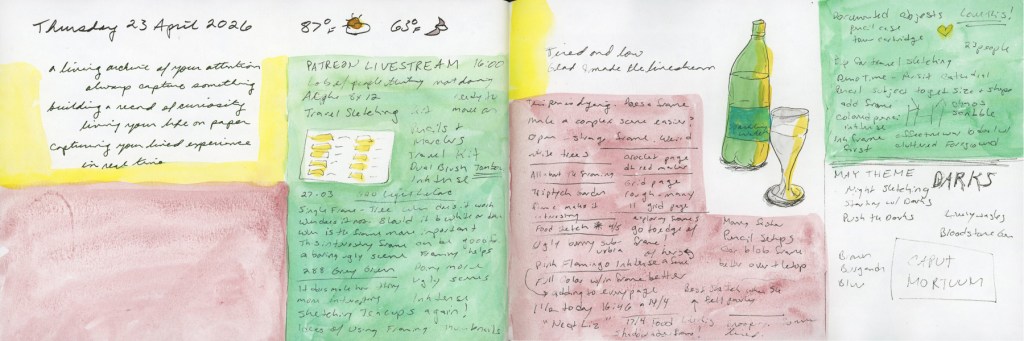
I started recording the weather alongside the daily dates in my sketchbook back in January 2023, Volume 12. Over three years now. It’s become one of those quiet anchors of my sketchbook. Even in the months where I sketched almost nothing else, the dates and weather hold the line. After an inflammation hit, or a hard week, or even death in the family, I come back and I catch up the weather. I fill in the gap from whenever I fell off to when I’m picking the sketchbook back up. There’s something grounding about that return.

It makes the sketchbook practice a living, breathing reflection of life itself and that is worth capturing. Here is the flow of the full sketchbook pages for the month.

I had such great energy and joy at the start of the month! I was feeling the spring bloom, and painting my pages with the Winsor Newton Sap Green. Edges class was starting and I was super excited about that.

A dual page sketchbook spread — dates and weather log for Saturday 28 February through Thursday 5 March 2026 with moon phases and astronomical events on the left, and the March 2026 Coloring Book of Shadows page painted in greens, yellows, and warm browns depicting a witch's kitchen cottage, on the right, with Edges course notes on a bright green wash in the background
February tail end and March — A Witch’s Kitchen, CBOS 2026
A dual page sketchbook spread — Edges Lesson course notes with painted examples including a red onion and a figure in yellow on a bright green wash on the left, and the January 2026 Coloring Book of Shadows page painted in purples, greens, and golds depicting a magical home with a cat, on the right
Edges Lesson notes and January CBOS — A Magical Home

Since I really want to include the Coloring Book of Shadows monthly designs in my sketchbook this year, myy completist brain couldn’t leave January and February’s pages missing from the record. So in they went. They really are so pretty when colored.

A dual page sketchbook spread — the February 2026 Coloring Book of Shadows page painted in purples and greens depicting an altar and hearth cottage on the left, and a handwritten journal entry in Robert Oster Cherry Blossom ink with small decorated collage images on the right
February CBOS — Altar and Hearth, with Cherry Blossom ink journaling

I’ve been making a deliberate effort to do more journaling in the sketchbook this year. Apparently I was doing journal notes back in January 2023 as well, and I just forgot! I like it, as it captures actual life, not just sketches. It is also a great excuse to use the large collection of fountain pen inks I have!

A dual page sketchbook spread — the March 2026 Coloring Book of Shadows elements page painted in greens and pinks with dates and weather log and journaling in Cherry Blossom ink on the left, and a bold watercolour gradient wash from Sap Green to Hansa Yellow Light with Hearts and Honey written vertically in Cherry Blossom ink and small painted collage images on the right
March CBOS — The Elements, and a Hearts & Honey gradient closing page

Hearts and Honey is the book I’m currently writing, and it’s very hard to document a writing project! They aren’t very sketchable unless I start doing storyboards (those are Hard!) but it’s a big part of my life and it deserves to be documented.

A dual page sketchbook spread — three sketches of the Frank Lloyd Wright Spire at Scottsdale Road and Frank Lloyd Wright Blvd on the left with handwritten location notes and journaling on a teal colour block wash, and a painted watercolour study of the spire with Edges course notes on the right
Frank Lloyd Wright Spire, three sketches

This is where the spire series lives in the sketchbook. Three attempts, ink through to direct watercolor. You can read more about that in the March Theme: Three post!

Bathtime at the Reflection Pool — Lovebird in 3 Poses, with Gradient Bar

Sketch outing notes on a color block, and the lovebird page that ended up anchoring the Three post. One bird, three poses, with a watercolor gradient bar.

A dual page sketchbook spread — twenty watercolour portrait studies in small numbered grid squares on green and blue washes on the left, and ten loose ink figure studies in sepia on the right, labelled One Week 100 People, 30 including the children
One Week 100 People — 30 done, faces and figures

I did not do as much as I wanted for One Week 100 People, but I’m happy I got one day of sketching in!

double page sketchbook spread. The left page shows a handwritten dates and weather log for March 11–19 2026, with weather icons and temperatures climbing from 84°F to 103°F, an Extreme Heat Watch notation, a watercolor Irish flag sticker with shamrock, and a decorative red and green tile washi tape border along the bottom. The right page has a dramatic background of Diamine Ruby Taffeta and Diamine Overcast inks in deep red and soft teal, with three gold shamrock coin stickers and a detailed Trim Castle sticker showing stone ruins against a green lawn.
Dates and weather 11–19 March, with a St. Patrick’s Day page in Diamine Ruby Taffeta and Overcast ink.

March broke heat records, by a lot! Over ten degrees above the previous records, some days. The washi border and Irish flag sticker are for St. Patrick’s Day — a little celebration tucked into the data. A dramatic sketchbook page with a deep red and soft teal ink background made with Diamine Ruby Taffeta and Diamine Overcast inks, with three gold shamrock coin stickers and a detailed Trim Castle sticker showing stone ruins against a green lawn. The stickers and washi tapes are from this month’s Cora Crea box.
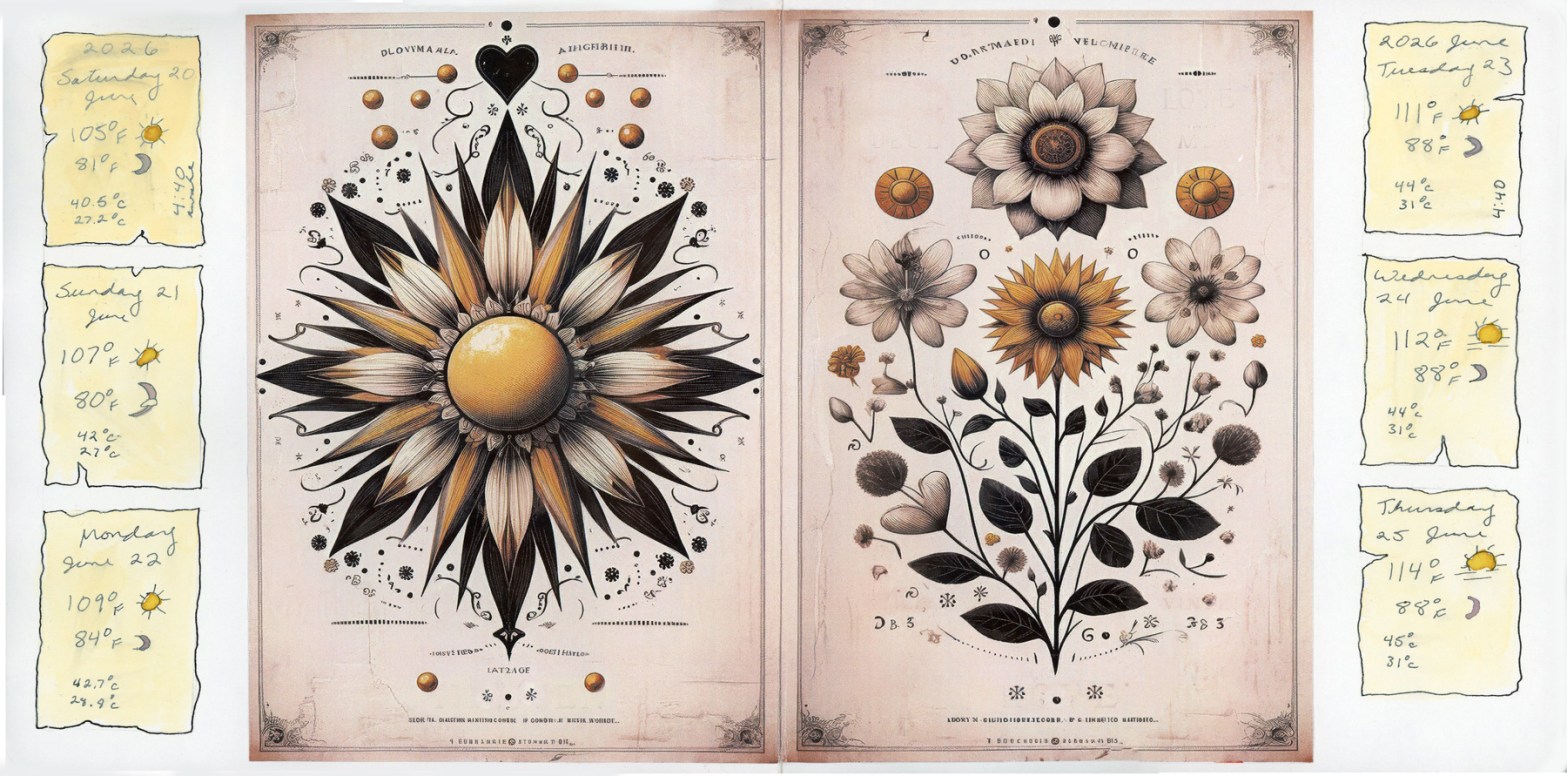
A double page sketchbook spread showing a handwritten dates and weather log for March 20–31 2026, with red exclamation marks on record breaking temperatures reaching 105°F, Ostara noted on March 21st, a trailing ivy sticker on the right side, and two decorative washi tape borders in blue-green tile and red tile patterns running along the bottom of both pages.
Dates and weather 20–31 March — breaking records all week. Ostara at 105°F.
I wanted to sketch, but inflammation hit badly, so a string of dates and weather is all I managed. At least the weather is cooling off! Still unseasonably warm, and matching the record high temperatures.

A double page sketchbook spread. The left page shows dense handwritten notes from Edges Livestream 2 covering lessons 3 and 4, written over a warm Gansai Tambi Cosmic Olive green wash, with small ink sketches illustrating concepts like foreground, middle ground, prioritizing tone, and lost and found edges. The right page shows five large granulating watercolour swatches of the Gansai Tambi Granulating 2 Cosmic palette, labelled Cosmic Violet, Cosmic Red, Cosmic Olive, Cosmic Blue, and Cosmic Green.
Edges Livestream 2 notes on a Cosmic Olive wash, alongside the Gansai Tambi Granulating 2 Cosmic palette swatches.

Ending the month with some notes from the second and final Edges livestream, then a little color exploration. I had to swatch out this Gansai Tambi Granulating 2 colors.

Like most of my sketchbook pages for the last several months, I have more notes than sketches, but it does capture life as it’s happening. Honestly, I’m surprised I have as many pages done as I do! That’s not nothing. Here is March, on the page. 

March Theme: Three

March Theme: Three

Liz Steel’s Patreon community theme for March was Three. Three sketches, three objects, three colors, a triad palette all counted, and it is a very versatile theme. I didn’t sketch as much this month as I wanted (hello inflammation hit!), but when I looked back through my sketchbook, three had been quietly showing up all along.

The most obvious was the Frank Lloyd Wright spire. I drew it three times. First just ink, getting acquainted with the energy of it. The second ink sketch was working on getting those complex angles and changes in plane. The spire has this wonderful jagged, faceted quality and it took real concentration to follow all those shifting surfaces. Much more challenging subject than I anticipated!

By the third, I went straight to direct watercolor. I always seem to love direct watercolour. It’s so much more forgiving! . There’s a looseness and confidence that comes from having already worked through the subject twice. Another aspect of three, was using just three colors: Winsor Newton Cobalt Turquoise Light, Winsor Newton Sap Green, and Daniel Smith Transparent Pyrrol Orange.

Something lovely happens when you sketch a single subject three times. I should do this more often. It looses you up, and you get more familiar with it.

Three watercolour lovebirds painted in bright greens, orange and yellow, sitting along a grey perch with soft reflected colour below, on white paper
One lovebird, three poses — green, orange, and full of personality

I loved this bird! One lovebird, in three poses, taking a bath. I drew these from photographs I took at the time. One sketch wasn’t enough to capture his fluttering energy during his bath at the reflection pool outside. Fifteen grackles were also present, focused on their own baths. Having those three poses meant I could tell the whole little story of this bath on a single page: the cautious approach, the full splashy middle, the ruffled aftermath.

I worked with a very limited set of colors across both subjects. The spire was a three color palette of Cobalt Turquoise Light, Sap Green, and Transparent Pyrrol Orange. For the birds it was a three color palette of Hansa Yellow Light, Sap Green and Trans Pyrrol Orange. I did add a hint of Cobalt Turquoise for the dark shadows on those wing feathers, and of course, Shadow Violet quietly sneaking in for the water. Technically five colors. Spiritually still three. Ha!

A sketchbook page showing three lovebird poses in watercolour, with five painted colour swatches across the top labelled Shadow Violet, Cobalt Turquoise, Sap Green, Hansa Yellow Light, and Transparent Pyrrol Orange, a handwritten title reading "It's Bathtime at the Reflection Pool," and a green-to-orange gradient bar along the bottom.
One lovebird, three poses, in (almost) three colors.

Then I had to add three design elements to this page! So we have the color gradient. (I do love painting a nice color gradient! Been practicing those for years!), the color swatches, and, of course, the main subject of the sketch. My swatches might be over-large for the best page design, but I still like how it tells the story of the colors as well as the love bird. After all, his colors are what makes him so special!

So that’s my exploration of the theme of three for March. One spire, drawn three times. One bird, three poses. A page with three design elements. Lastly, a palette that tried very hard to stay at three colors and almost made it.

Bathtime at the Reflection Pool

Concluding The Messy Middle from last week, you saw a sketchbook in progress — pages waiting, spaces held open, intentions taped into place. This is the update. The pages are filled. Titles are added.

A dual page sketchbook spread — three sketches of the Frank Lloyd Wright Spire at Scottsdale Road and Frank Lloyd Wright Blvd on the left with handwritten location notes and journaling on a teal colour block wash, and a painted watercolour study of the spire with Edges course notes on the right
Frank Lloyd Wright Spire, three sketches

This is my Edges Lesson One outdoor outing — the Frank Lloyd Wright Spire at the little commemorative park at Scottsdale Road and Frank Lloyd Wright Blvd, sketched on location. I knew it was going to be the last good weather day for a while, so there was no hesitation — I had to get out there while I could.

The sketches are chaotic in the best way — three poses of the spire, which also happens to tie in perfectly with Liz Steel’s Patreon March Challenge of three things. The outing felt messy and alive, and I wrote all of it down right there on the page while I was still sitting in the shade. I finished this page by adding the date and the Title to it. I also tried to lift the wet paint transfer that the wind had put on the ink sketches.

A dual page sketchbook spread — handwritten journaling in black ink on a teal colour block wash on the left describing the Edges outdoor outing and the surprise lovebird sighting at the reflection pool, and three watercolour lovebirds painted in greens, oranges and yellows with the header Bathtime at the Reflection Pool on the right
Bathtime at the Reflection Pool — 15 grackles and 1 lovebird

But this is the page that made the whole outing. I’d gone to sketch the spire, and I found a lovebird.

Fifteen grackles and one lovebird, bathing at the reflection pool. A few escaped from a pet store years ago, apparently, and they’ve been surviving in the wild ever since. I spotted it, grabbed some photos, and left the blank page so I could paint these birds at home.

Three watercolour lovebirds painted in bright greens, orange and yellow, sitting along a grey perch with soft reflected colour below, on white paper
One lovebird, three poses — green, orange, and full of personality

Three lovebirds — one lovebird in three poses, because it was there taking a bath. They’re green and orange and yellow and absolutely full of personality. The journaling on the left is written in that teal colour block wash, and it holds the whole story of the outing: the victory of getting outside, the chaos of the spire, the unexpected gift of the birds.

A dual page sketchbook spread — twenty watercolour portrait studies in small numbered grid squares on green and blue washes on the left, and ten loose ink figure studies in sepia on the right, labelled One Week 100 People, 30 including the children
One Week 100 People — 30 done, faces and figures

The One Week 100 People page got its finishing touches too — thirty people including the children, faces in watercolour on the left, ink figures on the right. I added the numbers and the titles to finish off this page.

A handwritten weather log for Wednesday 11 March through Thursday 19 March 2026, with hand drawn weather symbols in yellow and red, noting temperatures rising from 84 degrees Fahrenheit to 103 degrees, with annotations reading Extreme Heat Watch, Record Breaking, and Extreme Heat Warning to 22nd
Weather log 11–19 March 2026 — record breaking heat in March

I knew my outing day was the last cooler day for awhile, but wow has the heat spiked! Breaking records by a mile! And it’s just going to get hotter, if you can believe that. I don’t usually see these kind of temperatures until May. We went from a warm pleasant 84°F on Wednesday the 11th to 103°F — record breaking — by Wednesday the 18th, with an Extreme Heat Warning extending through the 22nd. In March. The thermometer icon I drew in red says everything. And it’s only getting hotter!

Titles and notes help complete pages, and aid in telling the story of the everyday life I’m documenting with my sketchbook. This mini series of posts has shown a bit of the process for what is usually only shown completed. It’s easy to think I should complete pages in just one sitting, all perfect, but the truth is that isn’t how it’s done, really, if you are going to add a little sketchbook design to your pages.

Why Page Design Makes All the Difference (Even for a Food Diary)

If you’ve been following the Illustrated Food Diary for a while, you know the premise is pretty simple: I sketch what I eat, sometimes with calories, carbs, and cost noted alongside. Same subject, every single day. Plates, bowls, bottles of sparkling water, the occasional bag of chips.

It could get very repetitive very fast. And honestly, without some intentional page design, it does.

I’ve been thinking about page design since taking Liz Steel’s Sketching Now course — Sketchbook Design — and with Sketchbook Volume 24 (my 5th food sketchbook,) I got serious about actually applying it to the food diary. Near the back of the book I filled a few pages with wireframe sketches: little thumbnail layouts exploring different ways to organise a page. What Liz called recipe book in the Sketchbook Design class. Some ideas came from Liz, some from scrapbooking, and some I just made up. The note I wrote on the title spread still holds: design makes it look so much better.

Watercolour title page in purple reading "Page Design" with handwritten notes citing Liz Steel, scrapbooking, and personal ideas as sources, beside a page of small coloured thumbnail layout sketches for food diary pages
Page Design — sources and first thumbnails, Vol. 024
Two pages of hand-drawn wireframe thumbnail sketches showing named food diary page layout concepts including Modular Stack, Overlapping Flow, Spiral, Deconstructed Journal, Blueprint Grid, and Map, with watercolour colour studies
Wireframe page design layout concepts.
Two pages of food diary layout wireframe thumbnails in various colour combinations including pink, blue, orange, purple, teal and green, with handwritten notes reading "Food Diary Page Design from Liz Steel 2008" and Epsilon sketchbook specifications.
Wireframe page design layouts for S&B Epsilon 5.5 x 3.5-inch Landscape sketchbook.

Here’s what I landed on as my toolkit.

Colour blocking is my favourite for making plates really pop. A solid band of colour behind the food — yellow, teal, pink — does something almost magical: suddenly the sketches read as a designed page rather than a collection of doodles.

Illustrated food diary page for Saturday 5 July 2025 using a yellow colour block band, with watercolour sketches of cereal, Greek wraps, and kettle chips, annotated with calories and costs
Saturday 5 July — Food Sketch page with yellow colour block

The baseline layout — everything lined up along a common ground line — gives a page a clean, almost theatrical feel, like the food is on a little stage. The variety of shapes along that line (round bowls, wedges of quesadilla, tall bottles) creates a natural rhythm without any extra effort.

Illustrated food diary page for Monday 7 July 2025 with all food items lined up along a common baseline, including dark chocolate, red lentil pasta, watermelon, quesadillas, and sparkling water, annotated with calories and costs.
Monday 7 July — Food Sketch page with baseline layout.

Column dividers are great when you have a lot of items and want to create clear sections without things feeling cluttered. Vertical bands separate the day into distinct moments, and it ends up reading almost like a magazine layout.

Illustrated food diary page for Saturday 12 July 2025 using green vertical column dividers to separate meals, with watercolour sketches of dark chocolate, red lentil pasta pizza, cherries, and a Greek-style mezze plate
Saturday 12 July — Food Sketch page with column dividers.

And then there’s direct watercolour with a simple frame — no planning, just paint. This is what I reach for on a busy day, or when I’m catching up after falling behind. It’s the fastest approach, and even a simple frame lifts a page considerably. That Wednesday the 16th spread — done entirely in one deep plum — is a good reminder that design doesn’t have to mean colour variety. Monochrome with a strong layout is its own kind of striking.

Illustrated food diary page for Wednesday 16 July 2025 entirely in deep plum monochrome watercolor marker, showing a full day of meals arranged along a baseline across a two-page spread.
Wednesday 16 July — Food Sketch Page in Watercolor Marker, monochrome.

Here are a couple of recent examples from the current volume. Wednesday 4 March is a good fast-day page — loose, direct, just a simple wavy frame holding everything together.

Loose watercolor food sketch on a double page spread, Wednesday 4 March 2026. On the left page, dark mushroom shapes and a teal oval sit beside a large yellow pasta bowl rendered in fluid, gestural brushwork. On the right, a loosely painted brown shape sits centrally, with scattered sketches of cherry tomatoes on the vine, green cucumbers, a bean burger with ketchup, a bowl of strawberries, and more strawberries rendered in bright red. Handwritten food labels throughout.
Wednesday 4 March 2026 — Food sketch page in direct watercolour, simple frame

Thursday 5 March captures a dining out day — the teal colour block gives it just enough structure to feel intentional, and it nicely documents that mix of restaurant and home food in one spread.

Watercolor food sketch on a double page spread, Thursday 5 March 2026, with a bright turquoise border wash across both pages. On the left, a dark chocolate piece and a blue oval sit beside a yellow pasta bowl on a turquoise plate. On the right, two golden olive oil lemon cakes sit beside a grey bowl with a colorful glow bowl of vegetables and a plate of bright orange sweet potato fries. Food names are handwritten on both pages.
Thursday 5 March 2026 — Food Sketch page with teal frame including a dining out dinner.

The wireframe sketches aren’t precious — they’re just a menu I made for myself, so that when I sit down with the book I’m not starting from zero. I can glance at them and think colour block day or baseline day and just get on with it. Variety of layouts keeps it interesting for me, and on days when I just can’t, a simple frame and loose direct watercolour is still a page worth keeping.

If you want the full backstory on how I first approached page design recipes for this sketchbook size, I wrote about it back in Food Sketches Week 27.

You can see all posts of this food sketchbook volume 24 here

One Week 100 People 2026: Twenty-Seven People

I made it to the gym.

The plan was to sketch at the gym business center, dedicated time and space, no excuses. It worked. I spent an hour there on Thursday with my sketchbook open and my palette out. Having that contained, intentional time made everything easier. Even the faces from Stargate SG1, which I was sketching from photos, came more readily than they do at home. There’s something wonderful about sitting down to sketch rather than sketching when distracted.

Photograph of an open sketchbook on a dark marble counter in a gym business center, showing a grid of small colorful watercolor portraits on the left page and loose sepia gesture figures on the right. A watercolor palette, woven bag, and red backpack sit nearby. The room behind has dome pendant lamps and tall spiky plants.

The portrait grid was directly inspired by Liz Steel’s approach this year, Mine are small watercolor faces in a taped-off grid, about 1-inch square. I used narrow green masking tape, which you can see in the photo. The portraits are mostly SG1 faces, though mixed in among them are three self-portraits I drew holding up my camera!

A grid of twenty small watercolor portrait sketches, arranged five across and four down. Faces in warm skin tones are painted against washes of green, blue, and purple. Hair ranges from bald to dark, blond to grey. Several figures wear glasses. The wet-into-wet watercolor technique gives many faces a soft, blooming quality.

I painted directly in watercolor, no pencil underdrawing, and I did not wait for paint to dry. The color blooms that resulted are some of my favorite things on the page. I was working pretty wet, and puddles of color bleeding, especially in the backgrounds, did beautiful things! Colors drifting into each other, faces softened by wandering washes. The whole grid has a dreamy, watercolory quality I really love.

Skin tones came from Buff Titanium, Potter’s Pink, and Van Dyke Brown. Other colors included Monte Amiata Natural Sienna, Sap Green (Winsor & Newton), Forest Green (Sennelier), Cobalt Violet, and Shadow Violet. (All paints are Daniel Smith, unless otherwise called out.) One brush throughout: the Rosemary & Co. R13.

The gesture figures on the facing page are a different story. Real people, sketched live, with brush and Van Dyke Brown wash. People walking past, sitting, moving. Seven of them. I’m proud of those. I love the parent with two kids the best.

even loose gesture figures painted in Van Dyke Brown wash on a white page, arranged in two informal rows. The figures are caught in various poses — walking, sitting, looking at a phones, carrying and holding hands with small children. The brushwork is fluid and gestural, with shapes suggested rather than detailed.

Twenty-seven people total. The challenge calls for a hundred in a week, and I started on Thursday. We will see if I am able to do more this weekend, but if this is where I land, I’m happy with it. Twenty-seven faces, one good hour, and a page I genuinely love.

The Messy Middle

Not every sketchbook page is ready for its close-up.

Right now my sketchbook is deep in what I’m calling the messy middle — pages that are made, but not finished. Collage laid down, journaling written, tape applied in anticipation. Color promised but not yet delivered. And I’ve decided that’s worth a post, because this is what a sketchbook actually looks like when it’s being lived in.

A dual page sketchbook spread in black ink — dates, weather, and temperature log for February 28 through March 5 with collage images from the 2026 Coloring Book of Shadows by Amy Cesari on the left, and handwritten notes and sketches from an Edges course livestream on the right.

I’m a little behind on my seasonal pages — this first spread catches up on the tail end of February and the first days of March. Dates, weather, temperatures. The facing page is covered in handwritten notes and sketches from the Edges course livestream. Messy and functional and very much in progress.

A dual page sketchbook spread in black ink — continued handwritten notes and sketches from an Edges course livestream on the left, and collage images from the January 2026 Coloring Book of Shadows by Amy Cesari on the right.

And speaking of catching up — that’s the January collage on the right. Yes, in March. I forgot it at the time, I like the images, so in it went. No apologies.

The collage images throughout these pages are from the 2026 Coloring Book of Shadows by Amy Cesari. They’re pasted in and waiting to be painted. That painted version is coming. Eventually is the operative word.

A dual page sketchbook spread — February collage images from the 2026 Coloring Book of Shadows by Amy Cesari with touches of spot color in Robert Oster's Cherry Blossom ink on the left, and a handwritten journal entry in the same pink ink with smaller collage images on the right.

This is where a little color starts sneaking in. I’ve been reaching for Robert Oster’s Cherry Blossom ink — a soft rosy pink — for both spot color on the collage images and for journaling. It wasn’t an accident. I’ve been thinking about sketchbook design, using a single ink color across multiple spreads to create a visual thread through this section of the book. Even in the messy middle, there are intentional choices happening.

A dual page sketchbook spread — March collage images from the 2026 Coloring Book of Shadows by Amy Cesari with spot color, dates and weather log for March 6 through 10, and a handwritten note in Robert Oster's Cherry Blossom ink on the left, and a handwritten journal entry in Cherry Blossom ink with small decorated collage images on the right, with  half of the page left blank.

The Cherry Blossom ink continues here — more dates and weather, a note marking the start of the Edges course, and a half page of journaling with small collaged images tucked into the corners. The pages are full. They’re just not painted yet.

There’s also a half page left blank — and I’m genuinely undecided whether that’s a space waiting for a sketch, or whether it should stay as white space. Sketchbook design is something I’m always thinking about and not always getting right. White space does not come naturally to me!

A dual page sketchbook spread — handwritten journal notes from an on location sketching outing to Frank Lloyd Wright Commemorative Park on the left, and a page header reading 'Bathtime at the Reflection Pool' with the remainder left blank and edges dotted with narrow green masking tape on the right.

You might recognize the right hand page from my last post — the header for the lovebird sketch that’s still waiting to be drawn. The green masking tape dotting the edges is there because the other side of the page is already taped up for something else. The blank space is intentional. It’s waiting.

A single sketchbook page prepared with a 4 by 5 grid of narrow green masking tape, ready for the One Week 100 People sketching challenge.

And this is my favorite kind of messy middle image — a page that’s completely empty but completely ready. Narrow green masking tape laid out in a grid, waiting for this week’s One Week 100 People challenge. No sketches yet. Just intention and tape and anticipation.

This is what a sketchbook in motion looks like. Not every page is finished. Not every page is painted. Some pages are still becoming what they’re going to be.

And that’s fine. That’s actually the whole point.

Sketching the Spire


Sketching the Spire (A Chaotic Victory)

Yesterday, I went out and sketched on location, which I rarely do

This was Lesson One of my Edges sketching course — the outdoor assignment. I picked the Frank Lloyd Wright spire in Scottsdale. I’ve photographed it many times, but never tried to sketch it. The assignment was to sketch a monument, and this spire came to mind. I had no idea how complicated that thing actually is.

The base and lower section of the Frank Lloyd Wright spire, showing the angular architectural details, with desert cactus landscaping at its base, Frank Lloyd Wright Commemorative Park, Scottsdale, Arizona.

I picked the best possible day for it, keeping a sharp eye on the swings in temperature lately. Clouds were big and plentiful, temperatures a gorgeous 74°F, with plenty of shade. I knew I had to grab it — next week is forecast to hit 100°F, which would be the earliest I’ve ever seen it that high. So Tuesday it was.

I did two ink sketches first — the assignment was to sketch edges where planes change, so I did one thumbnail of the whole spire and one attempting a closer view. I liked how the plants came out. The angles on the spire itself? Not so much. It is genuinely, mercilessly complex and I had completely missed that fact until I was sitting in front of it with a pen in my hand.

Ink and line sketches of the Frank Lloyd Wright spire — a thumbnail of the full spire and a closer view of the lower section with cactus, with paint smudges.

Then I moved on to a direct watercolor sketch to do the changes is color assignment. This became a wet, blobby situation. And then the wind caught the wet page, flipped it over, and smeared wet paint all over the ink sketches on the other side. Ack!

Of course it did.

A loose direct watercolor sketch of the base of the Frank Lloyd Wright spire, painted on location, in sage green and turquoise, Frank Lloyd Wright Commemorative Park, Scottsdale, Arizona.
A dual page sketchbook spread showing ink and line sketches of the Frank Lloyd Wright spire on the left page, and a loose direct watercolor sketch of the spire base on the right, painted on location in Scottsdale, Arizona.

The wind had danced with my page, and I had a puddle of water in my palette because I forgot a water container, but I had water. Oh yeah, I also forgot to refill my fountain pen, so I ran out of ink and had to use a fineliner. I was lucky I had my paint! I wrote my notes for next time right there on the page, on location, because some lessons need to be recorded immediately:

  • Don’t run out of ink — good thing I carry many pens
  • Do carry a water container — I was using a well in my palette
  • Do bring a clip — even a little wind will flip a wet page and ruin everything
  • Do think about page design a little first
  • Do enjoy the birds

That last one is important.

A handwritten journal page describing a sketching outing to the Frank Lloyd Wright Commemorative Park, with a list of notes for next time, from the Edges sketching course outdoor assignment.

There were fifteen grackles at the reflecting pool while I was sketching. And then — a lovebird. A few escaped from a local pet store years ago and a small flock has somehow survived in Scottsdale ever since. It came and went so fast I barely registered it. I thought I’d missed my chance.

It came back. I got a photo.

A lovebird perched on the edge of the reflecting pool at Frank Lloyd Wright Commemorative Park, Scottsdale, Arizona, one of a small flock of escaped pet store lovebirds that have survived in the wild locally.

I have a spot waiting on the page next to my journal notes for a proper lovebird sketch. That’s a whole other post.

A sketchbook held open to show ink sketches and a direct watercolor painting of the Frank Lloyd Wright spire, with the actual spire visible in the background — Frank Lloyd Wright Commemorative Park, Scottsdale, Arizona.

My sketches are a mess. The watercolor is blobby, the angles on the spire are wrong, the wind made a disaster of my pages. And I sat there on location and wrote in my sketchbook that it felt chaotic, and also that it felt great.

Both are true. That’s the joy of sketching on location, isn’t it?

I will have many chances to improve my rate of on location sketching this year. Not only do I have the four outdoor assignments for the Edges course. but this year is rich with Sketching Now courses that are outdoor. The Travel Sketching course is running in May, and the Watercolor On Location will run this summer. In the heat. Oh dear. I’ll need some strategies for that!

One Week 100 People 2026 Starts

One Week, One Hundred People

Every year, -ish, I do this challenge. I love it. And every year, before I start, I get a bit stressed how hard people are to draw.

This is One Week 100 People — a challenge that runs annually in the Urban Sketchers community, where sketchers commit to drawing one hundred people in one week. It sounds challenging. It is, a little. But when you start, and something loosens up, and the faces start coming.

I always do better at faces than I think I will. Even the hilariously misshapen ones are somehow delightful. I don’t often get a genuine resemblance, but if it looks like a person at all, I’m happy with it. Once I get into it, I always feel that faces are fun, and why was I so resistant?

A little history

I first did this challenge in 2021. I’d never drawn people before — not once. I picked up a brush pen, found an episode of Edwardian Farm (a British documentary where living historians recreate life on an Edwardian farm, which is exactly as charming as it sounds), and started drawing. I didn’t get to 100, and that was fine. I loved these little gestures.

I skipped 2022 and 2023. Life happened. Or maybe I was too intimidated to begin.

In 2024 I came back with a Faber Castell dual markers portrait set and spent the week with Murdoch Mysteries, Oak Island, and Death in Paradise keeping me company. You can see the 2024 entry here.

2025 was my favorite year so far — I experimented with materials, mostly using the Inktense Shade and Tone Mixed Media Set, and the full color pages are ones I’m genuinely proud of. You can see all of those pages in last year’s post.

And this year?

This year’s faces will be coming from Stargate SG1, mostly. It’s what I’m streaming right now. I have my sketchbook taped up and ready — a grid of narrow green masking tape waiting to be filled with faces. This I plan to sketch in the business center of my gym and attempt to sketch people live. Quick gestures, people in motion, no time to overthink it.

Maybe that’s the best possible way to start. One hundred people. One week. Here we go.

End of a Series (and a lot of Red Lentil Pasta)

The End of a Series (and a Lot of Red Lentil Pasta)

It’s March, and I’m sketching food again. If you’ve been following along, you might notice that February and March seem to have a strange gravitational pull for sketching food! My first food sketchbook started 1 February 2020, my second picked up again 1 February 2021, and here I am in 2026, wrapping up my fifth. I genuinely did not plan that.

This post covers March 1–8, the final eight days in this little sketchbook — Volume 24 overall, Food Sketchbook No. 5. It’s a 3.5×5.5 inch Stillman & Birn Epsilon, softcover, 150gsm smooth white paper. I’ve used a few different Stillman & Birn papers across the five food sketchbooks, and this one has been a pleasant surprise — it handles ink beautifully, and the watercolor behaves better than you’d expect from a smooth paper. It allows for harder, crisper marks, which suits food sketching well.

Watercolor and ink food sketch on a double page spread, Sunday 1 March 2026. Plates of food are arranged along a bold dark horizontal band across both pages, including a green plate of yellow pasta with orange and green vegetables, a small dark bowl, a purple shape, and a large oval plate with colorful vegetables. Handwritten notes on the left list foods, prices, and nutrition data.
Watercolor and ink food sketch on a double page spread, Monday 2 March 2026. Four individual food portraits are arranged in a grid of framed panels across the top of both pages, showing dark chocolate, a green plate of red lentil pasta with roasted tomatoes, a plate of rice cakes with cheese and jam, and a blue plate with a bean burger and pickles. A framed panel at the bottom left shows the daily total cost and nutrition data.

These eight pages are a bit of a mixed bag stylistically, and I’ll be honest about why: I got behind and had to catch up. Six of the eight are loose, direct watercolor without nutritional data, because that’s simply much faster to do. The two more structured pages — the panoramic spread on Sunday March 1st, and the grid of four individual food portraits on Monday the 2nd — are closer to what I’d do if I had unlimited time. The Monday page even has the full daily cost and nutrition totals at the bottom, which is the whole point of the exercise, really.

One ounce of dark chocolate chips is a must to start the day, of course. I do have a shocking amount of the red lentil sedanini every week, month, year. What can I say, it’s easier on the glucose hits, and carries a nut cheese sauce well. Food allergies, so I’m gluten free and vegan as much as possible. And let’s face it, scanning through sketches is far easier when finding a culprit!

Watercolor and ink food sketch on a double page spread, Tuesday 3 March 2026, with a corrected date visible. A large bordered rectangle frames both pages. On the left, a small dark bowl of chocolate and a blue circle sit beside a large yellow pasta bowl on a green plate. On the right, small sketches of coconut date bars sit beside two more green plates — one with red lentil spaghetti marinara and one with trail mix. Food labels are handwritten throughout.
Loose watercolor food sketch on a double page spread, Wednesday 4 March 2026. On the left page, dark chocolate shapes and a teal oval sit beside a large yellow pasta bowl rendered in fluid, gestural brushwork. On the right, a loosely painted My Bacon sits centrally, with scattered sketches of cherry tomatoes on the vine, green cucumbers, a bean burger with ketchup, a bowl of strawberries, and more strawberries rendered in bright red. Handwritten food labels throughout.
Watercolor food sketch on a double page spread, Thursday 5 March 2026, with a bright turquoise border wash across both pages. On the left, a dark chocolate piece and a blue oval sit beside a yellow pasta bowl on a turquoise plate. On the right, two golden olive oil lemon cakes sit beside a grey bowl with a colorful glow bowl of vegetables and a plate of bright orange sweet potato fries. Food names are handwritten on both pages.

The highlight of the week was Thursday, when I ate out at Flower Child with a friend who was heading off on vacation. The olive oil lemon cake on that page was hers — I did not eat two desserts, though I won’t say the thought didn’t cross my mind. The glow bowl and sweet potato fries were very good.

Watercolor and ink food sketch on a double page spread, Friday 6 March 2026, with a soft purple border wash. On the left page, dark chocolate pieces and blue-purple ovals sit beside a bold yellow and orange pasta bowl. On the right, a striking cluster of deep red cherry tomatoes on the vine dominates the center, with a plate of loosely painted orange red lentil spaghetti marinara beside it. Food names are handwritten below each item.
Watercolor and ink food sketch on a double page spread, Saturday 7 March 2026, with a blue border. A row of food items stretches across both pages: dark chocolate and a navy oval on the far left, followed by a green bowl of yellow pasta, a red-rimmed bowl of trail mix, a small dark bowl of chocolate, a sketch of tomatoes on the vine with strips of vegan bacon, and a red-rimmed plate with a bean burger and dill pickles. Food labels are handwritten above each item, with the date written at the bottom left.

Saturday brought a treat of a different kind: I’ve recently discovered My Bacon, a vegan bacon made from mycelium (soy-free, wheat-free, and genuinely delicious), and it shows up twice this week. Highly recommend if you’re navigating similar dietary constraints.

Watercolor food sketch on a double page spread, Sunday 8 March 2026, with a soft grey-purple border wash. On the left, dark chocolate pieces and a blue oval sit beside a large yellow-green pasta bowl. In the center, a small red-rimmed bowl holds a colorful trail mix. On the right, a pale grey bowl of red lentil spaghetti in a cheesy lemon sauce sits beside bright orange wedges of fresh orange. Food names are handwritten throughout.

And then Sunday the 8th, and that’s it. The book is full.

This is the fifth time I’ve filled one of these little landscape books with food, and I have no plans to stop — I’ll just be doing it within my regular daily sketchbook from here on, rather than in a dedicated volume. There will be one more post from this sketchbook: the wireframe page design diagrams I used to plan these layouts, which feels like a fitting way to close it out properly.

If you want to browse the whole food sketching journey, here are the starting points: