Before I put my handmade paper ink swooshes into the portfolio book, I wanted to use the backs of the cards. Can’t have blank paper! What’s the fun in that? Plus the chromatography aspect is so much fun, and what would happen if I had more paper to work with for a larger separation potential?
So I did what had to be done. I made a mess. A beautiful, atmospheric, very satisfying mess. I even had water and ink dripping off the page!
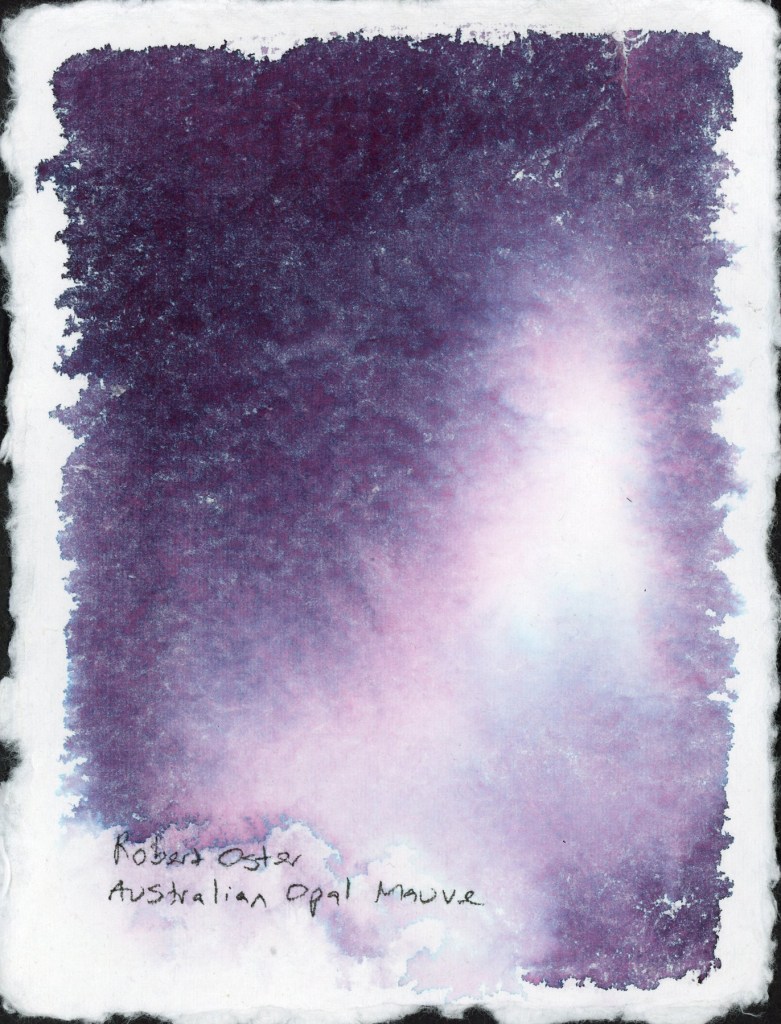
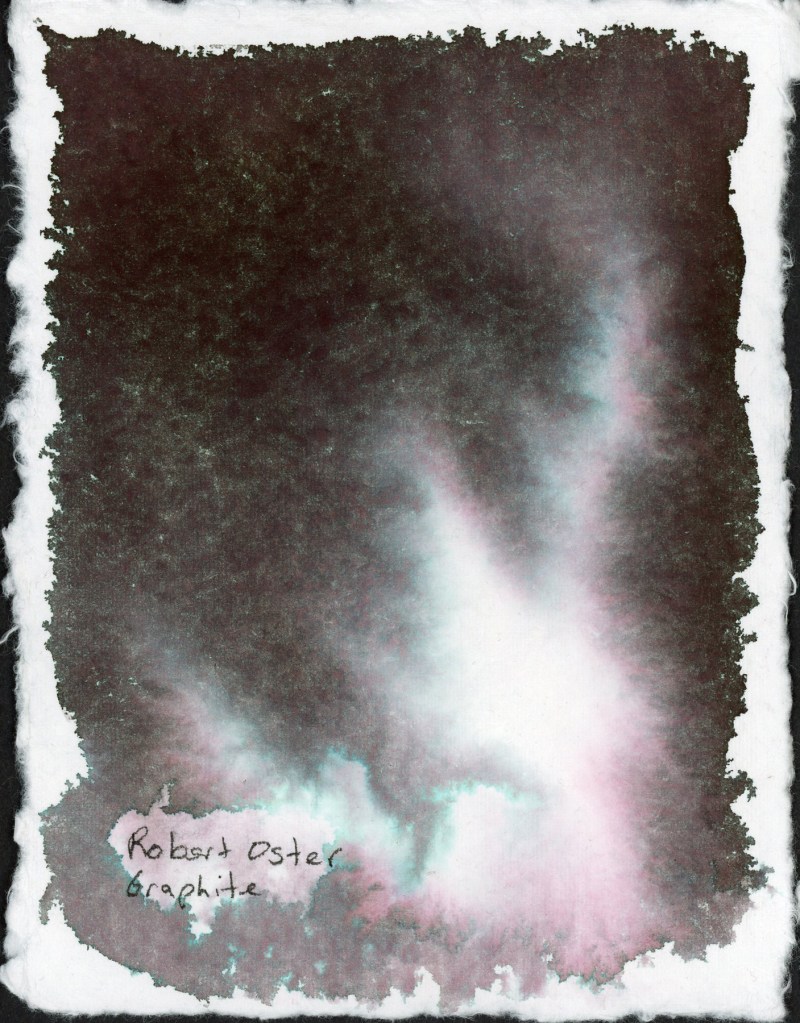
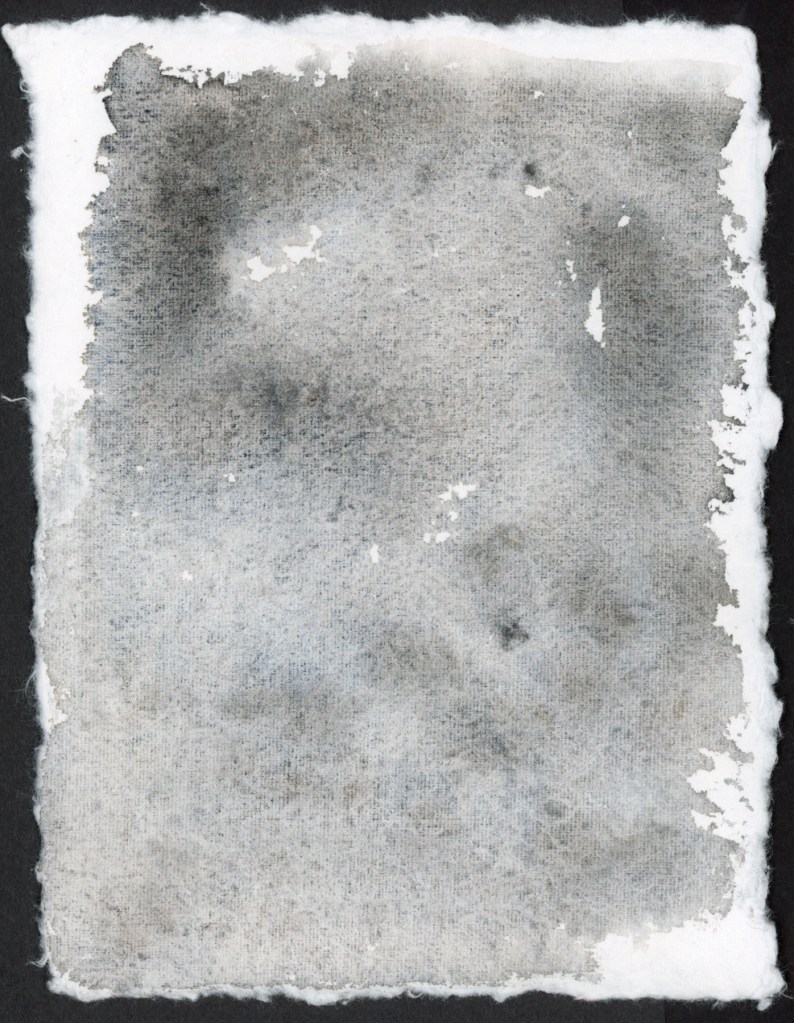
Robert Oster Australian Opal Mauve on Leather Village Handmade Cotton Watercolor PaperRobert Oster Graphite on Leather Village Handmade Cotton Watercolor Paper.
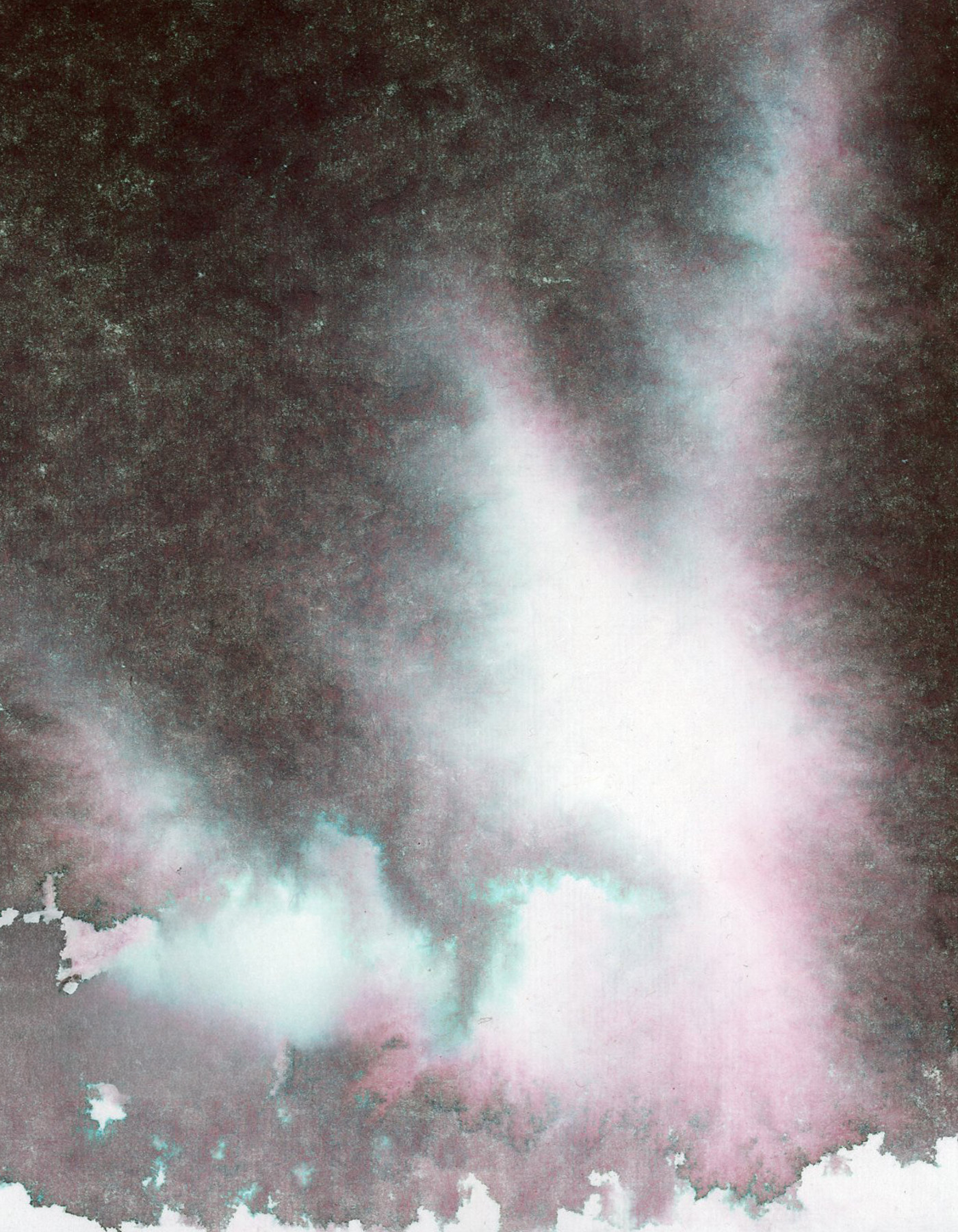
Robert Oster Graphite was one of my favorites from the chromatography lesson I posted about recently. That deep complex near-black opens up into the most beautiful teal and rose separation in the lighter areas. It looks like a nebula. I’m a little bit in love with it.
Then I wanted to see what this particular handmade paper does with some of my granulating watercolors. Granulating watercolors behave very differently depending on the paper. how much separation the pigments have causing that elusive “watercolor magic.” This handmade paper is cotton, and it does a very good job of having very even washes once it is dry. So watercolor magic? Not so much.
The granulation is visible, but the paper holds the pigments fairly close together rather than letting them really spread and separate. It’s a quieter, more even look. Perfect when you want smooth washes.
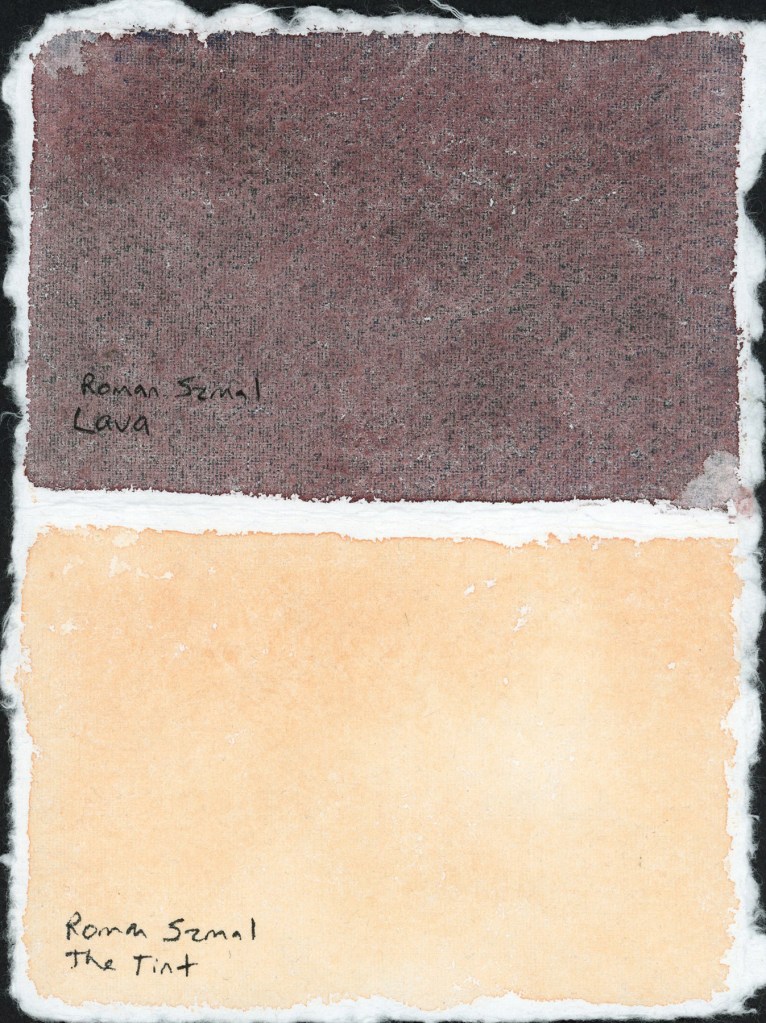
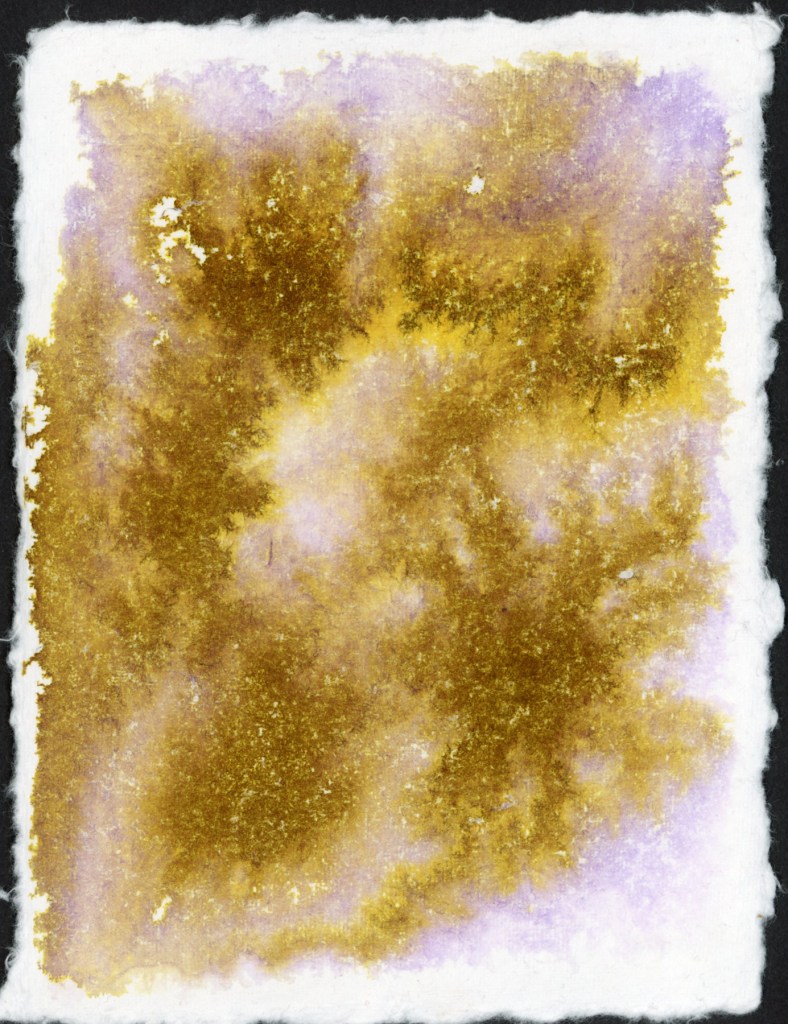
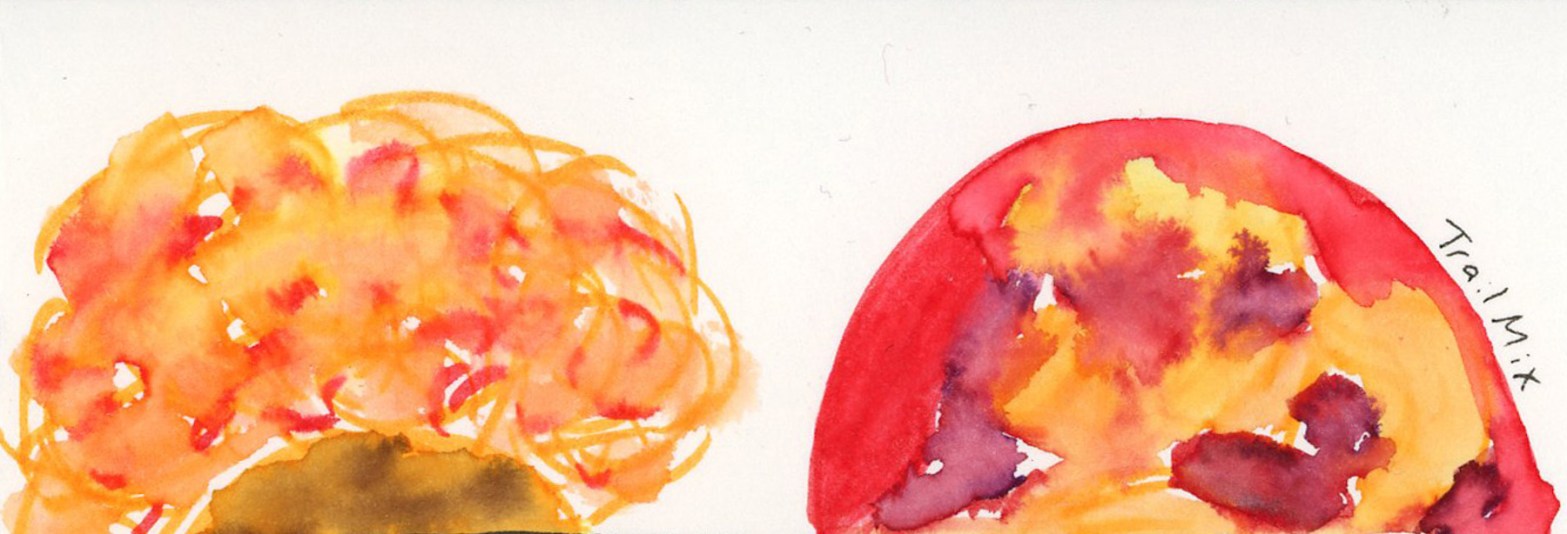
Roman Szmal Lava and The Tint — handmade paper test
I’m loving that Roman Szmal Lava in particular. I’m looking forward to using it a lot more. That dark reddish color, and it has lovely granulation on different paper.
I tested The Tint alongside it, to sample how pink versus yellow is it on this paper. A nice striking pair on the page.
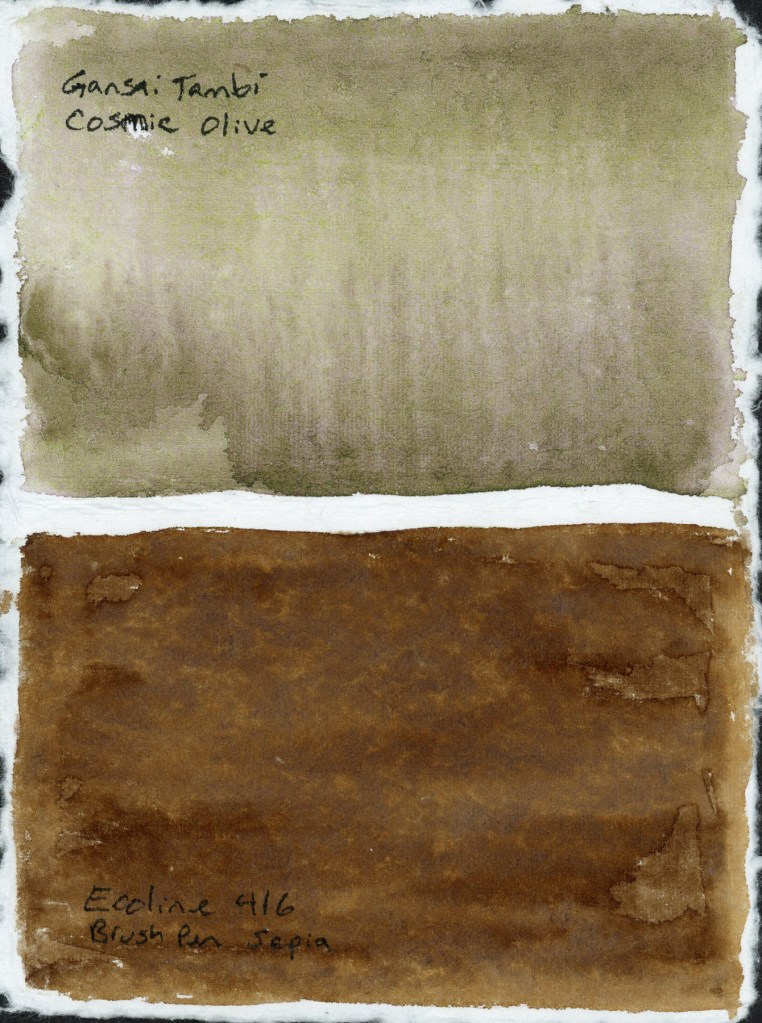
Gansai Tambi Cosmic Olive and Ecoline 416 Brush Pen Sepia — handmade paper test
The Cosmic Olive did not separate nearly as much as it does on other papers, and the Ecoline 416 Sepia marker turned out surprising flat. I expected more blooming when I added water.
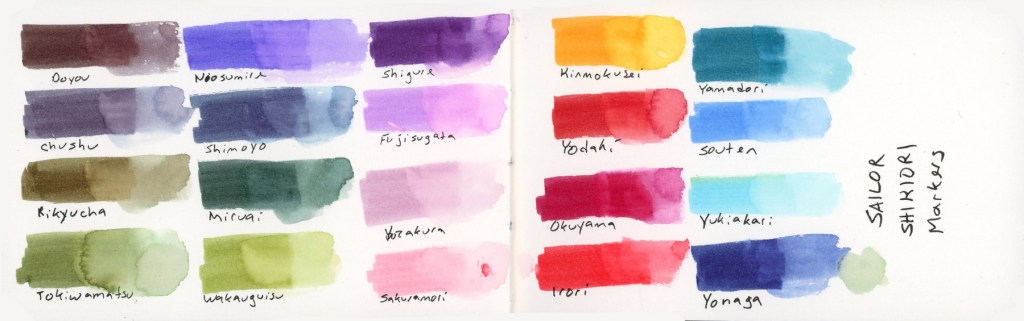
In the food sketchbook, the Delta, I’ve been using the Shikiori markers to sketch my food, so it was time to do a full color chart. Beautiful colors and they react strongly to water. I love that.
Sailor Shikiori Markers — full color swatch reference
The Shikiori markers do something I find absolutely lovely, add water and they bloom outward in that soft, spreading way that reminds me of how Faber-Castell watercolor markers behave. Very satisfying, very painterly. It’s easy to make a lovely watery mess, and I adore that. The Delta paper the results were clean and bright, and holds up well to markers and lots of water.
The Shikiori line takes its name from 四季織 — shikiori — meaning “weaving of the four seasons,” and the color names live up to that. They’re all Japanese seasonal and nature words, and I think they’re worth listing out properly because they’re just so beautiful:
Doyou — midsummer · Chushu — mid-autumn · Rikyucha — tea-brown, named for the tea master Sen no Rikyū · Tokiwamatsu — evergreen pine · Neosumire — sleeping violet · Shimoyo — frosty night · Miruai — meeting of seaweed · Wakauguisu — young bush warbler · Shigure — autumn rain shower · Fujisugata — shape of Mount Fuji · Yozakura — night cherry blossoms · Sakuramori — cherry blossom grove · Kinmokusei — osmanthus flower · Yodaki— night waterfall · Okuyama — deep mountain · Irori — hearth fire · Yamadori — copper pheasant · Souten — blue sky · Yukiakari — snow light · Yonaga — long night
Back in December when my Invent came I had been searching online and found Nick Stewart, who has swatched every Diamine Inkvent calendar for years. I was captivated by his method. In January I dabbled in his Udemy course, Fountain Pen Ink art. I also bought some of the inks for that course that really seemed to separate chromatically in breathtaking, and beautiful ways. I’d taken a toe dip into the course, with the few inks I had, and the handmade cotton watercolor I’d gotten for Christmas. The paper is from Leather Village — 400gsm, rough textured, with those beautiful deckle edges. A simple test, with just a couple inks, to see what the paper and the ink would do together. The method to get the most chromatography from the ink is to lay down a lot of water, then drop in the ink.
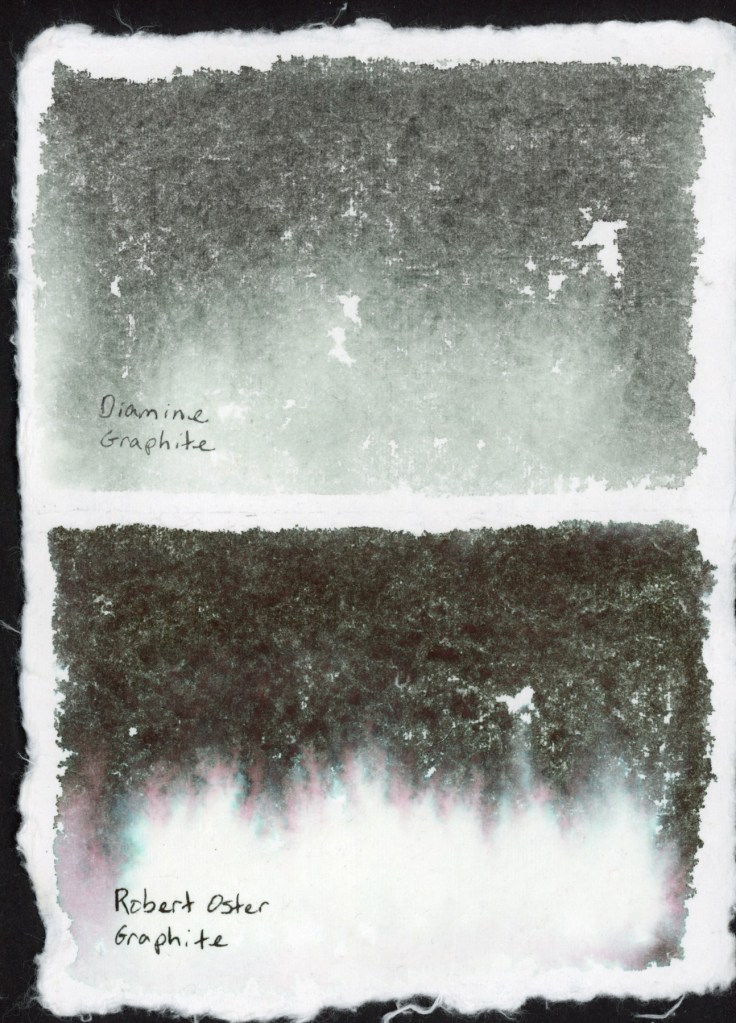
Noodler’s Rome Burning on Leather Village Handmade Cotton Watercolor PaperDiamine Graphite on Leather Village Handmade Cotton Watercolor PaperDiamine Graphite and Robert Oster Graphite on Leather Village Handmade Cotton Watercolor Paper
The two graphites looked very different! Diamine Graphite is a soft, cool grey-blue. Robert Oster Graphite is dramatically darker, and look at that pink and teal fringe bleeding out at the bottom.That chromatography is lovely, with those hidden colors separating out as the water carries them across the paper.
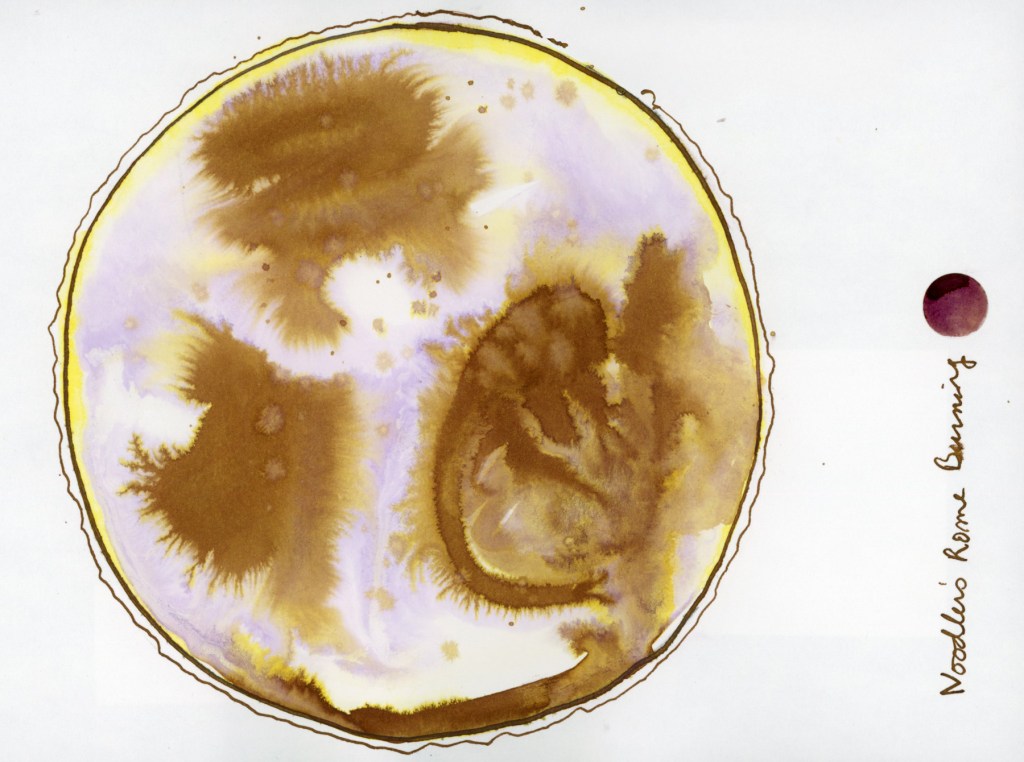
Noodler’s Rome Burning on Stillman & Birn Alpha — Chromatic World
I had also done this fun exercise, the Chromatic World in my Stillman and Birn Alpha sketchbook. You may have seen this in my “Early January 2026” post. You can really see how much Noodler’s Rome Burning in particular explodes when it hits water. That is one ink. One ink, water, and a circle. The gold, the ochre, the warm brown, the ghost of lavender — all of it was hiding inside Noodler’s Rome Burning, waiting for water to pull it apart. I find this genuinely magical every time.
When I was playing with ink in my recent food sketches, I got inspired to return to this course and do more extensive ink and paper tests. . Nick’s course uses mostly Bockingford watercolor paper, which I couldn’t source here, so I used what I have handy, and of course had to use different papers to see how they affect the results! I used the Stillman & Birn Delta, Strathmore Watercolor Paper 400 Series Cold Press 300gsm, and Arches Rough Watercolor Paper 300gsm.
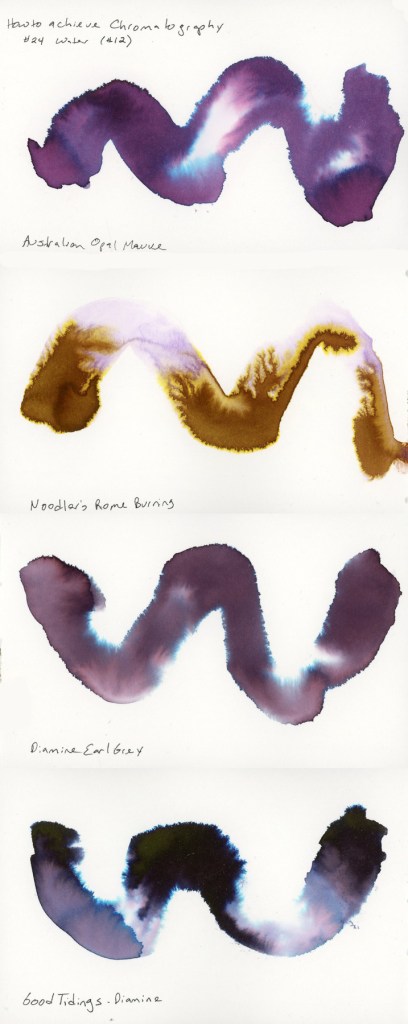
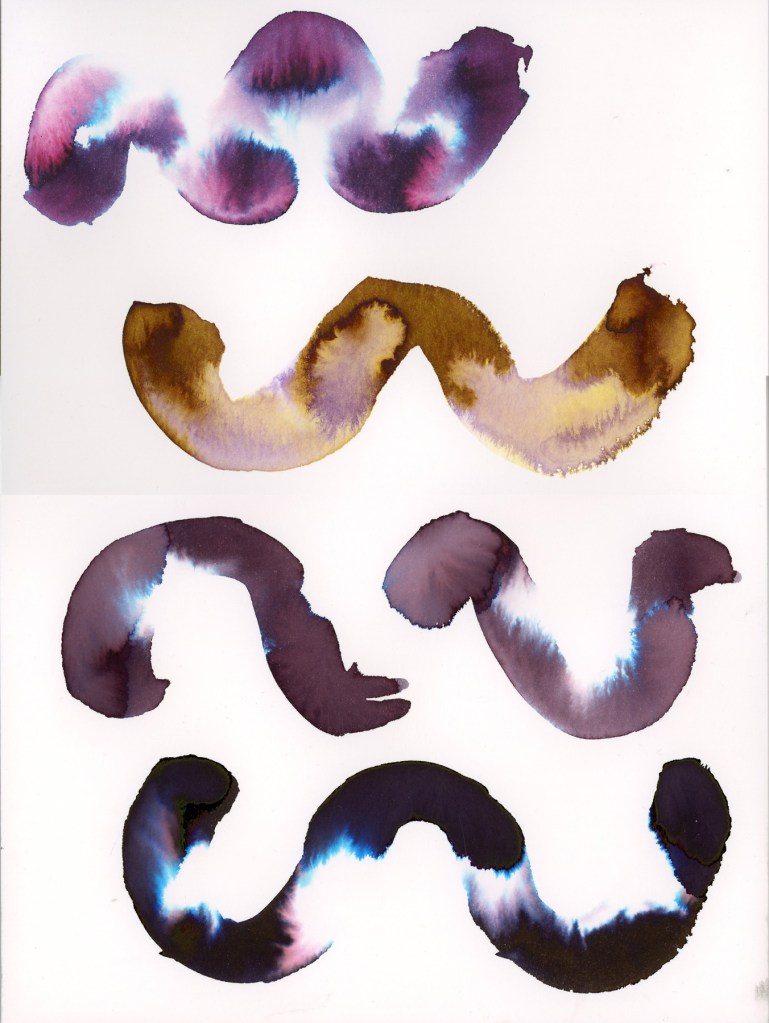
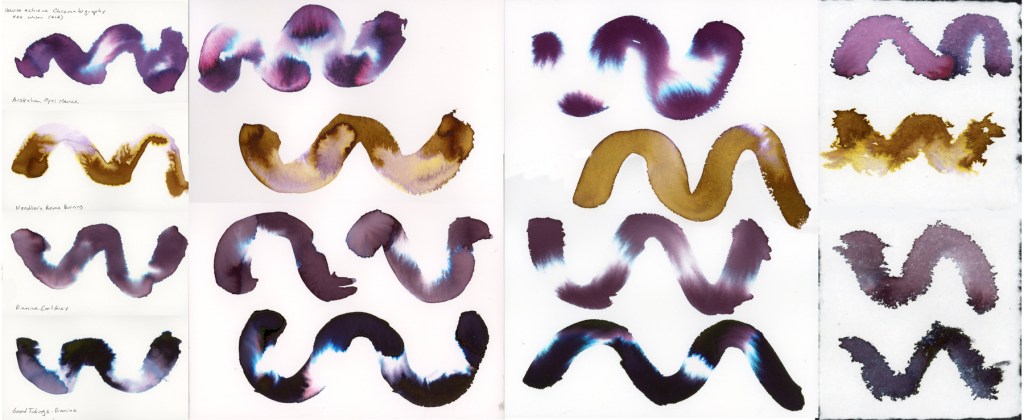
The first exercise is the Swatch Painting. You lay a wave or swoosh down with a big round brush loaded with lots of water. Then drop in the ink with a smaller round brush and watch it travel. How much it separates seems very different based on the paper. I used four inks: Robert Oster Australian Opal Mauve, Noodler’s Rome Burning, Diamine Earl Grey, and Diamine Good Tidings, though the Good Tidings only made it into the Delta book.
Robert Oster Australian Opal Mauve, Noodler’s Rome Burning, Diamine Earl Grey, and Diamine Good Tidings on Stillman & Birn Delta
The Delta paper gave me lovely fluid results. It actually holds up to these wet ink washes even better than with watercolor! Australian Opal Mauve separates beautifully, pulling apart into pink, violet, and that surprising electric blue is deeply satisfying. Rome Burning, which is brown as a writing ink, separates to this warm and golden ochre and lavender. Earl Grey is quieter, more restrained, a muted purple that bleeds to soft blue at the edges. The Good Tidings is the dramatic one of the bunch, near-black with that explosive teal bloom.
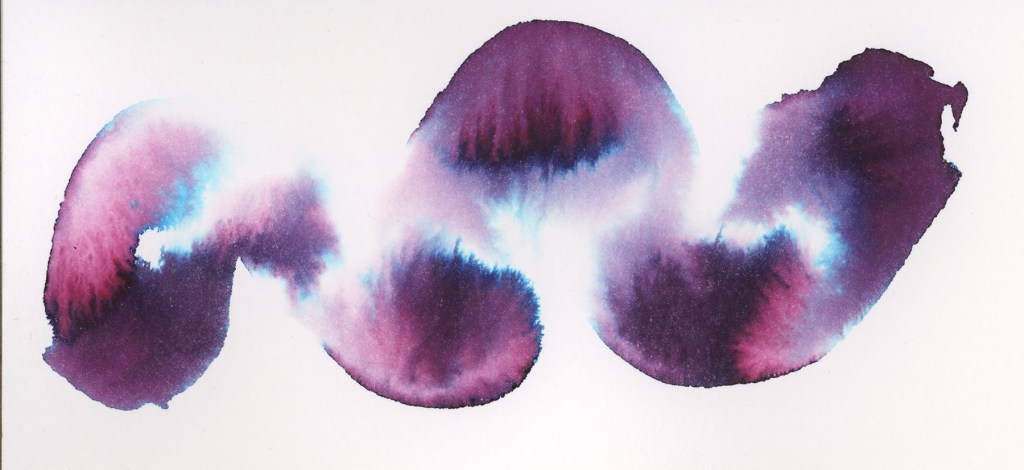
Look at the Australian Opal Mauve on the Strathmore paper!
Robert Oster Australian Opal Mauve on Strathmore Watercolor Paper
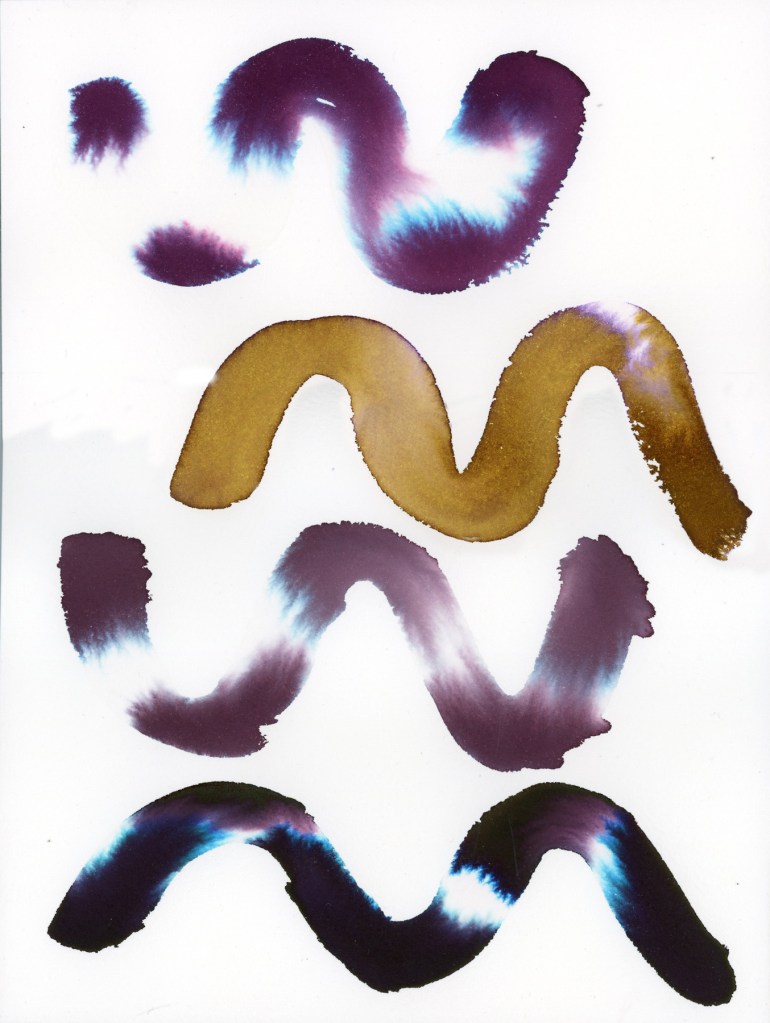
The four inks are sampled on both Strathmore Watercolor paper, and Arches Rough Watercolor paper.
Robert Oster Australian Opal Mauve
Noodler’s Rome Burning
Diamine Earl Grey
Robert Oster Graphite
Robert Oster Australian Opal Mauve, Noodler’s Rome Burning, Diamine Earl Grey, and Robert Oster Graphite on Strathmore Watercolor PaperRobert Oster Australian Opal Mauve, Noodler’s Rome Burning, Diamine Earl Grey, and Robert Oster Graphite on Arches Rough Watercolor Paper
The Arches Rough gives a noticeably different quality — the texture of the paper surface shows through the ink in a way that the smoother Strathmore doesn’t.
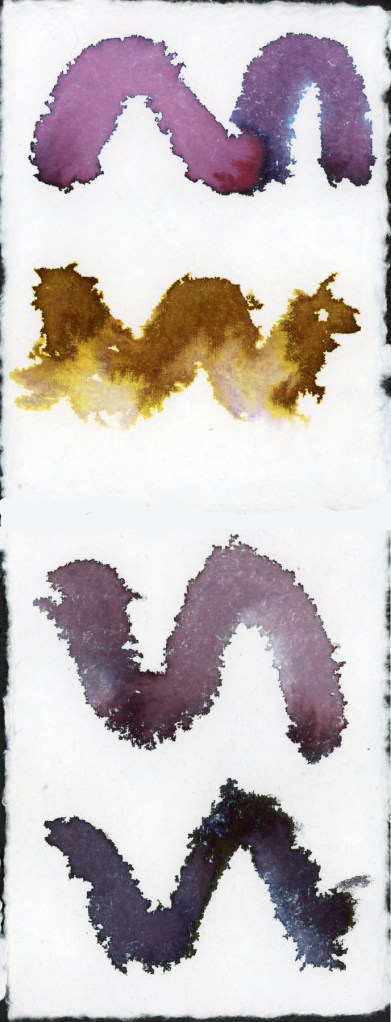
Robert Oster Australian Opal Mauve, Noodler’s Rome Burning, Diamine Earl Grey, and Robert Oster Graphite on Leather Village Handmade Cotton Watercolor Paper
The handmade Leather Village paper is a completely different experience. The rough fibrous surface grabs the ink differently, and the results are wilder and less predictable. Rome Burning in particular practically explodes on this surface. That ink has the best diffusion by far.
I tested the same four inks across all four papers, so you can really see how much the surface affects the results. Here they are side by side.
hromatography swatch comparison — Robert Oster Australian Opal Mauve, Noodler’s Rome Burning, Diamine Earl Grey, and Diamine Good Tidings / Robert Oster Graphite on Stillman & Birn Delta, Strathmore Watercolor Paper, Arches Rough Watercolor Paper, and Leather Village Handmade Cotton Watercolor Paper
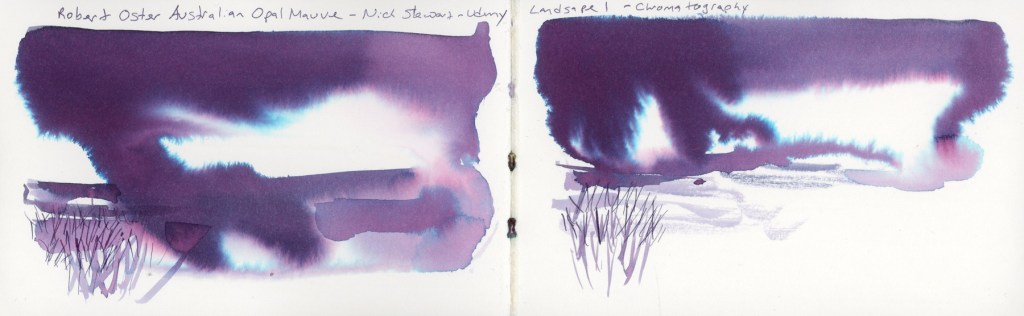
The final two exercises move into landscape territory, applying the chromatography technique to create actual pictures. Landscape One uses a large wet mass of ink for sky and atmosphere, with simple marks below suggesting ground and grasses. I used Australian Opal Mauve for both versions on the double spread. Nick Stewart Uses Robert Oster Barossa Grape, but I couldn’t find that ink.
Robert Oster Australian Opal Mauve on Stillman & Birn Delta — Landscape 1
There’s something about that ink in landscape form that feels almost otherworldly — those blue and pink separations read as light breaking through storm clouds. The little reed marks scratched into the wet wash at the bottom anchor it just enough to feel like a place. I had more dripping than I expected, but that is just practice. Wouldn’t this be great for snowy landscapes?
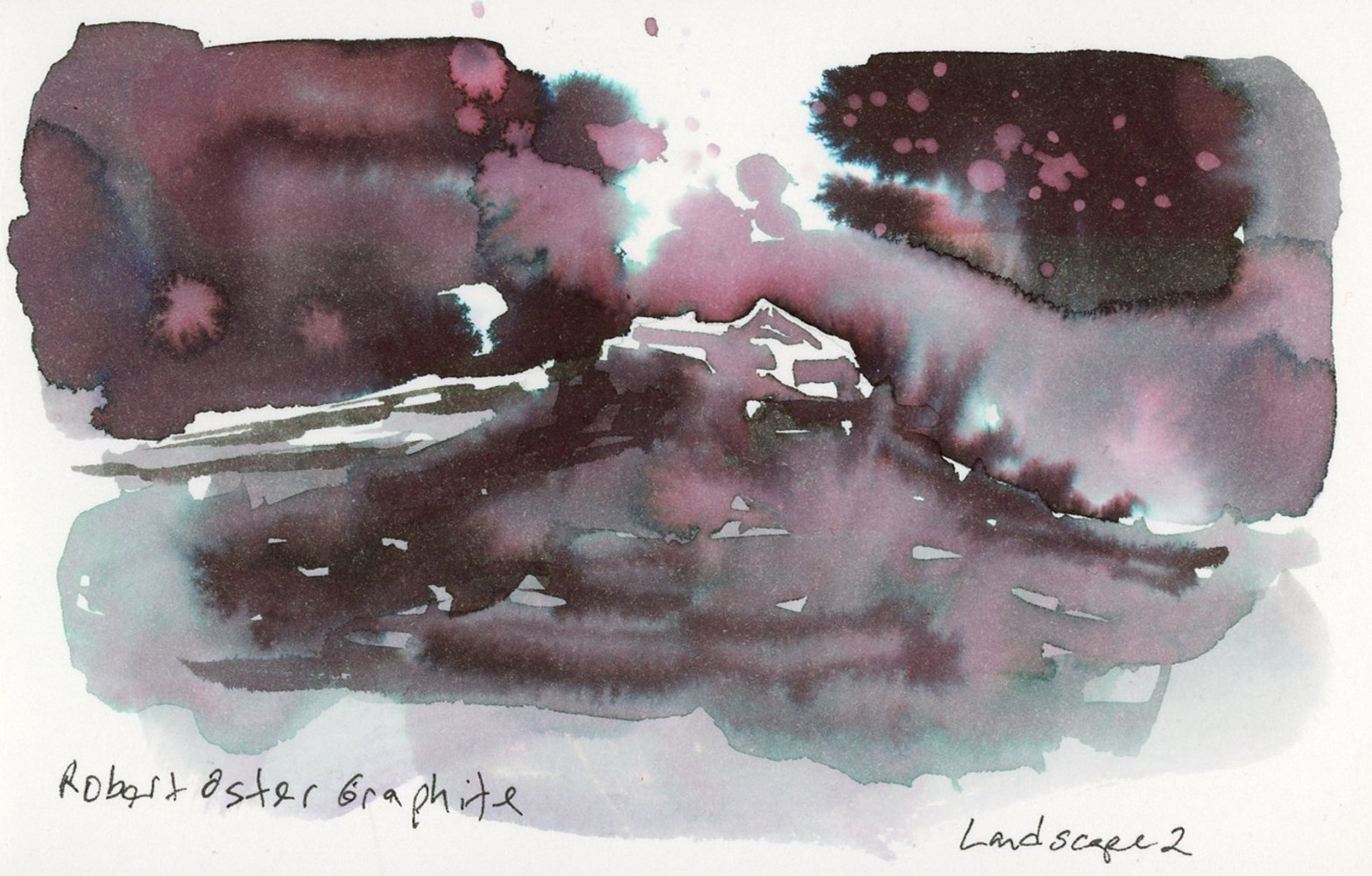
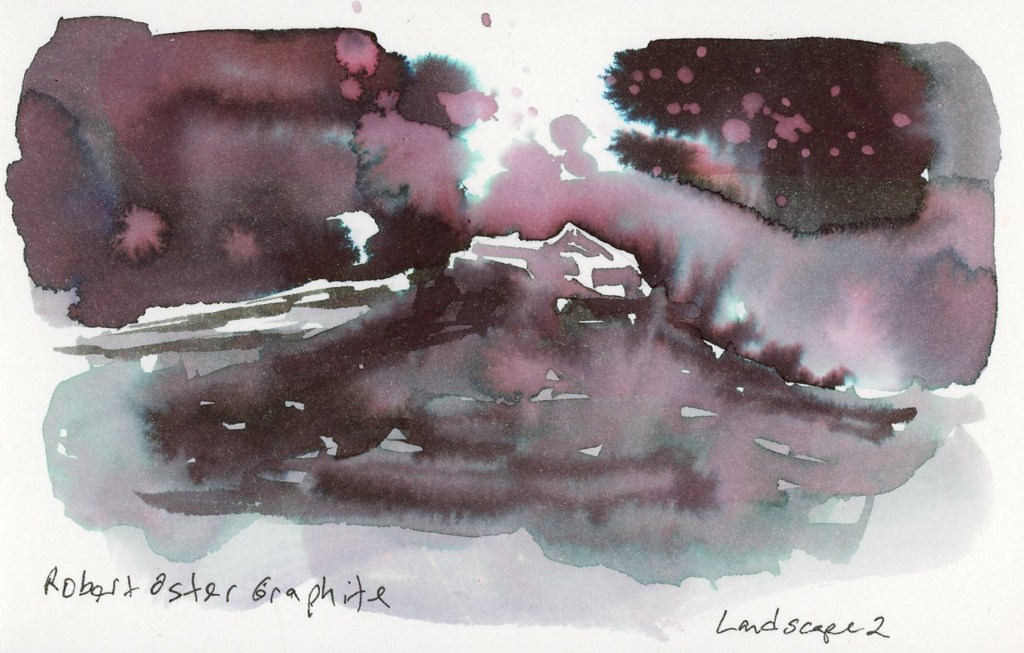
Landscape Two pushes further, adding more structure and a sense of depth. I used Robert Oster Graphite for this one, and it might be my favorite thing I made in this whole session.
Robert Oster Graphite on Stillman & Birn Delta — Landscape 2
The way Robert Oster Graphite separates in a wet wash — those deep plums, the pink spatter, the teal at the edges — makes a landscape that feels moody and atmospheric without any real effort to make it so. The ink does the work. That little glimpse of a structure in the negative space at the center, the misty ground below. If you blot the ink while it’s still wet, you get even more of that pink underlayer.
This Robert Oster Graphite is certainly the star player in this chromatography method! Honorable mention goes to Rome Burning, for it definitely separates well.
I did not plan to start another food sketchbook so soon. I said at the end of the last one that I’d be folding food sketching into my regular daily sketchbook going forward. But then I didn’t. Ha! I grabbed this Delta thinking it has fewer pages, and would be great for March. Also, tracking my allergens is genuinely easier in a dedicated book, and here we are. Food Sketchbook No. 6.
This one is a Stillman & Birn Delta, softcover, 5.5 × 3.5 inches, 270gsm cold press in ivory. I’ve tried the Delta paper before, one year ago exactly! I did not love it for watercolor. However, for ink it’s been great. Very wet ink washes with loads of water, it doesn’t even buckle!
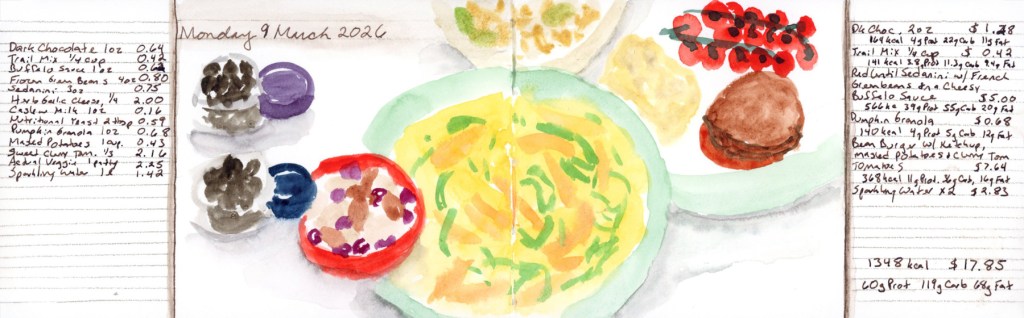
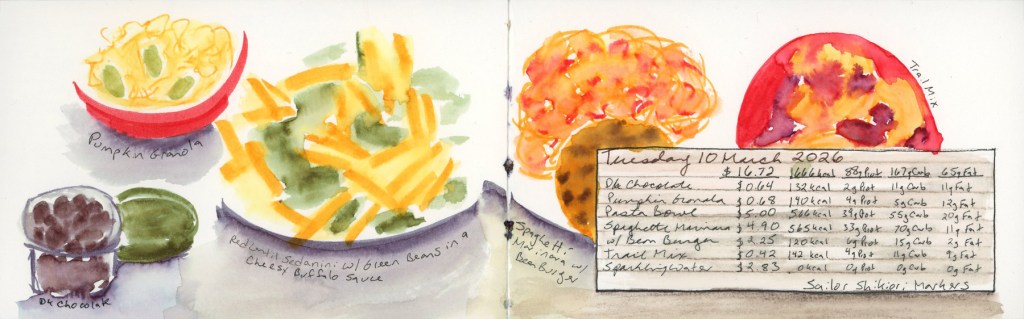
I book started on March 9th, intending to keep going through the month. But then those allergens hit, and I only got two days done. Both are done in Shikiori markers, because I was thinking markers would be fast and I was worried about not keeping up.
Monday 9 March 2026 — Food Diary in Sailor Shikiori markersTuesday 10 March 2026 Food diary in Sailor Shikiori markers
These are Sailor Shikiori markers. Japanese brush markers that take water beautifully. I do love that watery look. I had used Faber-Castell watercolor markers for food a few years ago and loved how they looked. I had these close by, so they were the obvious choice when I started this new book, hoping using marker would be a fast and easy method.
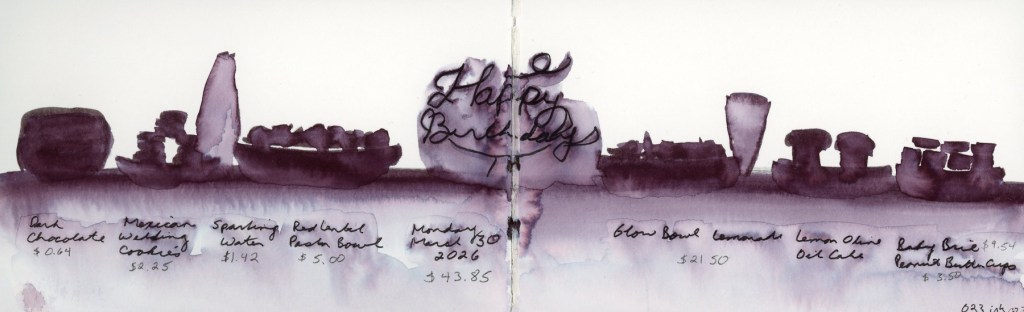
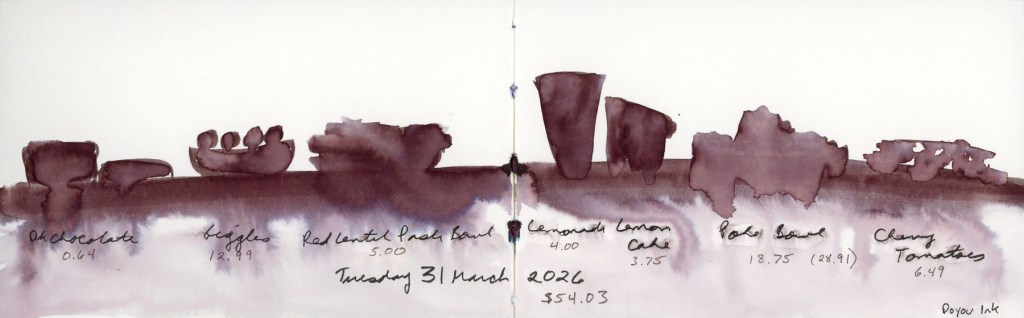
I got two days in. Once almost three weeks has passed, I knew I wouldn’t be able to catch-up, so I decided to jump in with my birthday. But I also knew I needed a fast method this busy week. One of my favorite sketches previously was a monochrome silhouette style, but I couldn’t remember if I’d done it in the 023 ink, or the Doyou ink. Obviously this means I had to both this week!
A fast way to record, and then the fun comes in the lovely ink washes as the dark lines are diluted.
Monday 30 March 2026 Food Diary in Shikiori marker 023.Tuesday 31 March 2026 Food Diary in Shikiori marker Doyou.
The 023 has the deeper purple undertones, while the Doyou leans toward the browns. Both work beautifully in the silhouette format, and the way the marker ink blooms into the wet wash below is very much what I was going for here.
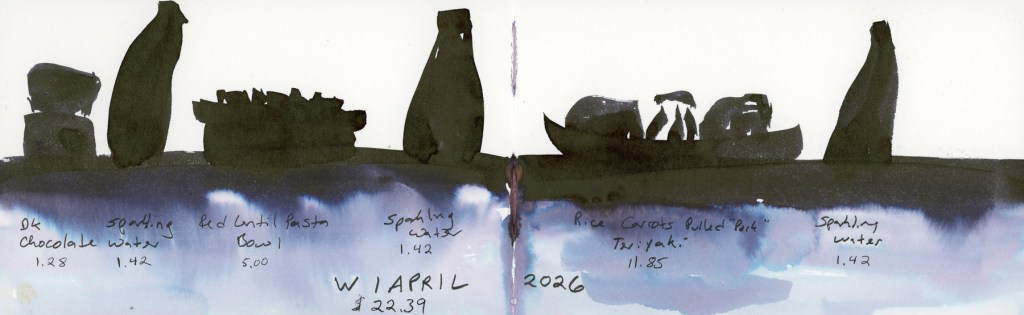
Wednesday 1 April 2026 Food Diary in Diamine Good Tidings Ink wash.
I wanted to keep going with the black inks, and I had the Diamine Good Tidings nearby. I really need to write the inks higher on the page, because doing it near the margin, they get cut off when I scan! I loved the color bleed on this ink so much!
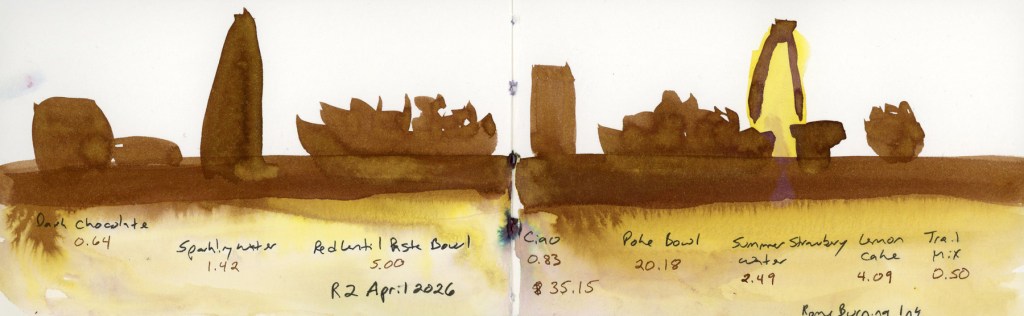
I remembered the Udemy course on fountain pen ink art by Nick Stewart that I’d dabbled with back in January — specifically his chromatography exercises, which are all about how inks separate and bloom when water is introduced. That’s exactly what was happening in these food spreads. One of the inks he uses in that course is Noodler’s Rome Burning, so I knew what ink I was going to do next!
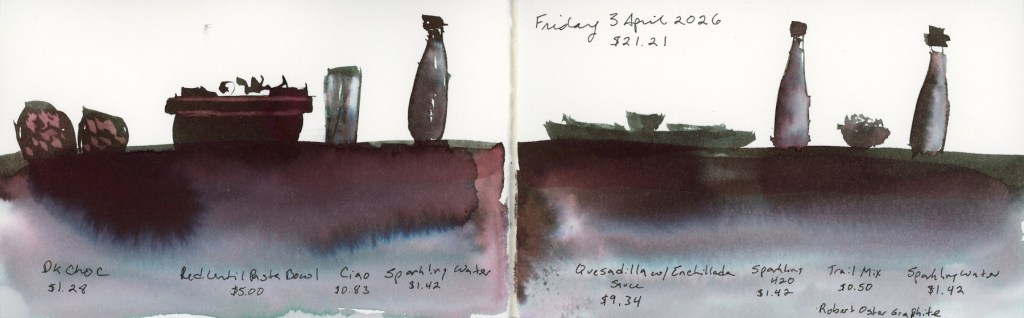
Thursday 2 April 2026 Food Diary in Noodler’s Rome Burning Ink washFriday 3 April 2026 Food Diary in Robert Oster Graphite Ink wash
The Robert Oster Graphite is also used in Nick Stewart’s course, and I can see why! Look at those colors! Deep plum-to-grey shift with the blue bloom and pink undertones in the wash is doing a lot of atmospheric work for what is essentially a record of sparkling water and a quesadilla.
From Shikiori markers to fountain pen inks. Now I’m energized to get back to the exercises in that Udemy course, and see what these inks can do!