So the question comes up, how do I document that I’m buying books, when I buy ebooks, and don’t really have anything to actually sketch? I could sketch the covers. I could sketch the kindle or the kobo. Or I could venture out of the world of observational sketching only, and venture into illustration. Gasp!
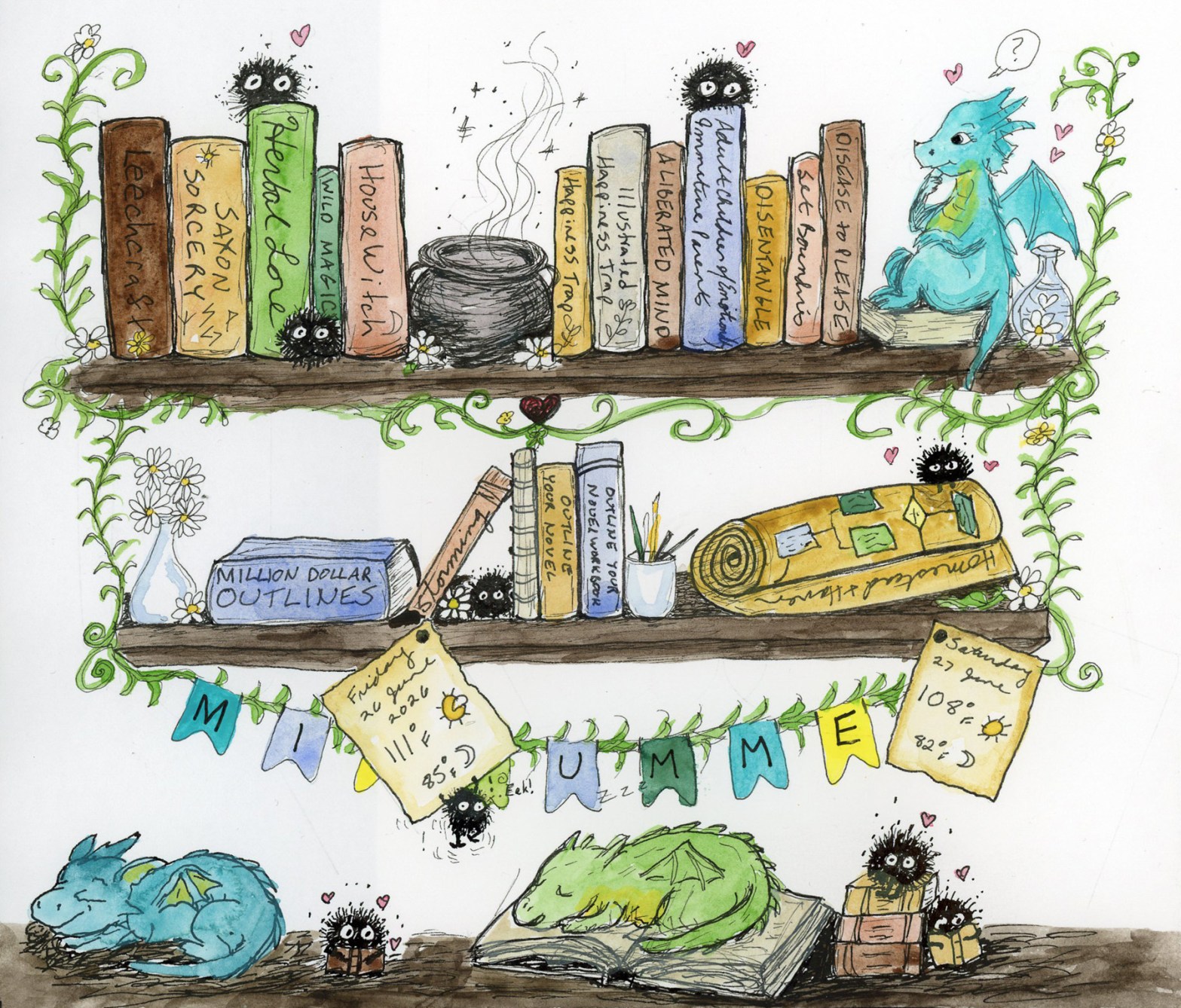
Well, if I’m going to venture into illustration, might as well add soot sprites and dragons then! Ha! So here is my illustrated bookshelf. the books are real and purchased, and I really am working on Homestead and Haven. The shelves, the vines, the flowers, the soot sprites, and the baby dragons are just for delight.
Midsummer Bookshelf with baby dragons, June 2026
Done with ink and watercolor wash, using my standard watercolor palette.
I think my favorite is that poor soot sprite trying so hard not to fall off that weather card! He is having a struggle moment, for sure!
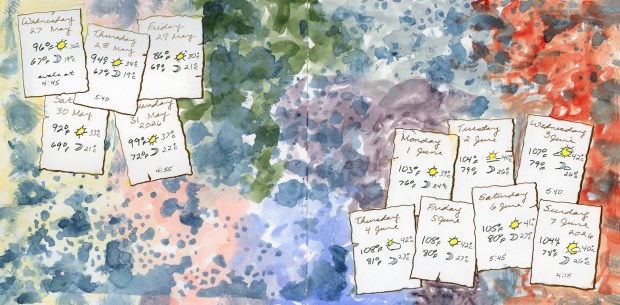
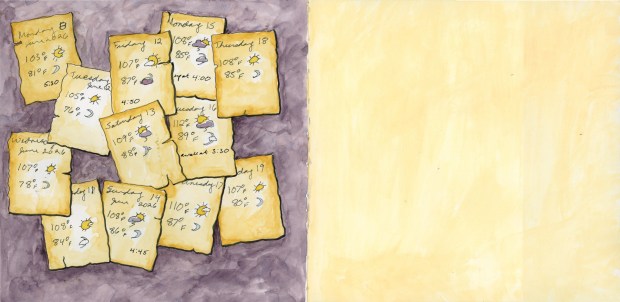
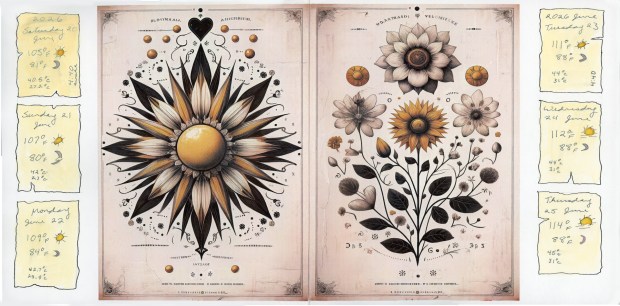
If nothing else this month (or two), I finally attempted to draw little aged note cards to give my weather pages a bit more design. Even when I’m not sketching, or doing much of anything else, I like to keep the weather notes and dates in my sketchbook to mark the passage of time. They serve as a record of when the going was more pitted gravel than smooth highway.
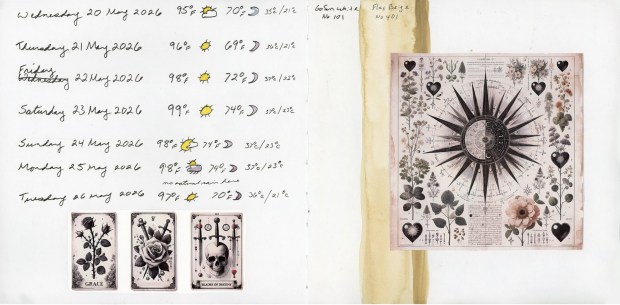
Weather diary, May 20–26.
I’m currently working in a new Stillman & Birn 7.5″ square Alpha. Remarkably, this page marks only the fourth spread in volume 30. Thirty!
Recently, my printer stopped working, (too old for modern networks!) which forced me to pivot. I ended up getting a new one, and since I had a junk journal kit on hand, I decided to test print with it. When I didn’t end up sketching anything else to capture the days, I used those pages for collage. I became captivated by that specific shade of aged paper and wondered if my Gansai Tambi paints could match it.
Gofun White 101: A perfect match for the natural shade of the Alpha paper.
Flax Beige 401: Has great potential for an “aged” look, but didn’t quite match these specific printed sheets.
Shifting Plans & Playing with Color
Weather diary, May 27–June 7.
I had plans for sketching, but as the days slipped away, I simply played with watercolor and stencils. I used the Holbein watercolors that I assembled into my Travel Sketching palette (which I talked about in my last post). The dark blue spots were stenciled with watercolor over the color blocked background.
Crafting the Aged Look
Weather diary, June 8–19.
Really diving into how to make these note cards look aged, I used the Holbein palette:
Yellow Ochre: Used for that weathered, historic feel.
Eurasian Jay Rose Grey: The moody background complementary color to make the cards pop.
Jaune Brilliant 1: The yellowed wash on the facing page.
I originally intended to sketch something specific for the summer solstice, but I suspect now that this solid wash of color will remain as my tribute to the day.
Solstice Collaging
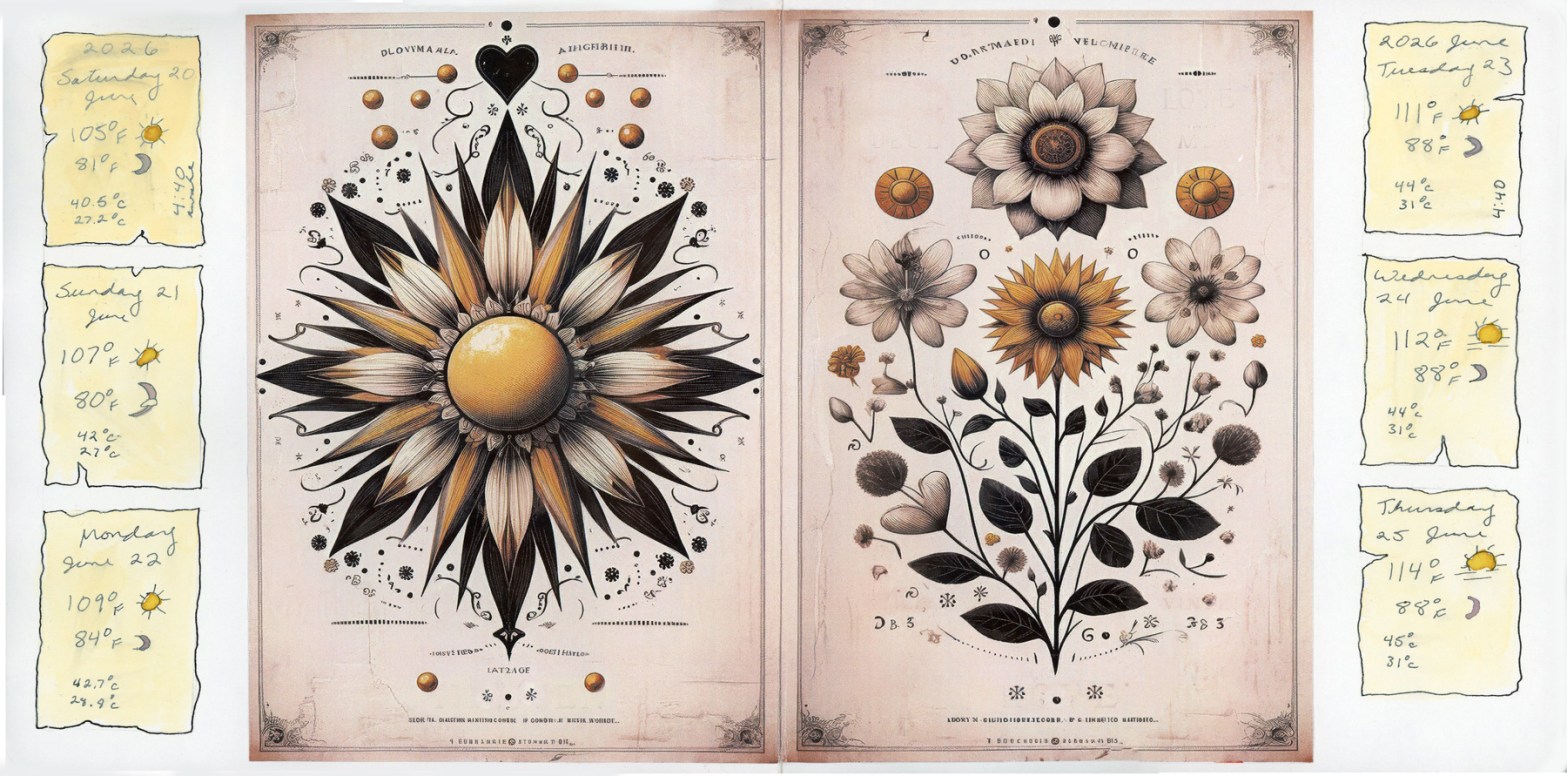
Weather diary, June 20–25.
Fortunately, this junk journal page felt incredibly fitting for the solstice, so I collaged it in alongside the Jaune Brilliant 1 note cards.
That opacity gave me some trouble over the text. With opaque paints I should probably paint my background first, or stick to a much more transparent paint!
Even when energy is low, keeping a visual record, an illustrated diary is important to me. I miss it, but at least I’ve captured this era in these small ways.
Once again the autoimmune adventures hit hard, and life piled on. I ended up just not doing any of the Travel Sketching class work except the intro kit building, and the current sketch. Now for the hard work of forgiving all the things I cannot control and just accepting the losses. I have, however, decided that I’m going to rest this summer, and not try for the Watercolor on Location group run. I’m obviously needing the recovery time.
It was hard to let go this time. But so be it. Back to the days and days of just listing the dates and the weather to mark the passage of time. I left some white space. In one of those half pages, I did a watercolor abstract like I used to do, and that turned out really well! (See below.)
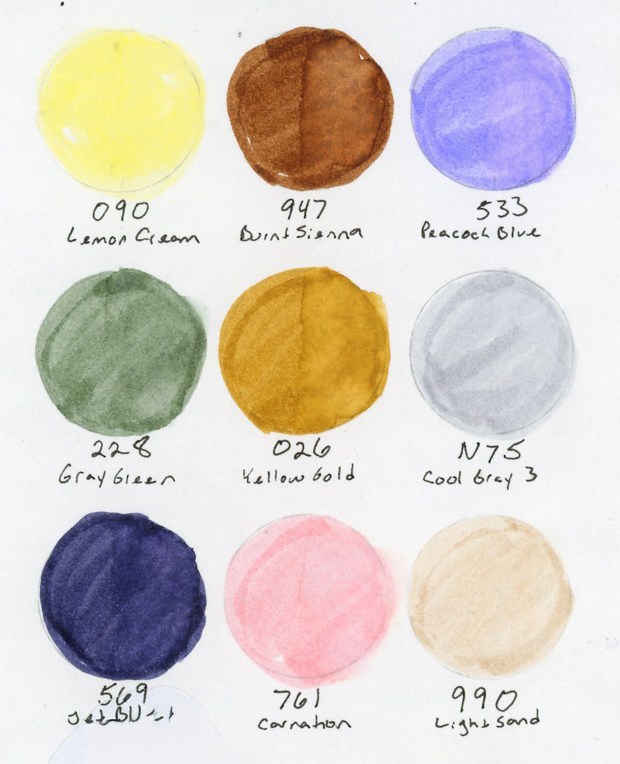
Before I lost all oomph, I did get the color charts done for the Tombow Dual Brush Markers:
Tombow Dual Brush Markers in Travel Sketching Palette
The Tombows do not seem very reactive to water. The second half of each circle was activated with water, and it shows in a couple colors, but not in most of them.
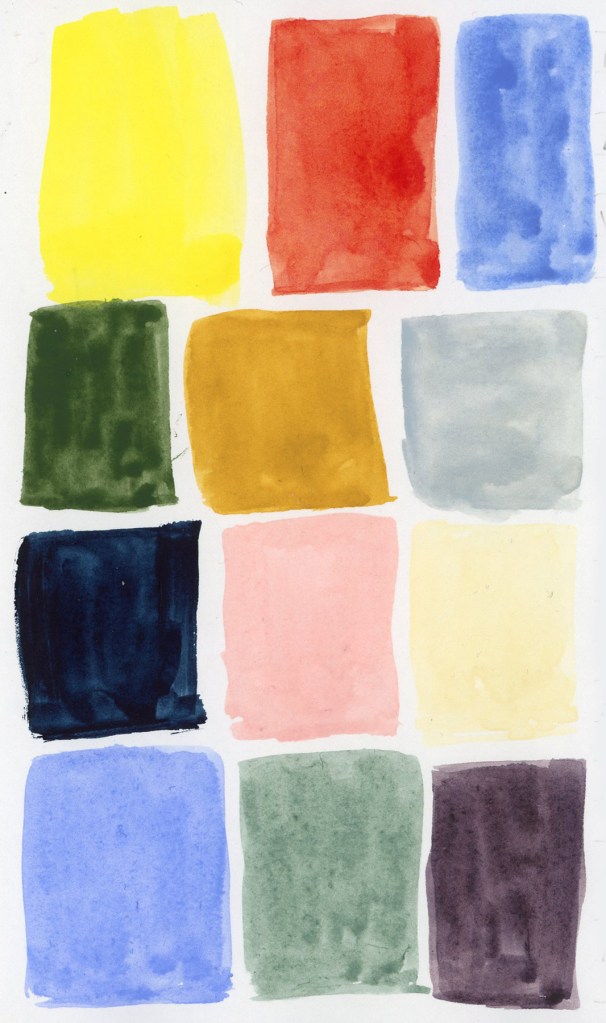
Holbein Watercolors in Travel Sketching Palette
Still in the grip of my obsession with recreating this Travel Sketching Palette (I blame the brain chemistry from the allergen hits!) I bought these Holbein Watercolors. Aren’t these lovely?
Holbein Watercolors in Travel Sketching Palette: Permanent Lemon Yellow W235, Lunar Eclipse Red WG605, Verditer Blue W295, Green Grey W352, Yellow Ochre W234, Grey of Grey W353, Indigo W298, Shell Pink W226, Jaune Brilliant No 1 W231, Lavender W316, Davy’s Grey W355, Eurasian Jay Rose Grey WG661.
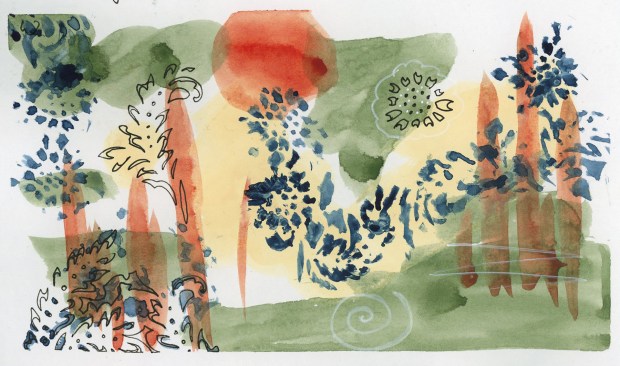
Abstract Watercolor
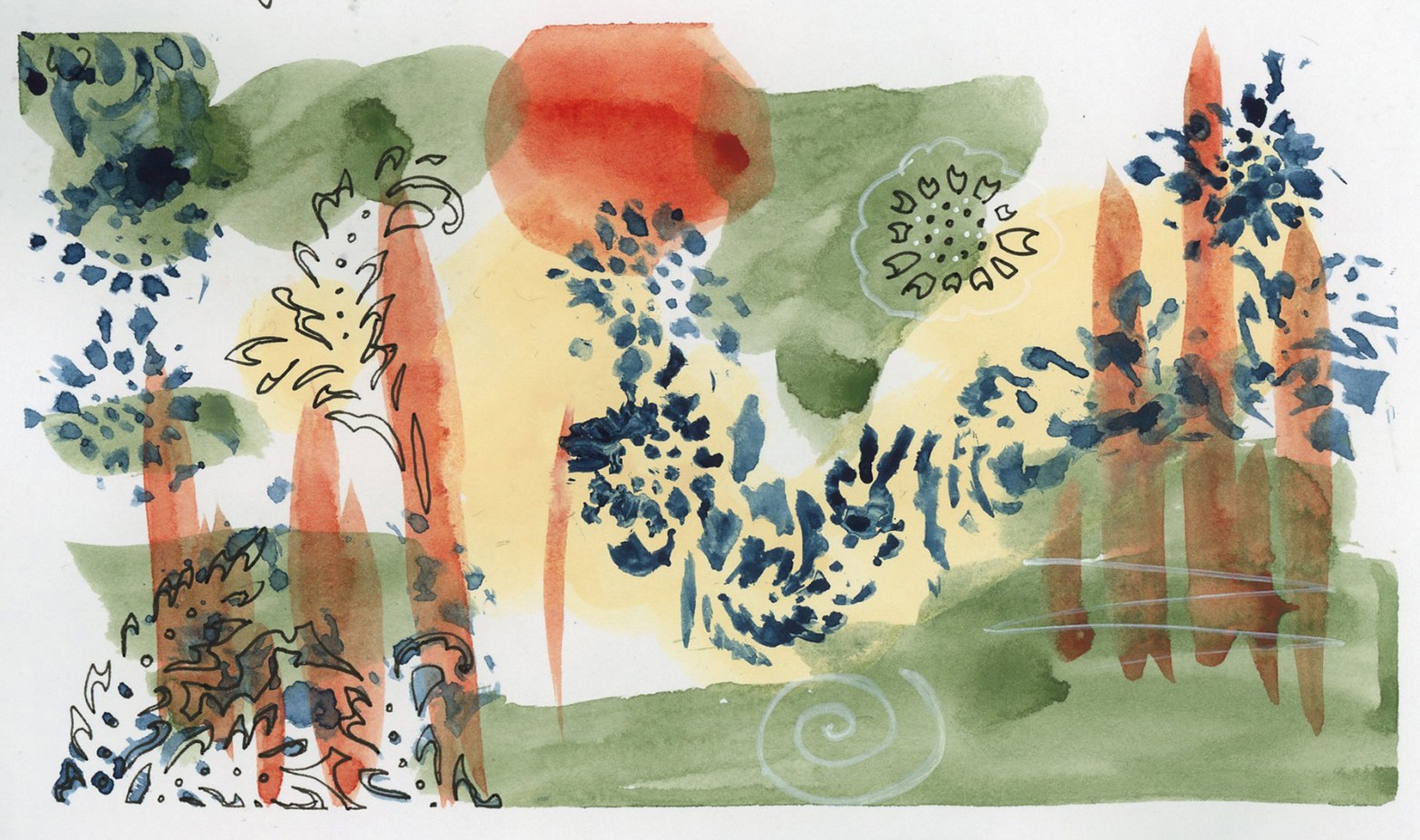
Last year I was doing some of these watercolor abstracts. They are such a lovely way to play with color. I had to test this palette with one. I rather like this one. It ended up looking like an abstract landscape. (Also note: I cannot for the life of me get Posca pens to work! Is my climate just too dry? But there is a hint of white showing my attempt!) These abstracts are so good for capturing mood, or a moment that I find they fit documenting life surprising well. They hold memories and feelings quite well.
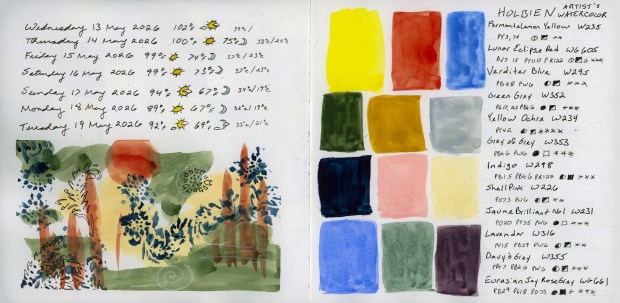
The complete spread in my sketchbook. A bit more thought on page design than I’ve used in a while, which feels good.
As for this summer, I have a few half pages with white space along with my dates and weather. Perhaps I will be able to sketch items or scenes. I will definitely make more abstracts.
I want to return to illustrated journaling, and documenting life as it happens. That has always been my primary goal, and what drew me to keeping a sketchbook in the first place. I am missing that in my influences and in my own work, so when I regain some oomph, I shall revisit my old inspirations.
I’m looking forward to the run this upcoming autumn of the Sketchbook Design course. Every time I’ve done it, I end up capturing more life and making pages I love. My sketchbook ends up feeling like me.
13-19 May 2026 with Abstract Watercolor, and Holbein Travel Sketching Palette swatches.
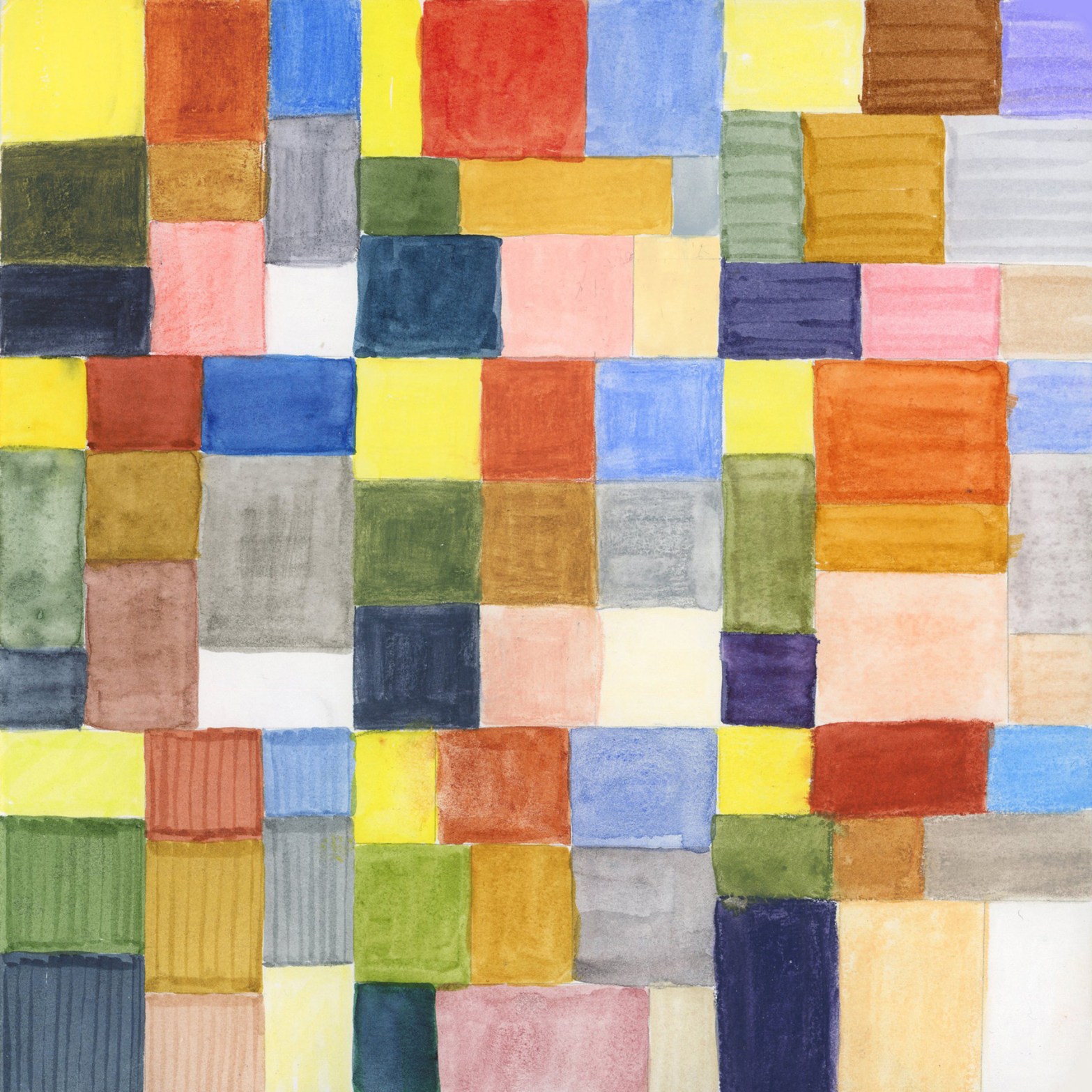
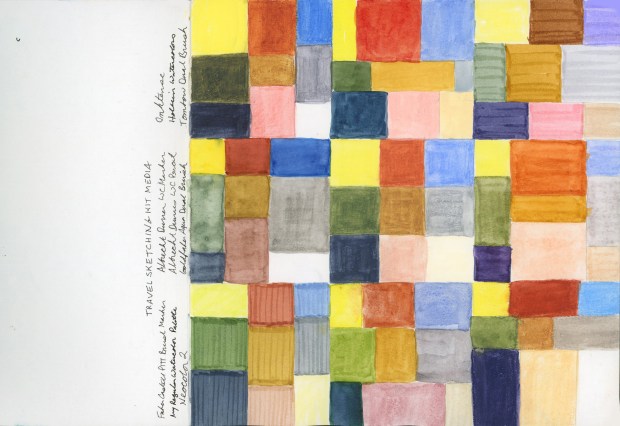
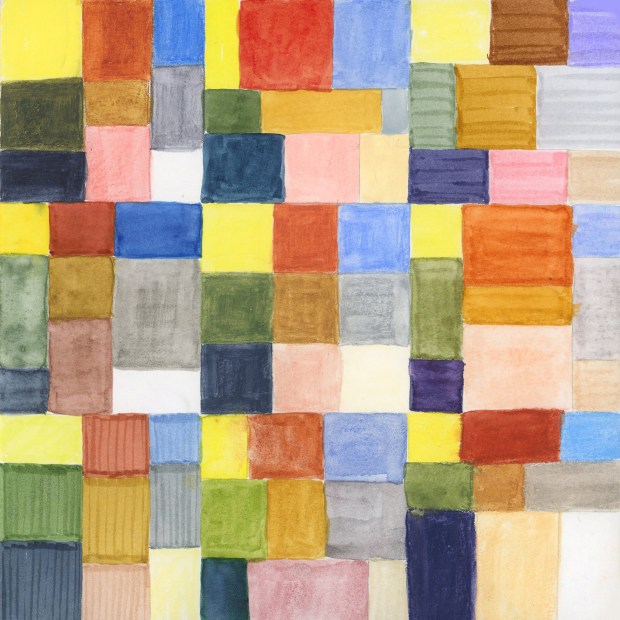
I had to add Tombow Dual Brush Pens and the Holbein Watercolors to the palette family! And I had to open Volume 30 with all of them as my frontispiece.
The Travel Sketching palette in nine media — Inktense, Holbein Watercolors, Tombow Dual Brush, Albrecht Dürer Watercolor Markers, Albrecht Dürer Watercolor Pencils, Goldfaber Aqua Dual Brush, Faber-Castell Pitt Artist Brush Pens, standard watercolor palette, and Neocolor 2. Volume 30 frontispiece, May 2026.
The concept is simple: same limited Travel Sketching palette, nine different media, arranged sudoku-style. Little nine patches of each medium. The first three nine patches are Inktense, Holbein Watercolors, and Tombow Dual Brush. The second three nine patches are Albrecht Dürer Watercolor Markers, Albrecht Dürer Watercolor Pencils (the original palette, in the center, and Goldfaber Aqua Dual Brush. The bottom three nine-patches are Faber-Castell Pitt Artist Brush Pens, my standard watercolor palette, and Neocolor 2.
The big surprise? How close in hue I was able to get each medium. The Neocolor 2 are nicely rich and creamy. Without labels you’d have a hard time telling most of them apart in a sketch.
This is the perfect way to really see how the different media work, and feel.
I have thusly begun Sketchbook Volume 30! I have been in a landscape format sketchbook for over a year, testing various Stillman and Birn papers in the 5.5 x 8.5 and 6 x 9 inch books. I am SO glad to be in a bigger book. This is the 7.5 x 7.5 inch Stillman & Birn Alpha and I can already feel the difference. With a little more space, I’m thinking about sketchbook design more and hoping to keep that in mind for this book.
The Travel Sketching palette in nine media — Inktense, Holbein Watercolors, Tombow Dual Brush, Albrecht Dürer Watercolor Markers, Albrecht Dürer Watercolor Pencils, Goldfaber Aqua Dual Brush, Faber-Castell Pitt Artist Brush Pens, standard watercolor palette, and Neocolor 2. Volume 30 frontispiece, May 2026.
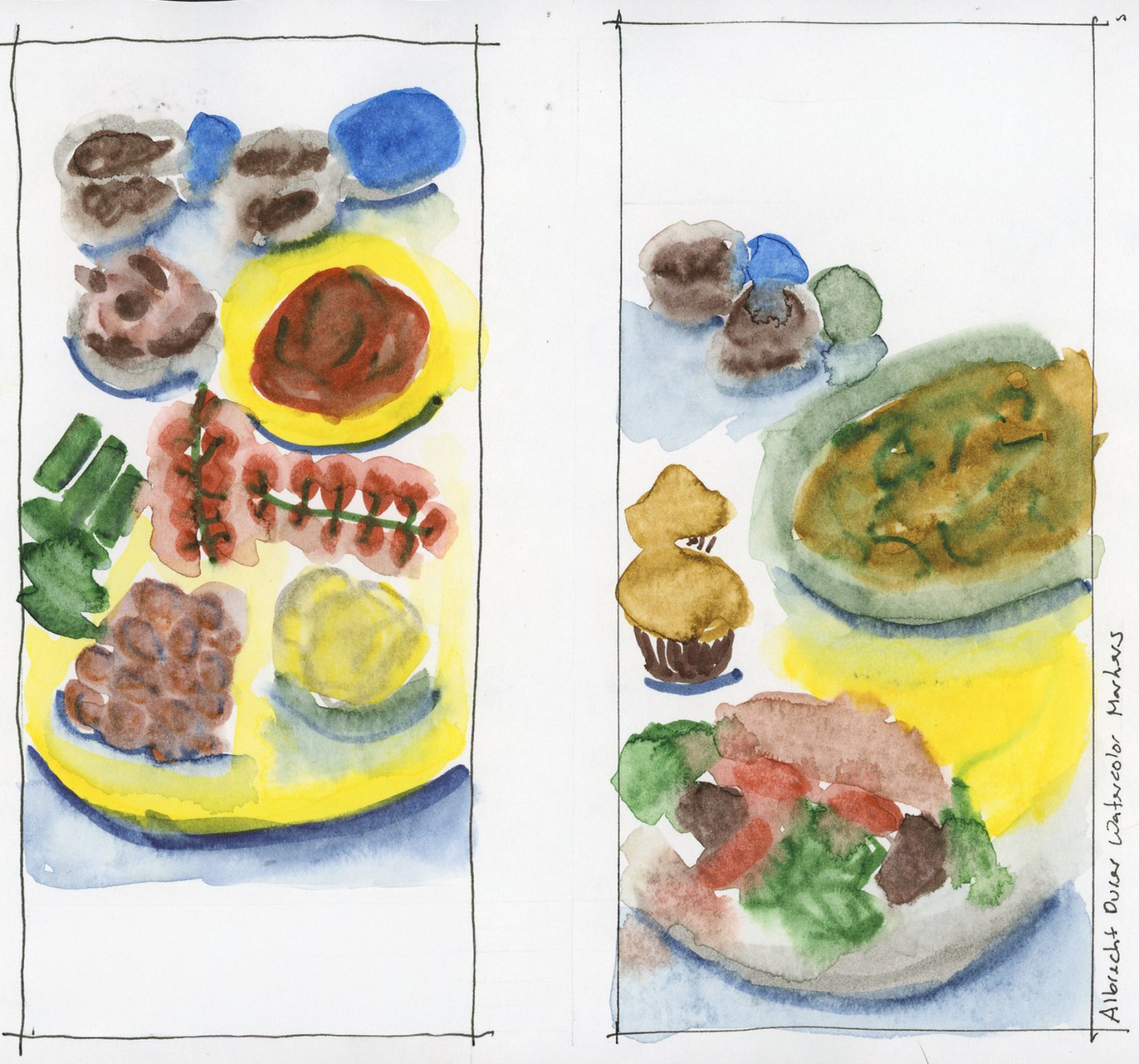
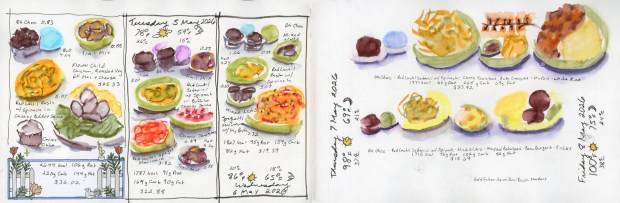
What do you do with a bag of many different types of markers, all in the same palette? Draw food, of course.
Well, I draw the food anyway. I’d been loving the Sailor Shikiori markers for food sketching — those gorgeous watery effects! But I’d also just finished building the same Travel Sketching palette six ways. Or eight. (What? I got obsessed.)
I knew the palette worked for landscapes and cityscapes. But food? I had to find out.
Food sketches in Shikiori and Goldfaber Aqua Dual Brush Markers, 5–8 May 2026
Shikiori markers for the first few days as I had been doing previously, then the Goldfaber Aqua Dual Brush Markers, then the Albrecht Dürer Watercolor Markers, and finally the Faber-Castell Pitt Artist Brush Pens — my first time ever using those in color.
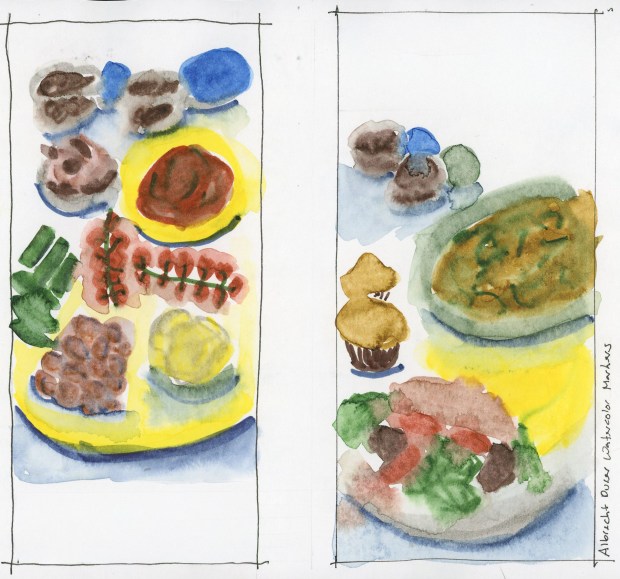
Ink on Paper — Albrecht Dürer Watercolor Markers, food diary, 9–10 May 2026
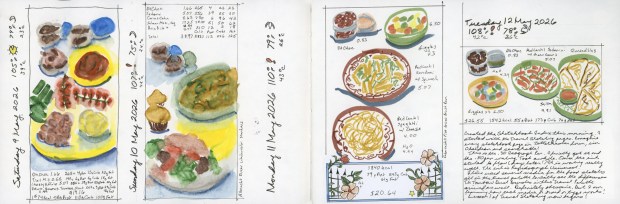
Not too bad, actually! The water-based markers end up more similar than different — the palette mostly wins. Except those tomatoes. You have to think about it to realize they’re tomatoes, because the sanguine is just not red enough. Every single person who looked at my sketchbook squinted at them. Sorry, tomatoes. You deserved better.
Food Sketches in Albrect Dürer Watercolor Markers, and Pitt Artist Brush Pens, 9–12 May 2026
In other news — I started indexing all my sketchbook pages. Can you imagine? A searchable index so I can find when I last sketched a particular subject, or when I sampled a paint color and then never used it again. Oh yes.
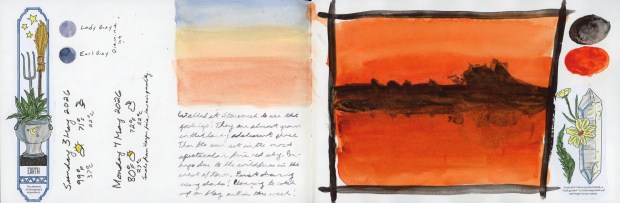
On Monday evening I walked over to Stonecreek to check on the goslings. They’re at that awkward adolescent phase where their down has turned brown instead of green, but their tail feathers are not yet coming in. I chickened out on drawing them.
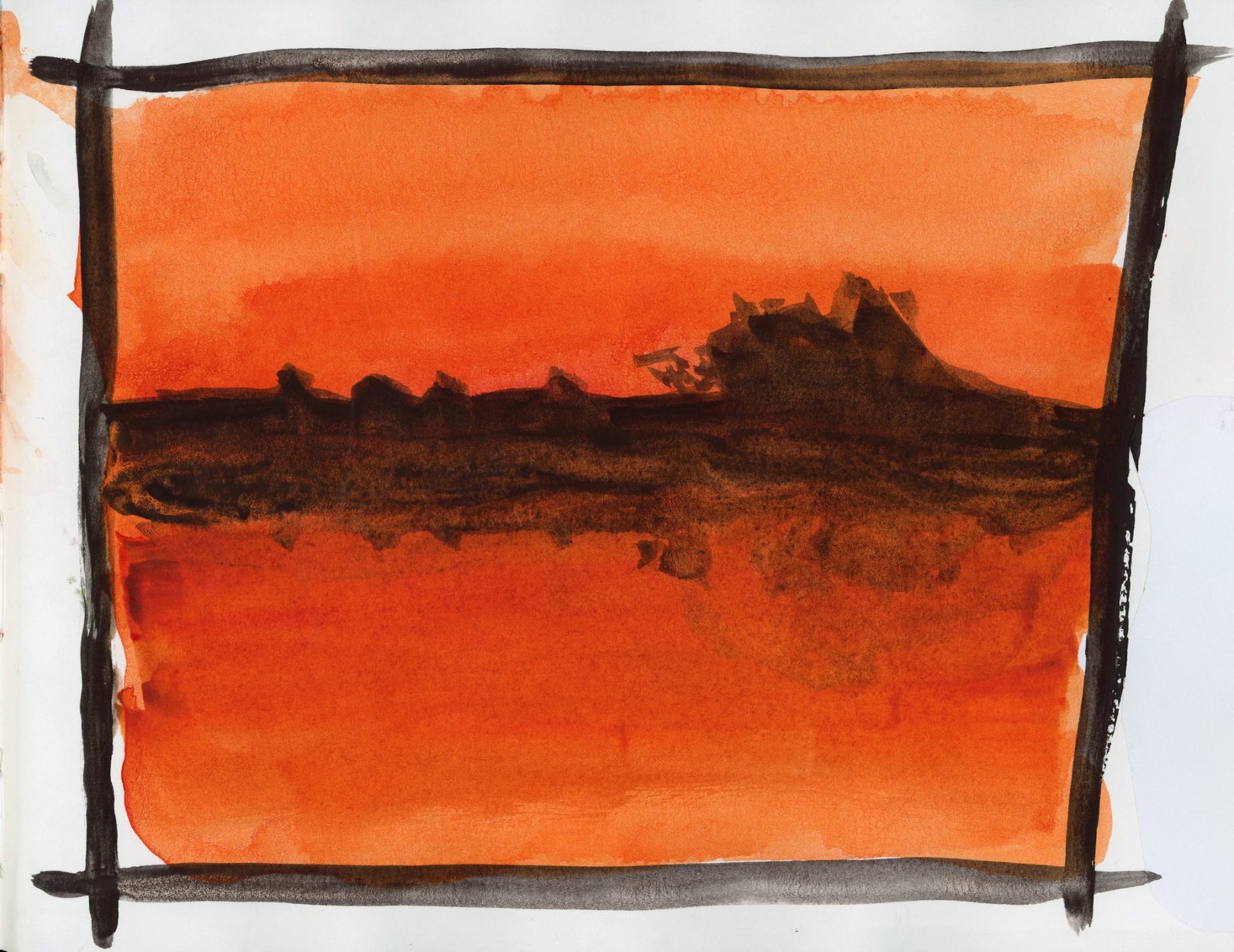
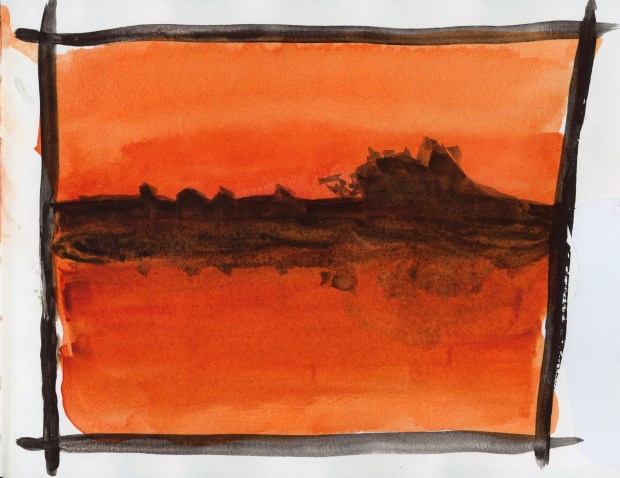
The sky, however, was putting on a show. I captured the soft pastels while the geese were eating. But I could tell the color was going to be spectacular so I raced to the other side of the pond, to catch the reflections. This extraordinary fire-red-orange rewarded me. What a stunning sunset! I found out the next day there was a wildfire to the west of town. That might explain the stunning color.
Bloodstone Genuine and Transparent Pyrrol Orange direct watercolor. Sunset at Stonecreek, 4 May 2026
I used Bloodstone Genuine and Transparent Pyrrol Orange. Even the frame is all watercolor. My first “Darks” drawing for May’s Patreon theme by Liz Steel.
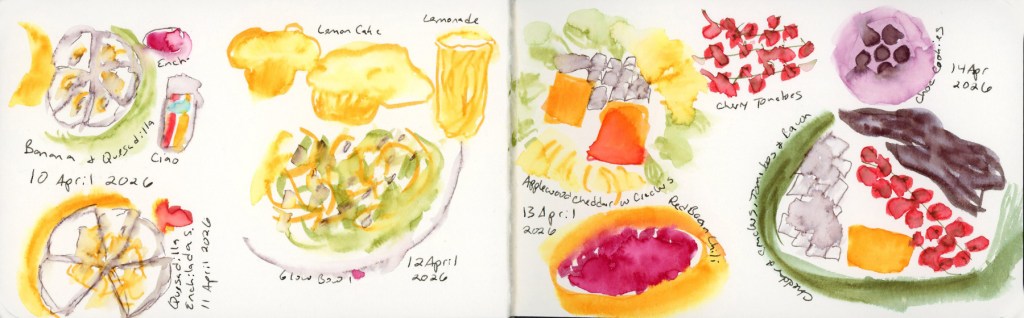
It wasn’t a bad month exactly, but it was a rocky one with symptoms flaring, energy unreliable, the kind of month where keeping up with a daily sketchbook practice just wasn’t in the cards. I kept eating dinner. I just wasn’t drawing it.
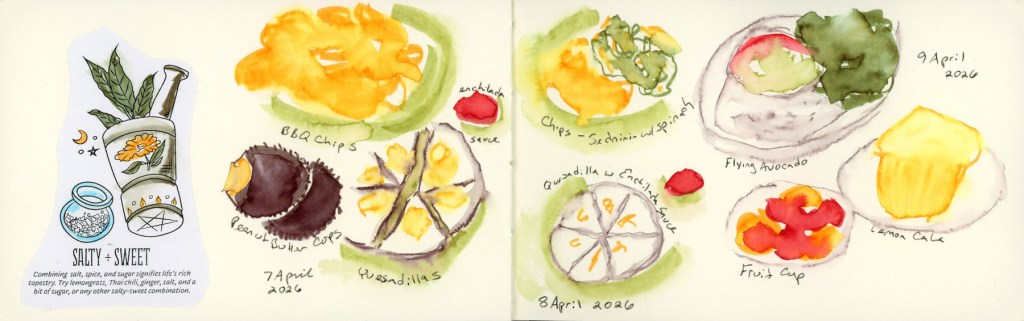
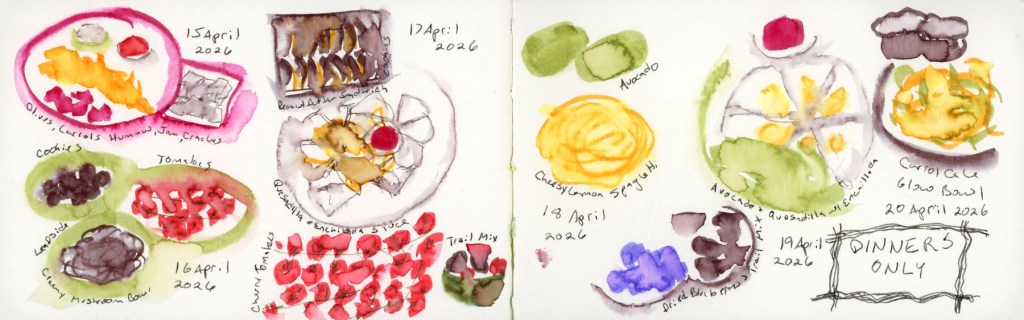
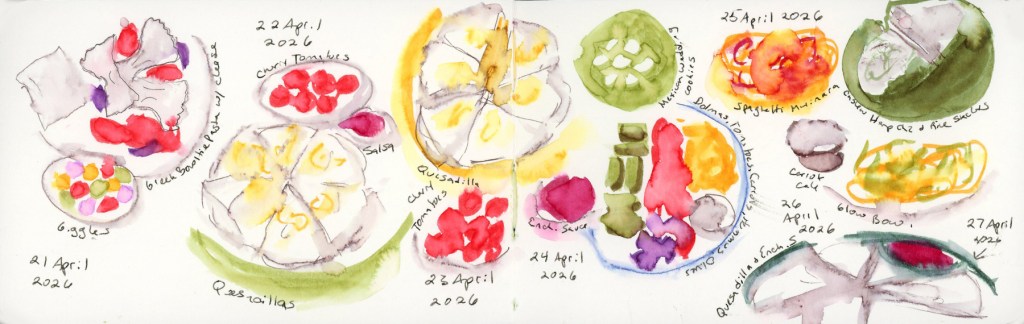
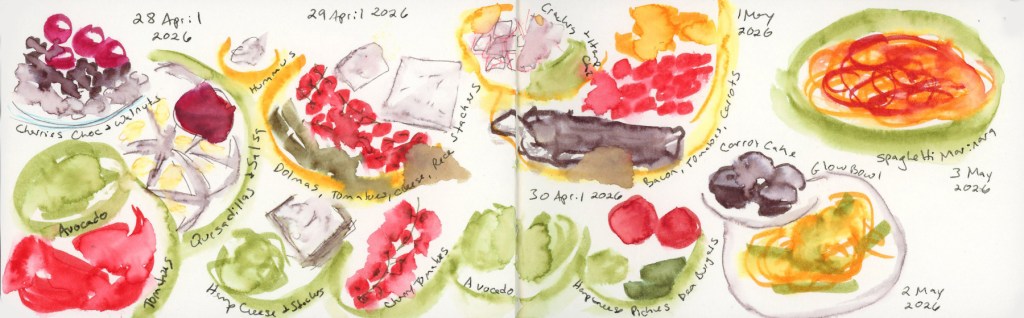
So yesterday I sat down with my phone, pulled up my photos, and drew twenty-six days of dinners in one go. Two and a half hours with the Shikiori markers, then another fifty minutes going back over everything with water to activate the color. I do love the blooms that activating watercolor markers can generate! Five pages. April 7th through May 3rd, all in one long, slightly meditative catch-up session.
I’ve done dinners-only before, back in 2022, but not since. The logic is the same now as it was then: breakfast and lunch don’t vary enough to sketch, and if something in my diet is causing a flare, it’s almost certainly lurking in dinner. The food diary is part creative practice, part detective work.
Drawing from photos all at once gave the pages a consistency I don’t usually get from in-the-moment sketching. Same hand, same markers, same energy — everything has a kind of visual unity that I actually like. It’s a different flow from the day-by-day record, but it’s still a record.
April 9th has a flying avocado, a fruit cup, and lemon cake, and I’m pleased with how cheerful it came out. April 12th’s glow bowl is one of the better-looking plates in the whole run. The cheesy lemon spaghetti on April 18th was delicious and the sketch knows it.
The DINNERS ONLY box that appears mid-April — I lettered it right there on the page as a label to remind myself I did still eat lunches! It has a slightly resigned, slightly determined energy that I feel captures the month accurately.
And then there’s the quesadilla. It shows up nine times. Nine. Quesadilla with enchilada sauce, quesadilla with salsa, quesadilla solo, quesadilla as a supporting player. It has practically become a character in this sketchbook. My Whoop has been giving me pointed looks about it. I asked about my poor sleep, and the theory offered is that a high fat and high carb dinner combination might be doing my sleep no favors. I did not buy tortillas on my last shopping trip. Let’s test this theory and see what happens. (But what will I eat on high brain fog, low energy days?)
This also concludes the small Delta Sketchbook that is my 29th sketchbook and my 6th food volume.
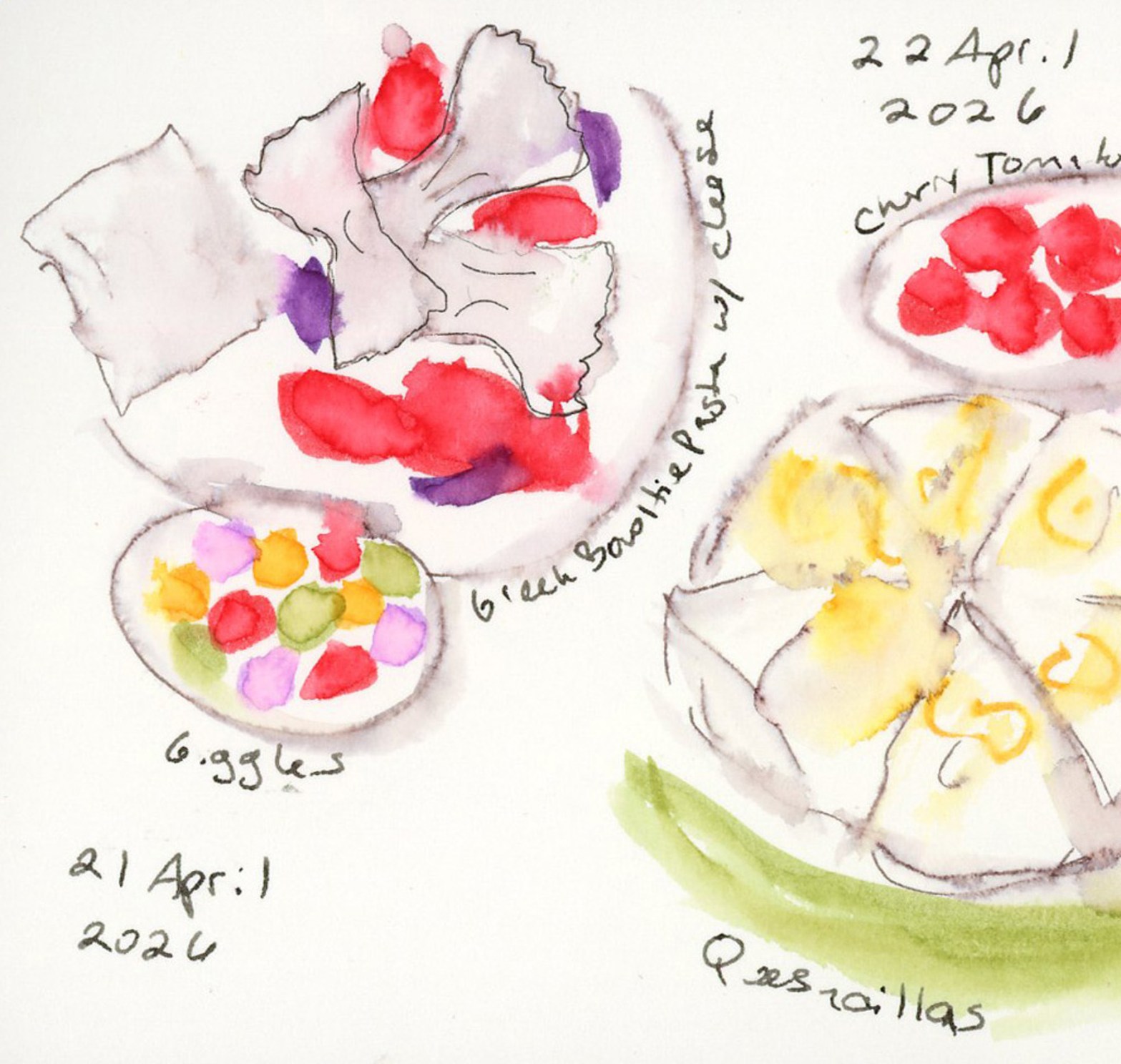
The featured image up top is from the April 21st spread — Greek bowtie pasta, and a little bowl of Giggles (allergen-friendly candy, think Skittles) with those bright confetti dot colors. It’s one of my favorites from the whole batch. Twenty-six dinners, one sitting, five pages. The record exists. On to May. Without my go to quesadillas!
Beltane comes and you can feel the season changing. I needed a week off. (Burnout persists!) I tried to clear the decks. I ordered a soft peachy floral display with sage colored leaves for the soothing soft vibes. (The order promised peach roses, white Asiatic lilies, peach miniature carnations, and white stock, accented with pitta negra, dusty miller, and a soft green echeveria succulent.)
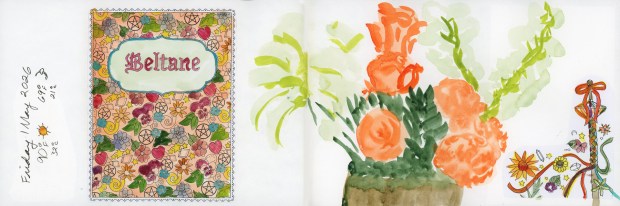
I printed my Coloring Book of Shadows Beltane images and the start of May as well, and distributed them through the remaining 12 pages (six spreads) of sketchbook volume 28. So close to the end I can taste it! I’m eager! I’m ready to move out of this year plus long series of landscape sketchbooks, testing the various Stillman and Birns papers. It’s been great, and I learned a lot about the papers. I am ready for a bigger page! I left room for sketches and hoped the spread-out collage pieces would create harmony on the pages. (The jury is still out on that.)
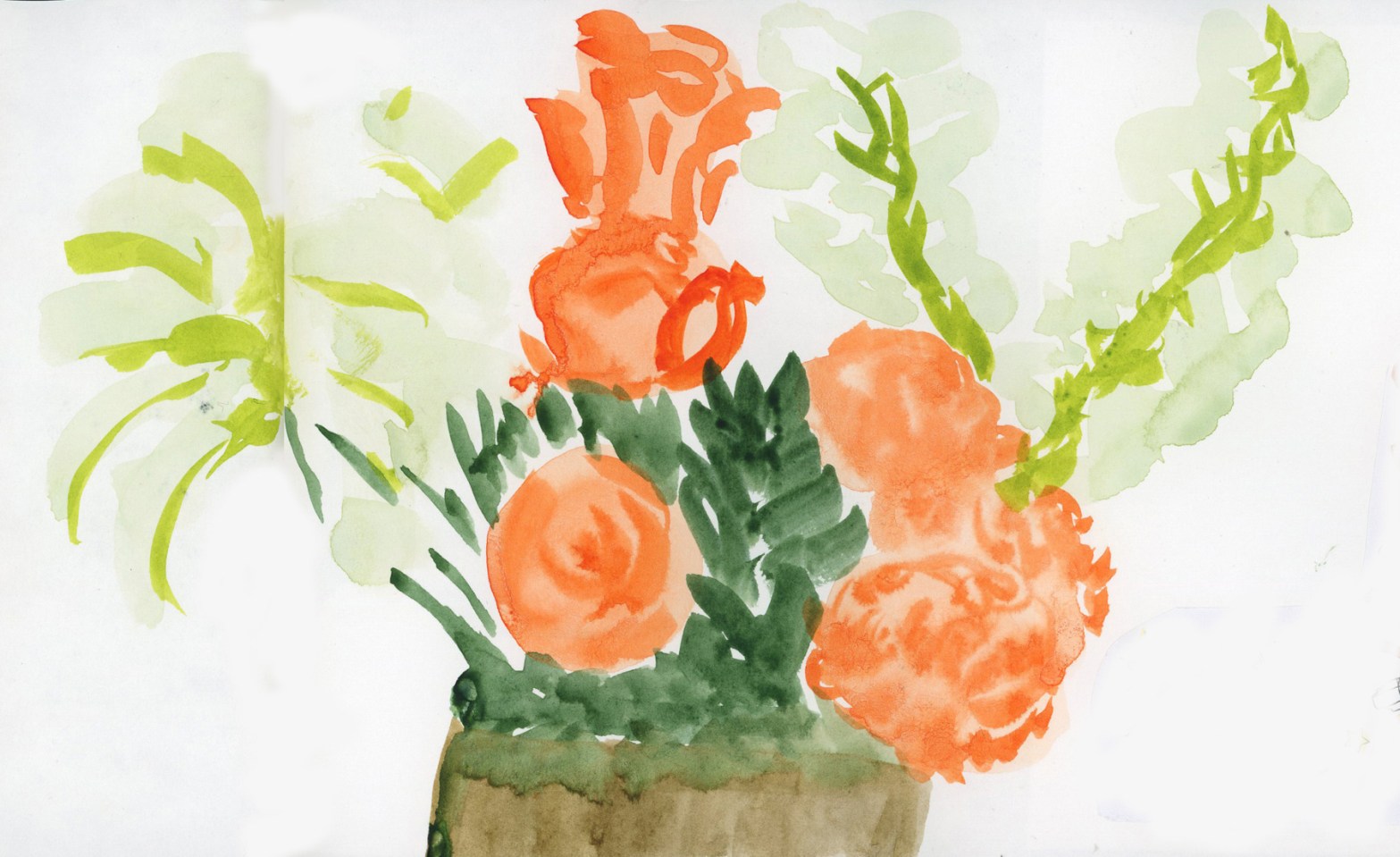
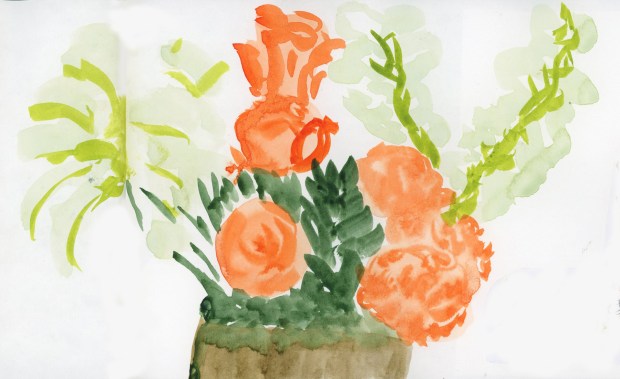
Direct watercolor, Beltane bouquet, 1 May 2026
My flowers arrived, and I received vibrant orange and dark green instead. “Flowers may be substituted.” (Tropicana roses, white Asiatic lilies, orange carnations, and white stock with leatherleaf fern and salal, and a dark green echeveria succulent.)
Well, I guess we’re doing Transparent Pyrrol Orange today!
Beltane Flowers. 1 May 2026
These are the flowers I received, so I’ll paint them as they came. I tried to capture the white Asiatic lilies and the white stock flowers. White flowers are hard to paint! The Transparent Pyrrol Orange was the perfect shade for the orange flowers, with no mixing needed. I did not paint it as bright as those Tropicana roses, though. I carried that color palette over to the Beltane collage sticker, as the new color story of the day.
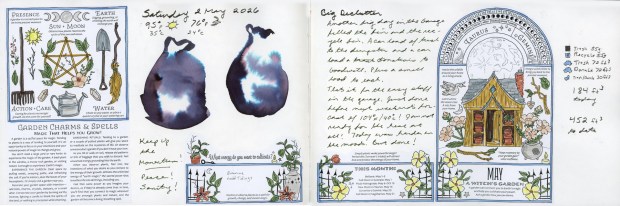
Ink Wash Bags for Declutter, 2 May 2026
Naturally, the weather threatened a crazy heat wave coming, and working in a hot garage is a bad idea, so I pushed to finish the garage declutter while the cooler temperature held one last weekend.
Robert Oster Graphite ink wash sketch, 2 May 2026
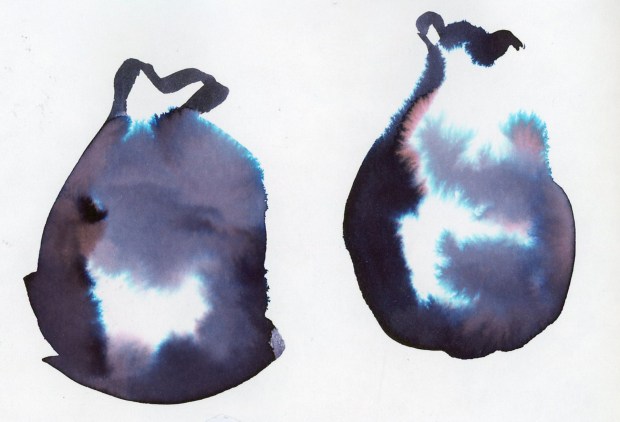
I love doing these Robert Oster Graphite inky chromatography garbage bags to document the decluttering. They are so expressive, and that color separation is delicious. Another big day of decluttering, and that settles the garage for the next eight months.
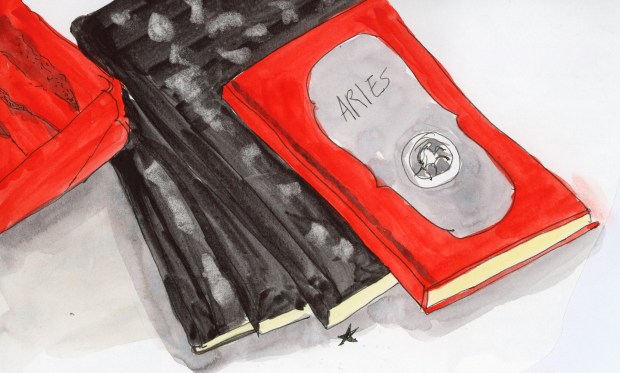
Book Still-life — ink and watercolor. 2 May 2026
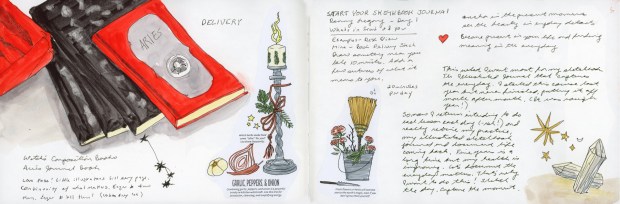
The Start Your Sketchbook Journal course by Danny Gregory is exactly what I want to be doing with my sketchbook practice, but I keep putting off the course. Maybe because I’m terrible at taking time off, and when I need a break, I end up decluttering garages, so the self-paced courses get put off so easily? Yeah. That.
Notebooks still life, 2 May 2026
But I sketched the new delivery of composition books and Aries Journal from Coloring Book of Shadows. I even sketched one of the corner designs by hand! I really need to practice illustration-style sketching!
Liz Steel’s Sketching Now Travel Sketching live run, begins later this month and I am jumping back in for my third attempt. I did finish the first run. The second run, I started but let’s just say life had other plans. I have tagged the whole archive of my posts if you want to see the full saga. The official start date is May 13th, but I’m getting a head start on the Introduction lessons.
The “Before” Sketch
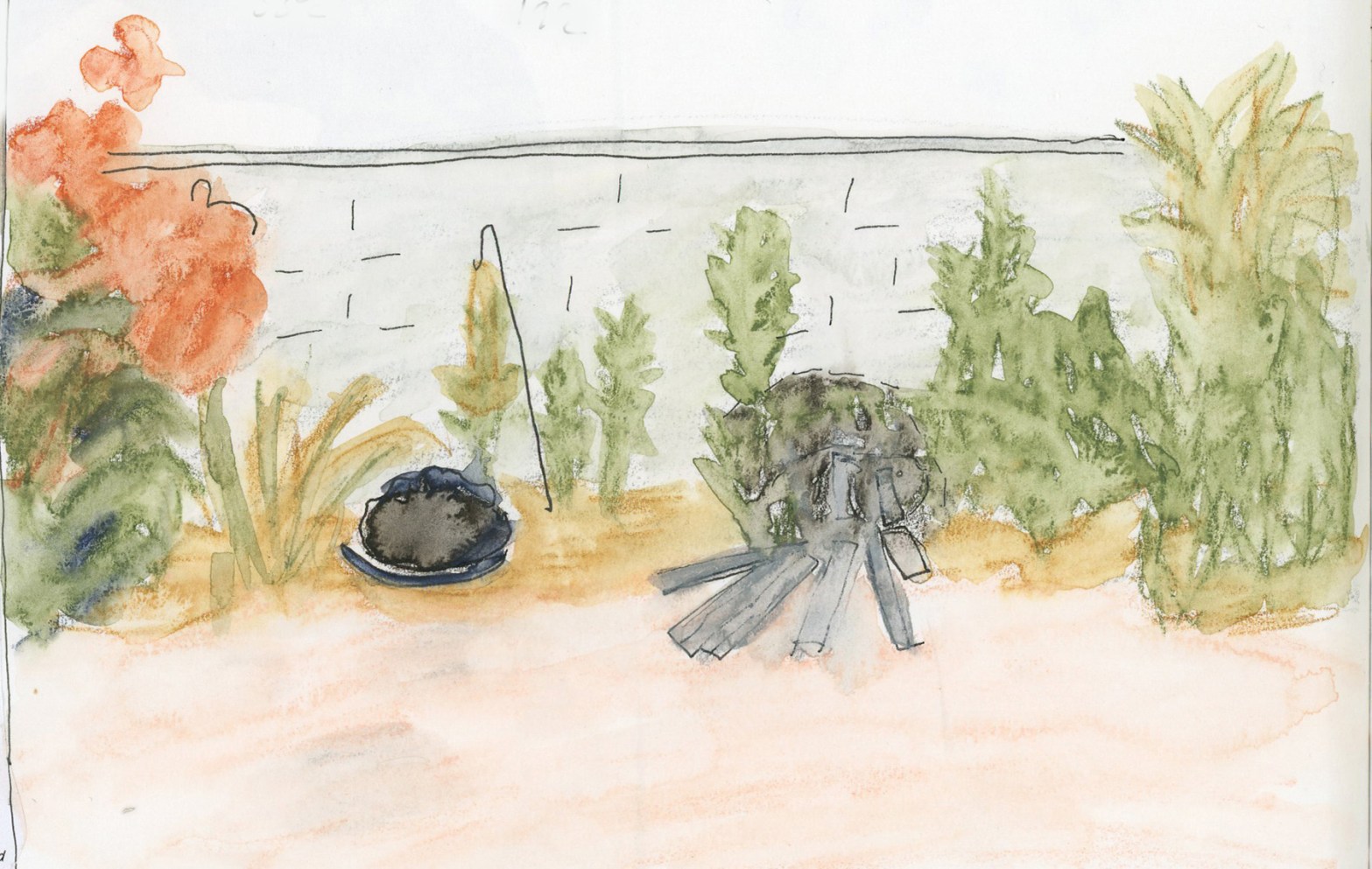
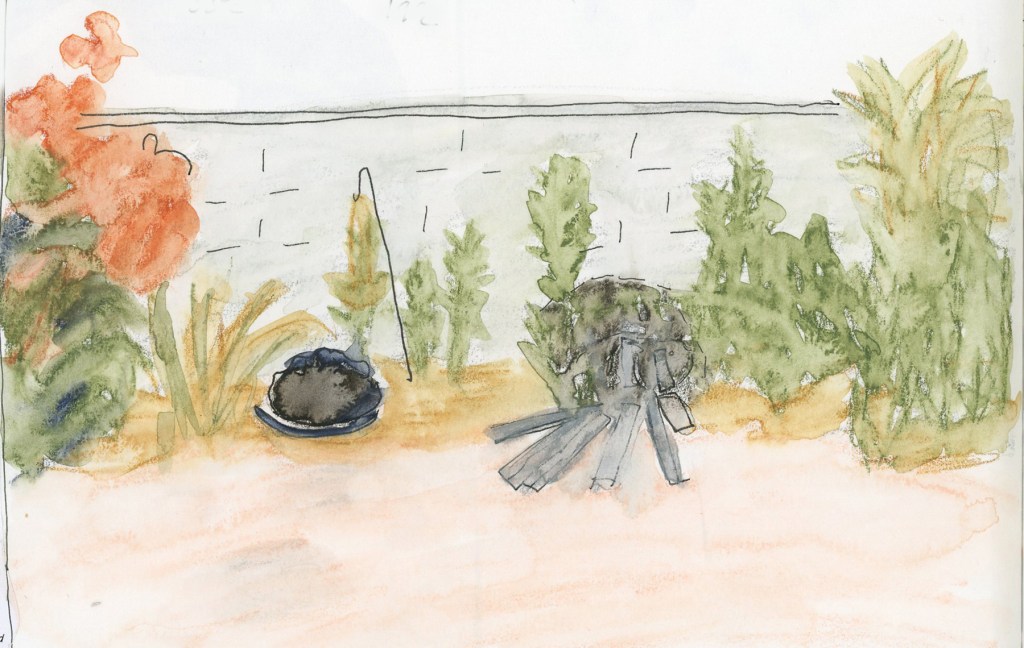
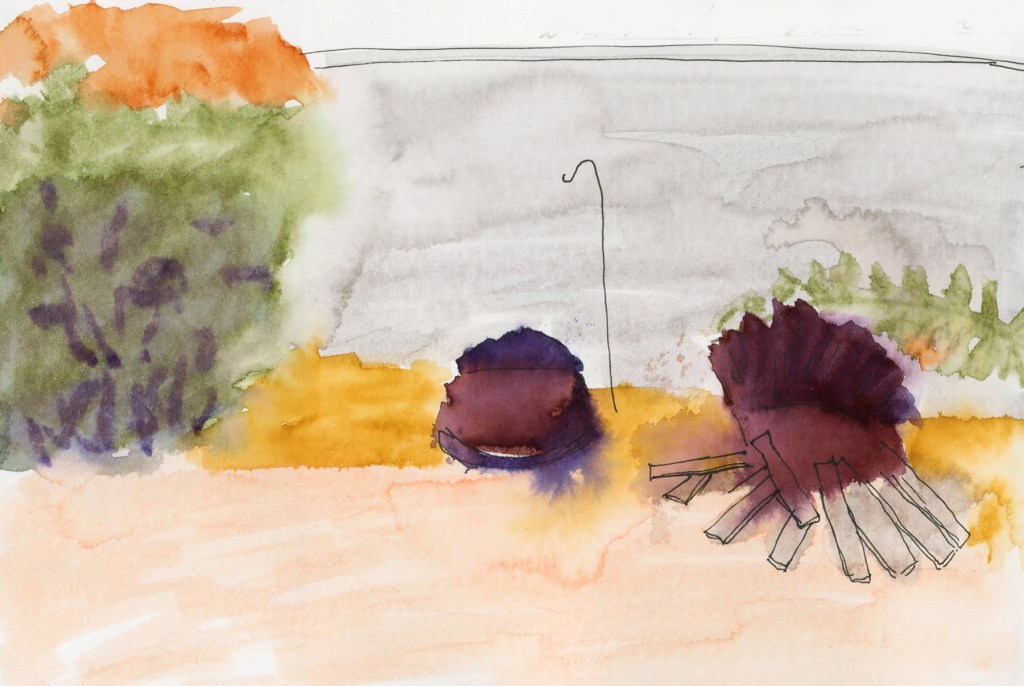
The Introduction includes a “current sketch” exercise. Your sketching where you are right now, before the course begins. Since I’ve done this before, I decided to sketch my back yard again. This is the same view I did as my first before sketch. Not only has the yard changed, but so has my sketching.
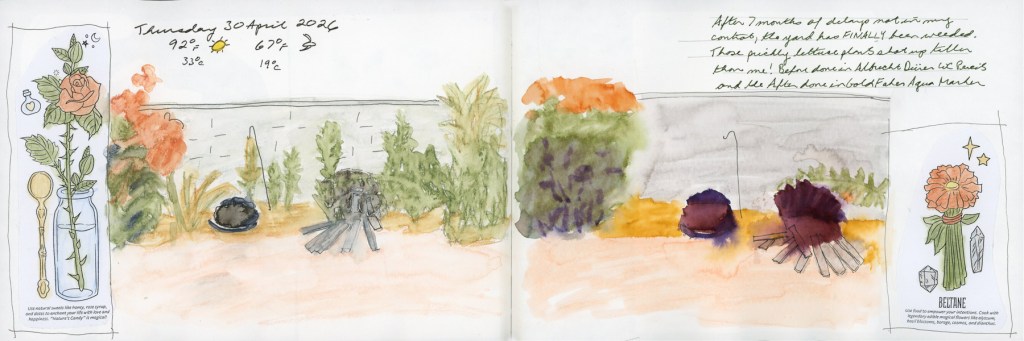
Naturally, I also had to document the fact that after seven months of delays in the landscaping (It’s been a whole drama!) the yard has finally been weeded. Those prickly lettuce plants had grown over six feet tall. Six feet! They were taller than me. I have photographic evidence. I think they were starting to develop permanent occupation plans. So the timing of this sketch gets to commemorate both that drama and its blissful conclusion on the day I did these. A dramatic before and after set of sketches for the yard.
The before sketch, with weeds, is in the Albrecht Dürer watercolor pencils, The after sketch is GoldFaber Aqua Markers. You can see the difference in the mediums, since I used the same color palette for both sketches. The marker version is noticeably brighter and more saturated; it’s the same scene, same composition, same palette, but a different medium. I really want to see how different mediums behave, and comparing the same color palette is a great way to do that.
Backyard, full of weeds in in Albrecht Dürer watercolor pencils.Back yard, freshly weeded, in GoldFaber Aqua Markers.
The yard features some very photogenic old barrel planters that are in the process of dramatically decomposing. They show up in both sketches as dark, slightly melancholy blobs surrounded by splaying lines. Less moody than the photographs of them!
Back yard sketches, before and after weeding. 30 April 2026.
The Kit
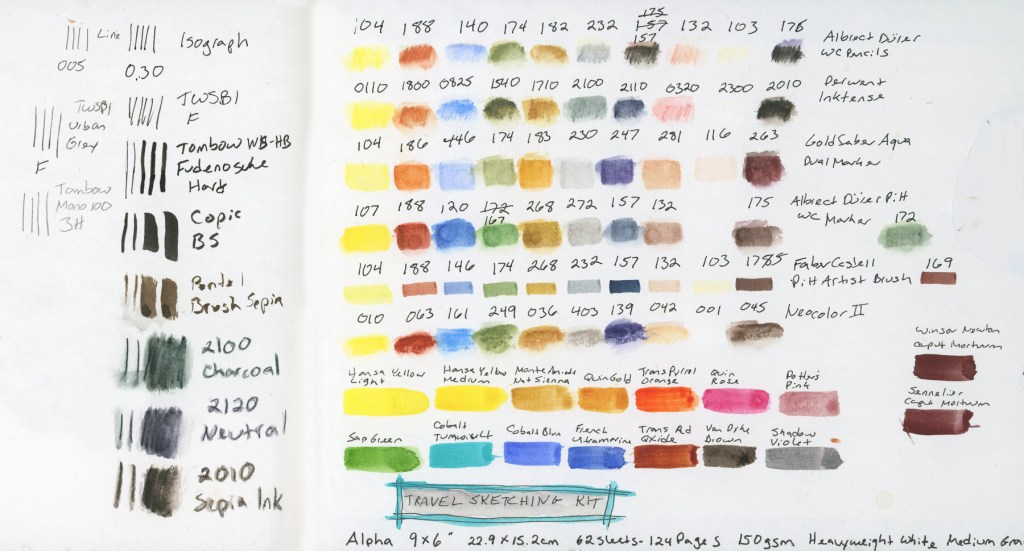
Part of the Introduction is also assembling materials for the travel sketching kit and doing a color/material chart. I wrote about my obsession with testing multiple media in this limited palette.
Travel Sketching Kit, April/May 2026.
Here’s what I’ll be working with for this run:
For line work, I have an Isograph 005 and 0.30, a TWSBI Urban Gray (F nib), a Copic BS, a Pentel Brush Sepia, and a Tombow WB-HB Fudenosuke Hard.
The course calls for graphite, but I’m skipping it since I find graphite too smudgy. I do have the one 3H pencil. For pencil sketches, however, I’m substituting three Derwent Inktense pencils: Charcoal (2100), Neutral (2120), and Sepia Ink (2010). I also have the class palette in Albrecht Dürer watercolor pencils, Derwent Inktense pencils, plus GoldFaber Aqua Dual Markers, Albrecht Dürer Pitt WC Markers, Faber-Castell Pitt Artist Brush pens, and Neocolor II water-soluble crayons.
For watercolor, my palette is: Hansa Yellow Light, Hansa Yellow Medium, Monte Amiata Natural Sienna, Quinacridone Gold, Transparent Pyrrol Orange, Quinacridone Rose, Potter’s Pink, Sap Green, Cobalt Turquoise Light, Cobalt Blue, French Ultramarine, Transparent Red Oxide, Van Dyke Brown, and Shadow Violet. There are also two Caput Mortuum swatches at the side, because I’m currently infatuated with that color.
The Sketchbook
I’ll be starting in my current 6×9 inch Stillman & Birn Alpha, even though I only have a few pages left in it. Shortly I’ll be moving to a 7.5×7.5 inch softcover Alpha. Both are Stillman & Birn, both are the Alpha series, just slightly different proportions. It’ll be interesting to see how the square format feels for travel sketching.
The weeds are gone, the kit is ready, and the barrel planters have been immortalized in watercolor. What more could I need? I’m ready!
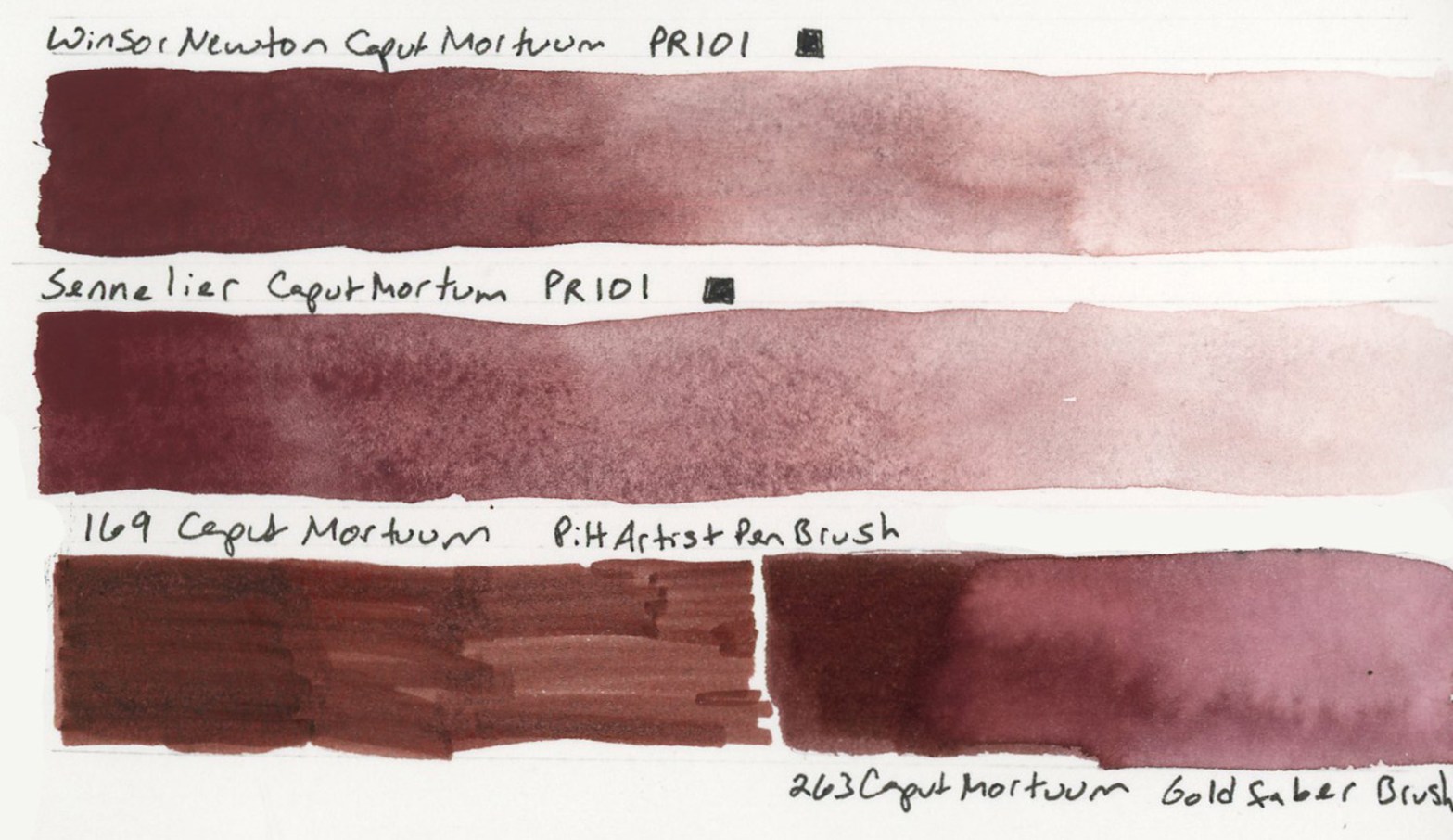
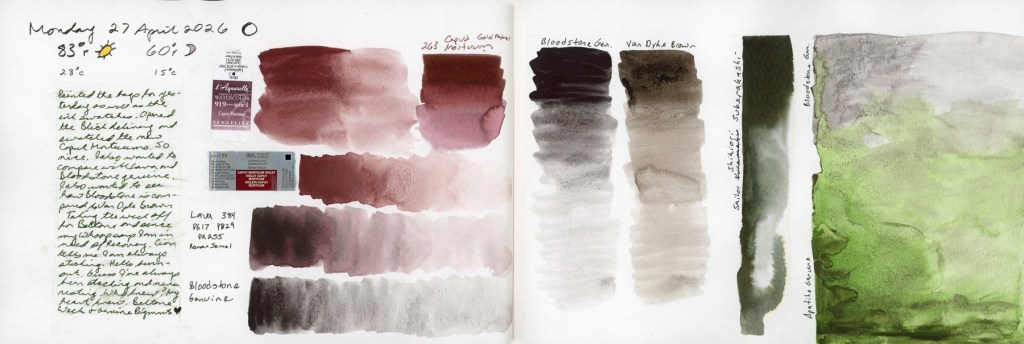
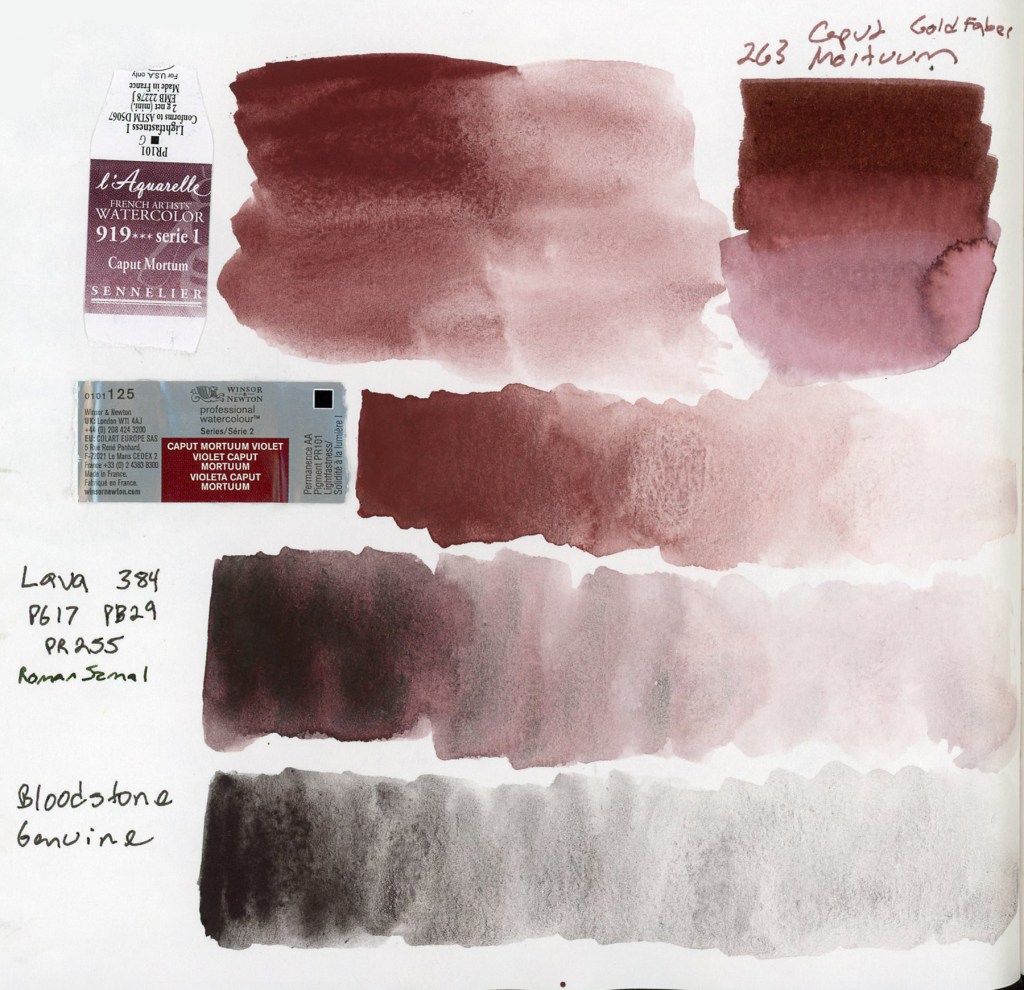
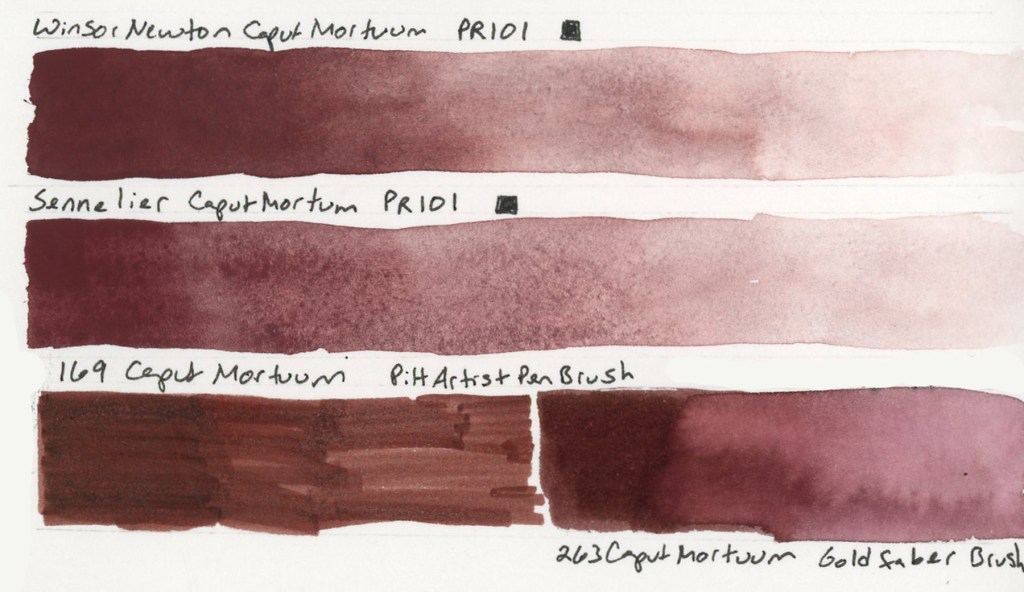
The Caput Mortuum watercolors arrived! My infatuation began when I put together the Travel Sketching palette, when the Goldfaber Aqua version caught my attention. Then in the notes page I thought of it immediately for the theme of darks. I knew I’d already ordered Winsor & Newton and Sennelier watercolors. Once they arrived I swiftly color swatched them.
Caput Mortuum, Lava, Bloodstone Genuine, Apatite Genuine, and Sailor Shikiori Subarakishi — Monday 27 April 2026 — Stillman & Birn Alpha
That deep, complex brownish-reddish-purple. Somewhere between burgundy and iron oxide. Caput Mortuum is Latin for “dead head,” an old alchemical term for the residue left after distillation. Macabre and poetic. I love it! Winsor & Newton and Sennelier are single pigment PR101, which is fairly opaque and highly granulating.
Caput Mortuum watercolor swatches in Sennelier and Winsor Newton. Roman Szmal Lava 384 and Bloodstone Genuine — Stillman & Birn Alpha, 27 April 2026Winsor & Newton Caput Mortuum Violet, Sennelier Caput Mortuum, 169 Caput Mortuum Pitt Artist Brush Pen, 263 Caput Mortuum Goldfaber Aqua Dual Brush Pen — Stillman & Birn Delta, 27 April 2026
The two watercolors are very similar in hue. The Sennelier is a little smoother, the Winsor & Newton has more granulation. Both are quite opaque. Opacity affects layering and mixing, and these will behave differently from transparent darks. Worth paying attention to, to avoid flat or muddy works.
I also pulled out the Roman Szmal Lava 384, which I’d first swatched back in early March. I still love it so much, and it definitely feels like it belongs in this color club. That PG17 PB29 PR255 triple pigment giving it a depth and richness that the single pigment paints don’t quite replicate. Roman Szmal paints are harder to source here in the States, though.
Naturally I had to include the markers! The Goldfaber Aqua 263 Caput Mortuum and the PITT Artist Pen Brush 169 Caput Mortuum, side by side with the watercolors. The hue match is surprisingly close. Markers are their own medium with their own behavior, but it’s satisfying to know that the color I fell for in the palette swatches is holding its own. My infatuation with this color continues. How will it look if I use it for my darks, for shadows, etc?
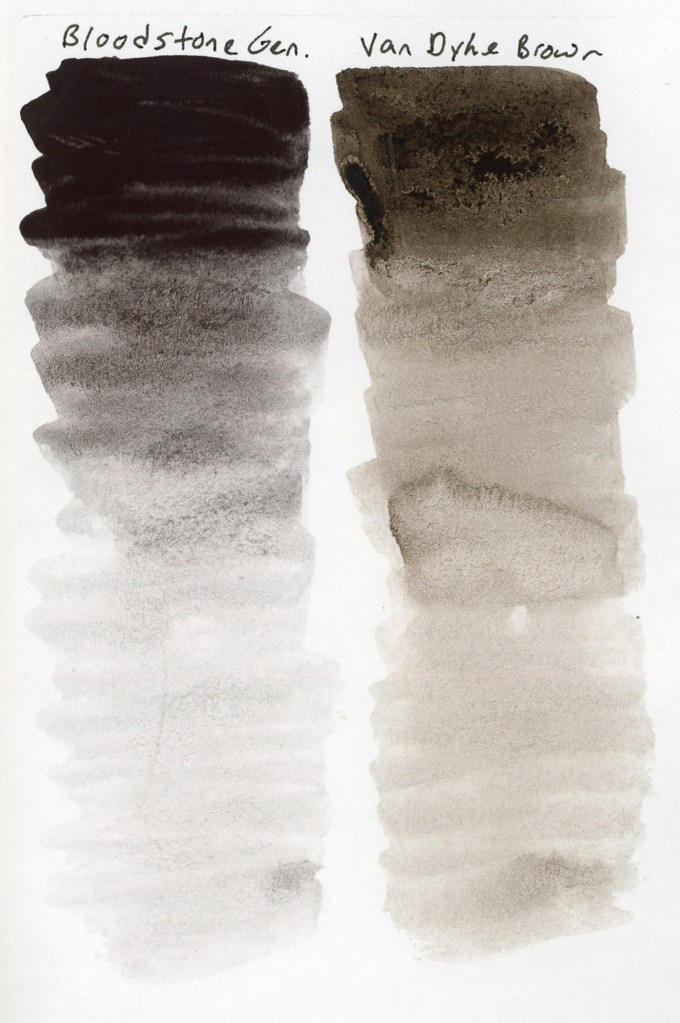
Bloodstone Genuine and Van Dyke Brown value gradients — Stillman & Birn Alpha, 27 April 2026
Since I was swatching anyway! I finally did the comparison of Van Dyke Brown versus Bloodstone Genuine. I’ve been curious about this since Liz swapped her Van Dyke Brown out last summer. Side by side in gradient swatches, the difference is clear. Bloodstone is greyer and cooler, less brown than Van Dyke Brown, and with potentially less of a color shift as it dries. Van Dyke Brown leans warmer and earthier. I can see why Liz made the swap, though I’m pretty sure my chocolate sketches need to keep the Van Dyke Brown! Bloodstone will work beautifully in landscapes and urban sketches, though!
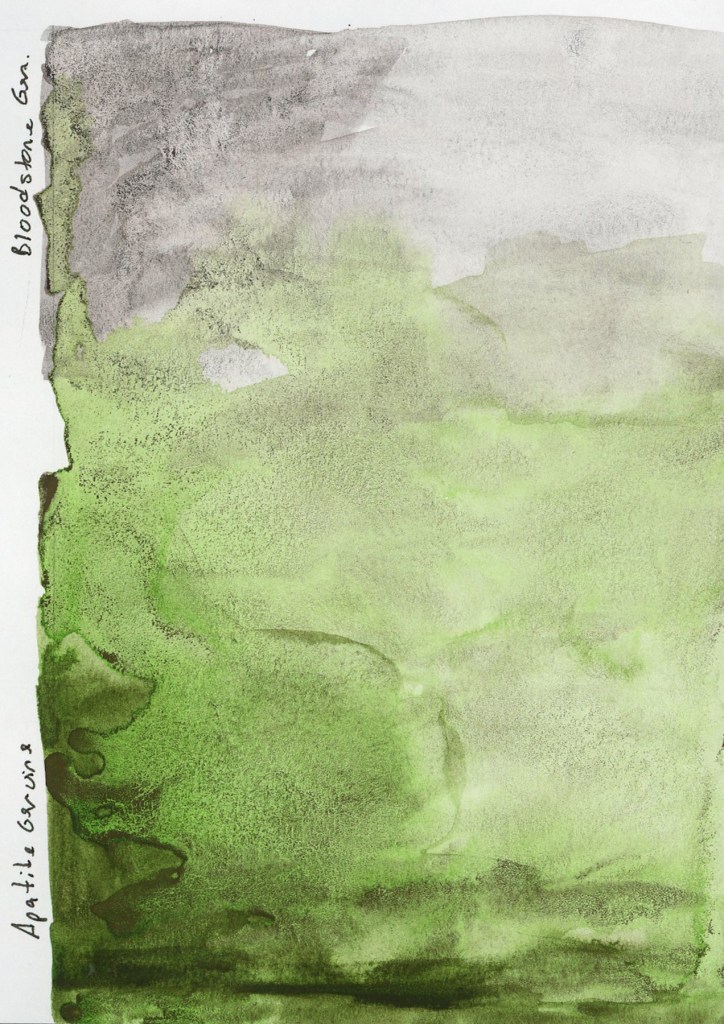
Bloodstone Genuine and Apatite Genuine — Stillman & Birn Alpha, 27 April 2026
Speaking of the landscape potential, both Bloodstone Genuine and Apatite Genuine granulate beautifully. I’m loving this texture of the genuine pigment paints, where the particles settle unevenly into the paper tooth and create something that looks almost geological. The Apatite Genuine is that luminous grey-green, softer and cooler than anything I could mix. Together on the page they look like a landscape seen from a great distance.
May has the Darks theme for the Patreon group, and the Travel Sketching course is running live. I’m excited for both, and hope to really dive in. I also want to get back to sketching the everyday things. It feels good to have more energy, and more enthusiasm again!