Open Compositions

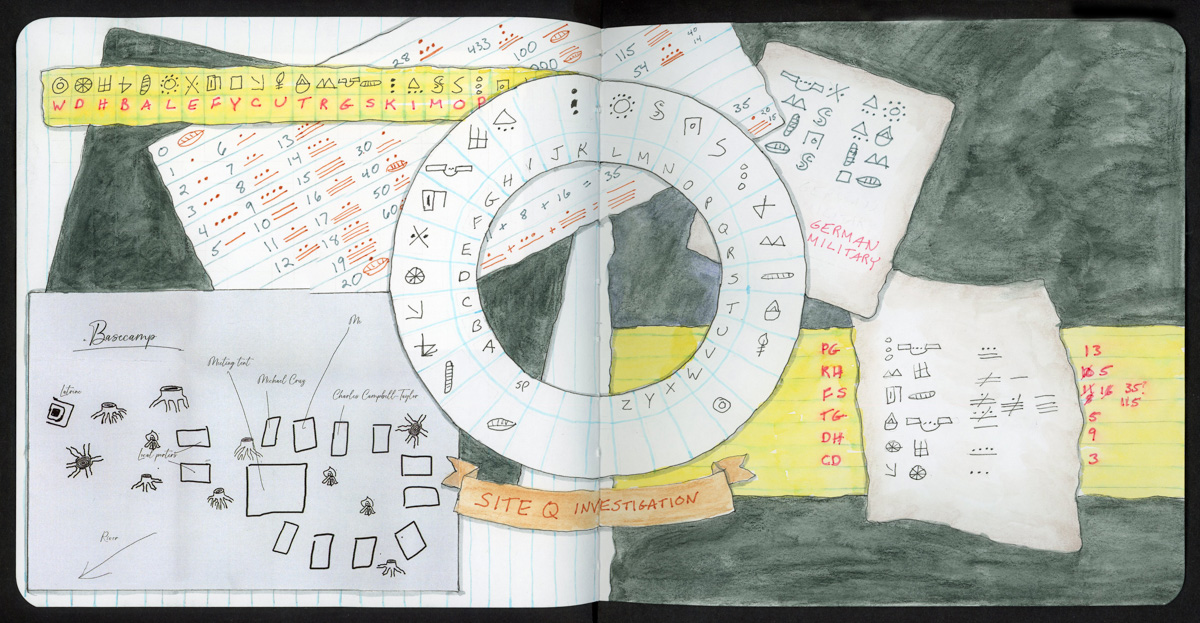
A landscape sketchbook spread of puzzle notes and a cipher key from Box 1 of the Site Q mystery box, built from overlapping papers, drawn to look like ruled notebook pages and yellow legal pad strips, all laid over a dark green-black painted background. A yellow strip across the top left is a cipher key: a row of hand-drawn symbols above the red letters “W D H B A L E F Y C U T R G S K I M O P.” Below it, a tilted ruled sheet lists the numbers 1 to 20 alongside red dot-and-bar numerals. At the center is a two-ring cipher wheel, with symbols on the outer ring and the alphabet A to Z on the inner ring. Through its center window you can see a strip with the dot-and-bar sum “+ 8 + 16 = 35.” A tan ribbon banner beneath the wheel reads “SITE Q INVESTIGATION” in red. At top right, a parchment scrap of symbols is labeled “German Military” in pink. At bottom left, a pale blue-gray sheet titled “Basecamp” maps a campsite: rectangles for tents, palm-like tree symbols, and handwritten labels for the latrine, meeting tent, local porters, “Michael Craig,” “Charles Campbell-Taylor,” “Me,” and an arrow pointing to the river. At bottom right, a yellow legal strip lists red letter pairs (PG, KH, FS, TG, DH, CD) next to a parchment scrap of symbol-and-numeral clues and a column of red answers, with one number crossed out and corrected.

The Open Compositions assignment has always challenged me and I haven’t managed it most of the years I’ve taken this Sketchbook Design course. I understand open corners, overlapping sketches, extending sketches, or “just put things on the page in a random way and have fun.” I just get overwhelmed.

I did two pages and ran out of time. In fairness, these were very time consuming pages. I leaned into the concept of overlapping. I leaned in hard. I ended up with a scattered desk look that I rather like.

Planning Page
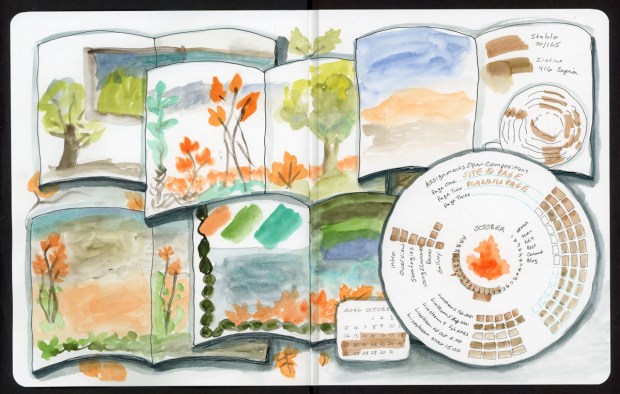
A landscape sketchbook spread showing a loose, overlapping pile of open sketchbooks drawn in black ink, each with a dark gray shadow underneath. Each little book holds its own watercolor sketch. There’s a yellow-green tree with a brown trunk, a blue-gray and green landscape, tall orange flowers with teal leaves, another tree above a row of orange shrubs, orange flowers over a peach and tan wash, swatches of orange, green and teal framed by a dark green beaded vine, and stripes of olive, green and blue. At top right, an open book holds a blue, peach and gray sunset wash on one page. The facing page has brown swatches labeled “Stabilo 70/165” and “Ecoline 416 Sepia” above a circle of dashed brown arcs. A large circular planning wheel fills the lower right. It reads “Assignments Open Compositions — Page One: Site Q Page, Page Two: Planning Page, Page Three,” and the third line is left blank. Around it are checklists for the lesson sections (Intro, Overview, Strategies, Using Elements, Demo, Gallery), a workflow list (Sketch, Scan, Edit, Post, Comment, Blog), and a list of livestream dates. In the center is “OCTOBER” with an orange flame-shaped tree, ringed by tan tracker boxes. A small 2026 October calendar sits below, with the last two weeks shaded tan, and loose orange leaves are scattered across the page.
Open Compositions – Planning Page

I am loving making these planning pages to keep me organized for each lesson. I drew the sample sketchbooks tumbling over each other, each holding its own small watercolor: trees, orange autumn flowers, a sunset, and a few swatch tests. The dark shadows under each book did a lot of the work. They push things forward and back, so the pile reads as a stack instead of a puzzle. The planning wheel sits on top of everything in the corner. It holds the lesson checklist, my workflow list, the livestream dates, and a little October calendar tucked underneath.

Site Q and Trompe-l’œil. (Contains Spoilers for the mystery!)
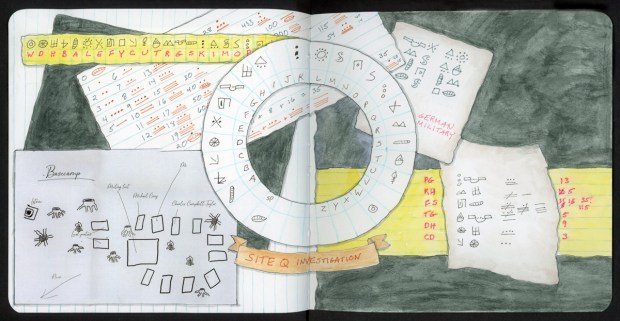
A landscape sketchbook spread of puzzle notes and a cipher key from Box 1 of the Site Q mystery box, built from overlapping papers, drawn to look like ruled notebook pages and yellow legal pad strips, all laid over a dark green-black painted background. A yellow strip across the top left is a cipher key: a row of hand-drawn symbols above the red letters “W D H B A L E F Y C U T R G S K I M O P.” Below it, a tilted ruled sheet lists the numbers 1 to 20 alongside red dot-and-bar numerals. At the center is a two-ring cipher wheel, with symbols on the outer ring and the alphabet A to Z on the inner ring. Through its center window you can see a strip with the dot-and-bar sum “+ 8 + 16 = 35.” A tan ribbon banner beneath the wheel reads “SITE Q INVESTIGATION” in red. At top right, a parchment scrap of symbols is labeled “German Military” in pink. At bottom left, a pale blue-gray sheet titled “Basecamp” maps a campsite: rectangles for tents, palm-like tree symbols, and handwritten labels for the latrine, meeting tent, local porters, “Michael Craig,” “Charles Campbell-Taylor,” “Me,” and an arrow pointing to the river. At bottom right, a yellow legal strip lists red letter pairs (PG, KH, FS, TG, DH, CD) next to a parchment scrap of symbol-and-numeral clues and a column of red answers, with one number crossed out and corrected.
Open Composition – Site Q (includes spoilers)

Site Q is a mystery box from Cosy Killer, and this spread is my notes and cipher key from Box 1. There’s a basecamp map collaged in, a symbol alphabet to crack, and some suspicious numbers that needed a lot of red ink before they gave up their secrets. Sketching my notes instead of just scribbling them on scrap paper made the whole thing feel like I was keeping a real field journal.

This is the spread I’m happiest with. I drew most of the elements to look like paper: ruled notebook sheets, yellow legal pad strips, and torn parchment scraps. It was so much fun! What a great trompe-l’œil effect! Once everything is “paper,” overlapping makes sense, because papers pile up on a desk. The cipher key slides under the number chart, the cipher wheel sits on top of both, and the basecamp map gets shoved into the corner the way real notes do mid-investigation.

The dark green background holds it all together and makes the pale papers pop. And yes, there’s a crossed-out wrong answer in the bottom corner. It stays. That’s what an investigation looks like.

This Site Q mystery has twelve episodes, and the first episode was two full pages in my sketchbook. I’m going to be having a lot of fun! This is my holiday season recreation project this year. I’ll be sharing as I go. (Along with the ink advent calendars again! They have been ordered! Stay tuned. December will be fun!)

What I’m taking away

Overlapping was much less scary once I gave myself a reason for things to overlap. Books in a pile, papers on a desk. If the objects themselves would naturally stack, the page stops fighting me. It’s still time-consuming, but I love the look of it.

Next lesson is the one I consistently struggle with. Designing on the Fly. It isn’t the designing part that gets me. It’s getting out to sketch multiple pages. However, the timing for this is right on Halloween week. I can’t resist leaning into that theme!

1 Comment

  1. Ginie's avatar Ginie says:

    This Open Composition spread is just fantastic! It looks great, and keeps drawing my eye into and around it. It’s beautifully composed.

    I really like your observation and conclusion that Open Compositions and overlaps make more sense when we think about representing things that would naturally overlap. Yes, that’s helpful!

    Thanks for sharing your journey Jamie and enjoy Halloween Week. 🎃👻💀 Or Samhain for the Celts among us. Which I’d like to say I am, though my affinities are spiritual more than due to a direct blood-line.

    Like

Leave a Comment