Some Caput Mortuum, please?

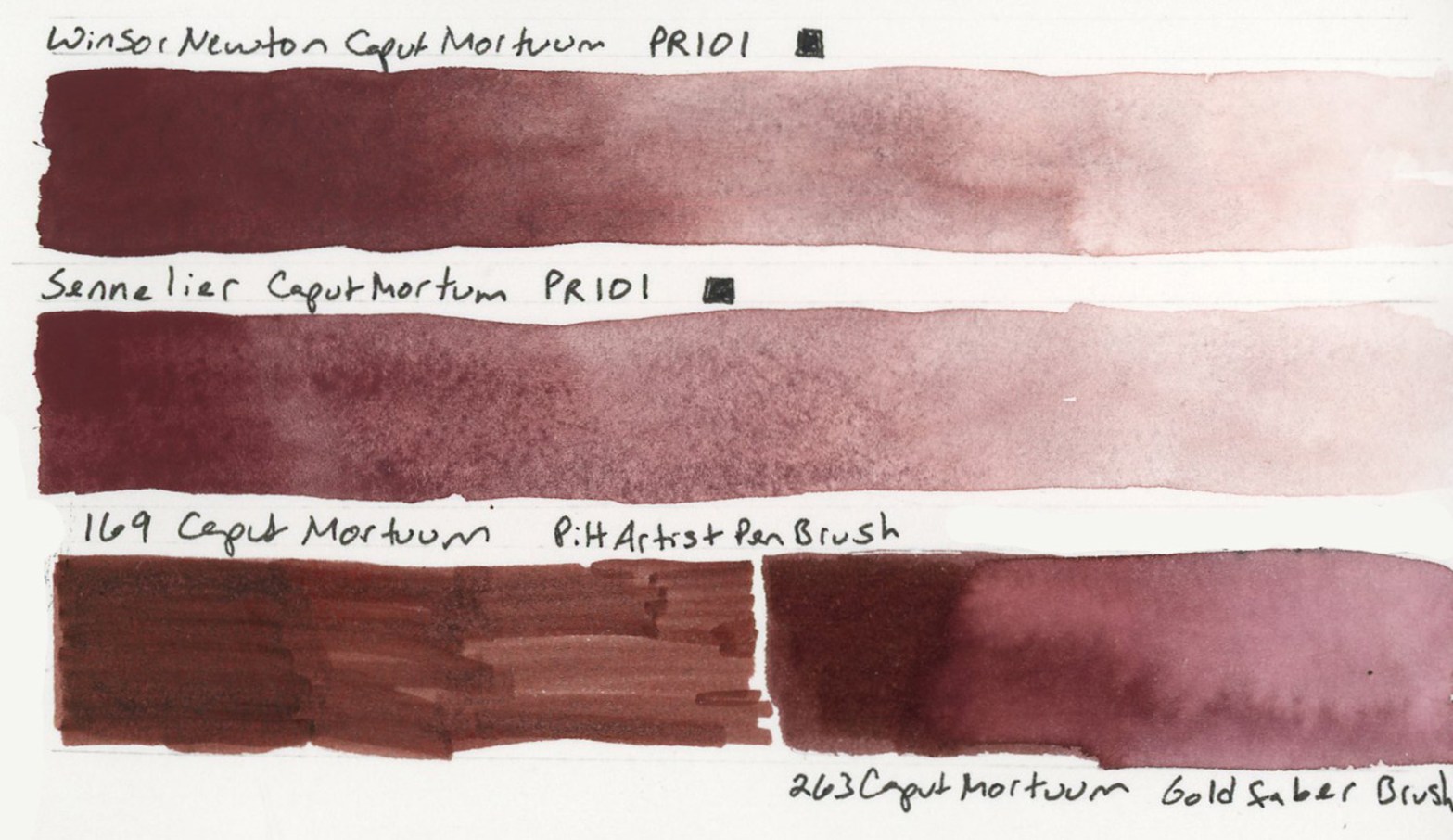
A watercolor swatch comparison page showing four horizontal wash bands on ivory sketchbook paper. From top to bottom: Winsor and Newton Caput Mortuum Violet, Sennelier Caput Mortuum, Pitt Artist Brush Pen Caput Mortuum, and Goldfaber Aqua Dual Brush Caput Mortuum. All are deep brownish-reddish-purple tones with subtle variations in warmth, granulation, and opacity. Stillman and Birn Delta sketchbook.

The Caput Mortuum watercolors arrived! My infatuation began when I put together the Travel Sketching palette, when the Goldfaber Aqua version caught my attention. Then in the notes page I thought of it immediately for the theme of darks. I knew I’d already ordered Winsor & Newton and Sennelier watercolors. Once they arrived I swiftly color swatched them.
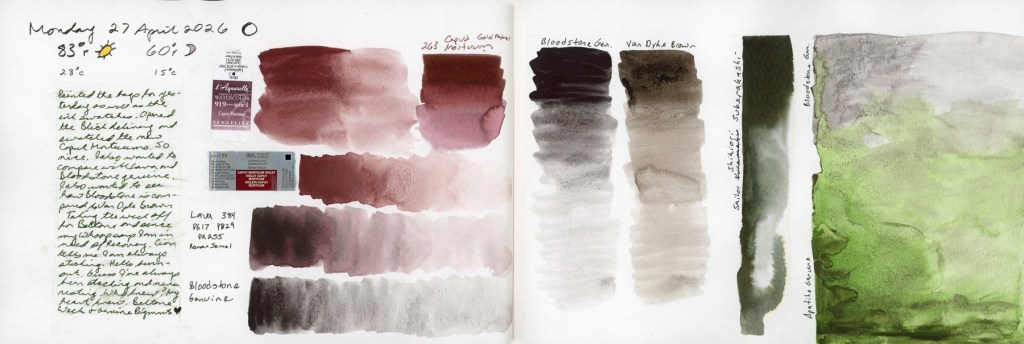
A double page spread in a Stillman and Birn Alpha sketchbook dated Monday 27 April 2026 with weather noted as 83 degrees Fahrenheit and 60 degrees at night. The left page shows a handwritten journal entry alongside Caput Mortuum watercolor comparison swatches with two paint tube labels affixed to the page. The right page shows Bloodstone Genuine and Van Dyke Brown gradient swatches, Sailor Shikiori Subarakishi and Apatite Genuine ink and paint swatches, and the Bloodstone Genuine and Apatite Genuine combined swatch. All pages are dense with color and handwritten labels.
Caput Mortuum, Lava, Bloodstone Genuine, Apatite Genuine, and Sailor Shikiori Subarakishi — Monday 27 April 2026 — Stillman & Birn Alpha

That deep, complex brownish-reddish-purple. Somewhere between burgundy and iron oxide. Caput Mortuum is Latin for “dead head,” an old alchemical term for the residue left after distillation. Macabre and poetic. I love it! Winsor & Newton and Sennelier are single pigment PR101, which is fairly opaque and highly granulating.
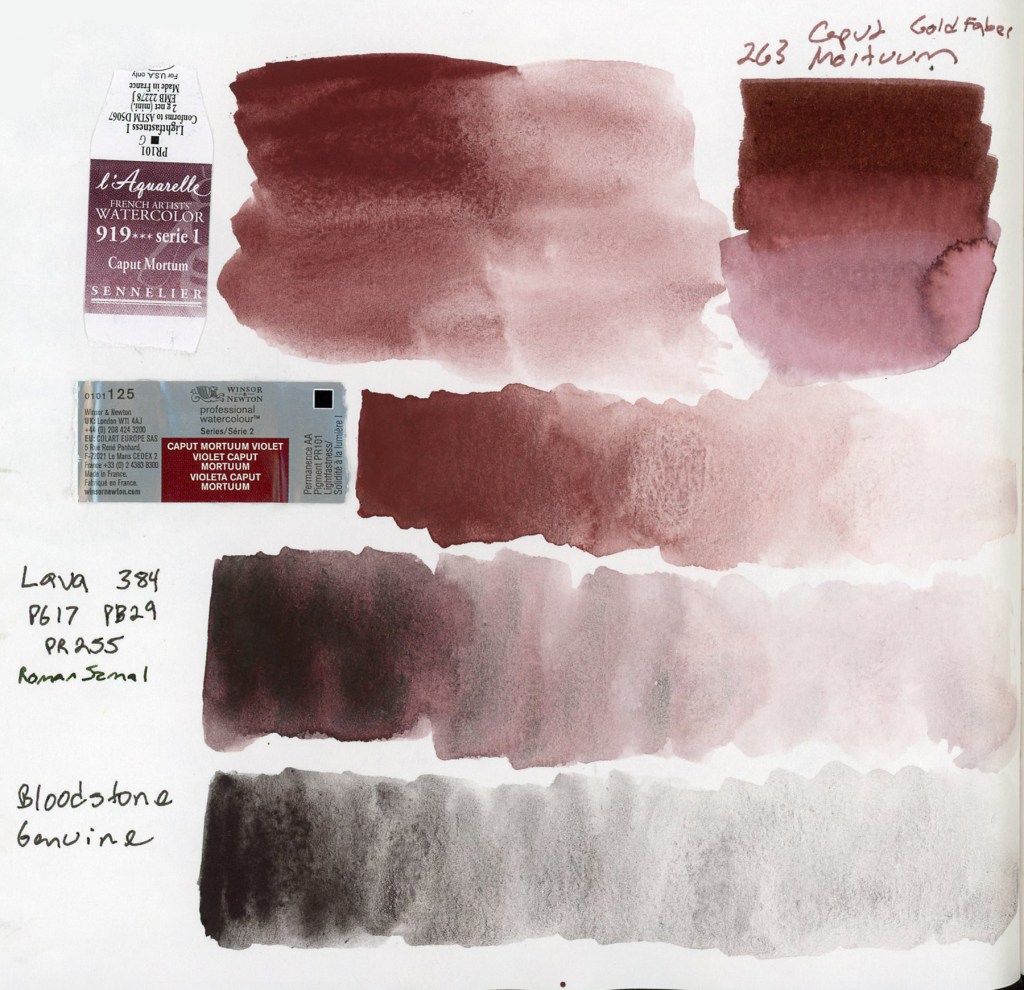
A sketchbook page showing Caput Mortuum comparison swatches across multiple media. Four horizontal watercolor wash bands fill the center and left, ranging from deep brownish-purple at full saturation to pale pink at dilution. Two paint tube labels are affixed to the page — Sennelier l'Aquarelle Caput Mortuum and Winsor and Newton Caput Mortuum Violet, both PR101. Handwritten labels identify Roman Szmal Lava 384 and Bloodstone Genuine. In the upper right corner a small swatch labeled 263 Caput Mortuum Goldfaber shows the marker equivalent. Stillman and Birn Alpha sketchbook.
Caput Mortuum watercolor swatches in Sennelier and Winsor Newton. Roman Szmal Lava 384 and Bloodstone Genuine — Stillman & Birn Alpha, 27 April 2026
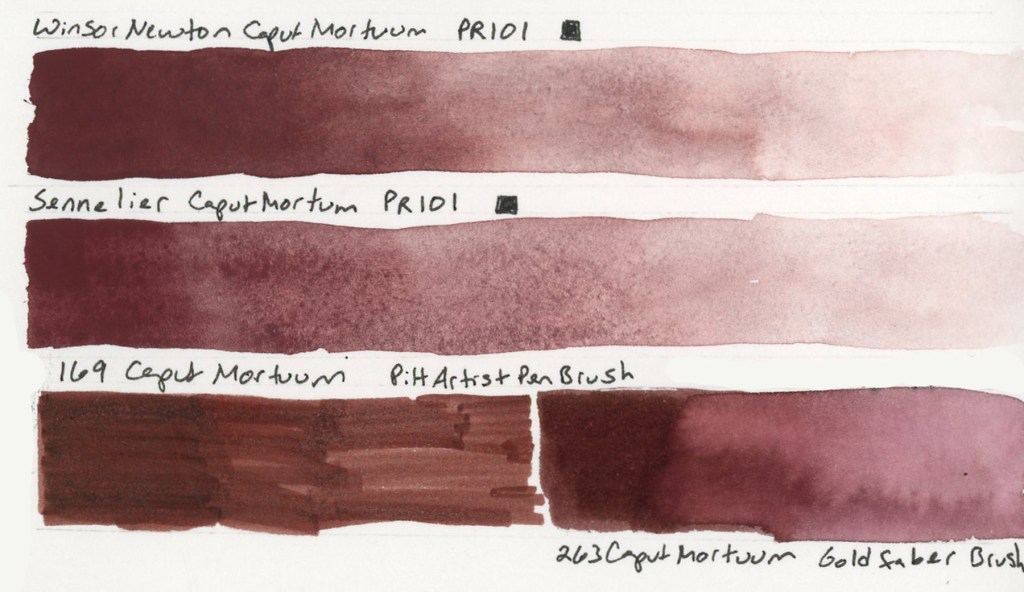
A watercolor swatch comparison page showing four horizontal wash bands on ivory sketchbook paper. From top to bottom: Winsor and Newton Caput Mortuum Violet, Sennelier Caput Mortuum, Pitt Artist Brush Pen Caput Mortuum, and Goldfaber Aqua Dual Brush Caput Mortuum. All are deep brownish-reddish-purple tones with subtle variations in warmth, granulation, and opacity. Stillman and Birn Delta sketchbook.
Winsor & Newton Caput Mortuum Violet, Sennelier Caput Mortuum, 169 Caput Mortuum Pitt Artist Brush Pen, 263 Caput Mortuum Goldfaber Aqua Dual Brush Pen — Stillman & Birn Delta, 27 April 2026

The two watercolors are very similar in hue. The Sennelier is a little smoother, the Winsor & Newton has more granulation. Both are quite opaque. Opacity affects layering and mixing, and these will behave differently from transparent darks. Worth paying attention to, to avoid flat or muddy works.

I also pulled out the Roman Szmal Lava 384, which I’d first swatched back in early March. I still love it so much, and it definitely feels like it belongs in this color club. That PG17 PB29 PR255 triple pigment giving it a depth and richness that the single pigment paints don’t quite replicate. Roman Szmal paints are harder to source here in the States, though.

Naturally I had to include the markers! The Goldfaber Aqua 263 Caput Mortuum and the PITT Artist Pen Brush 169 Caput Mortuum, side by side with the watercolors. The hue match is surprisingly close. Markers are their own medium with their own behavior, but it’s satisfying to know that the color I fell for in the palette swatches is holding its own. My infatuation with this color continues. How will it look if I use it for my darks, for shadows, etc?
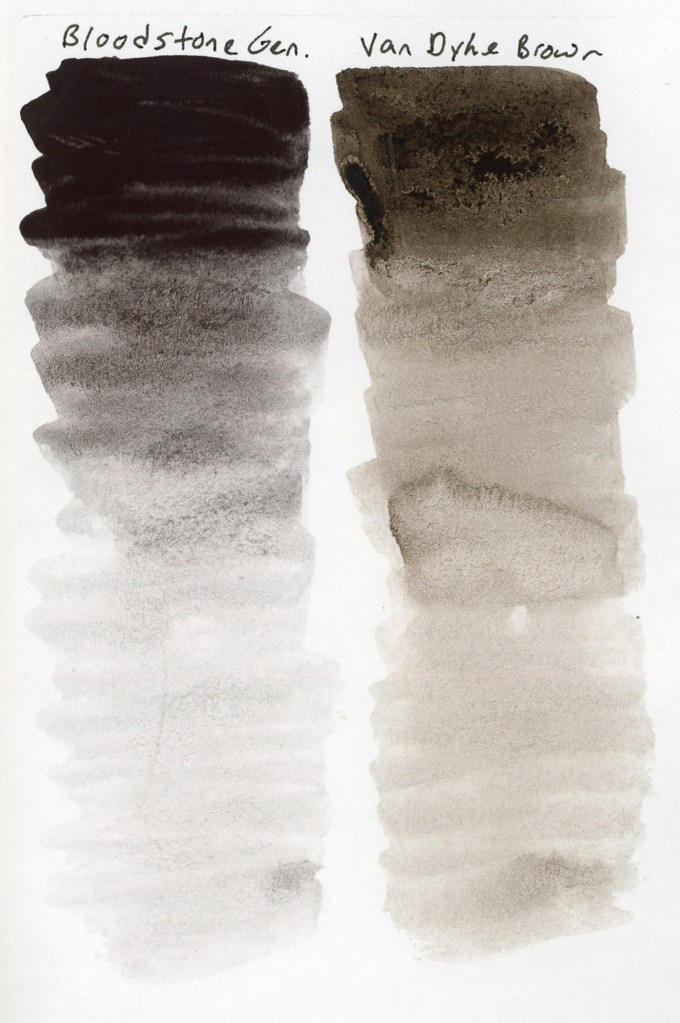
Two tall vertical watercolor gradient swatches side by side on white sketchbook paper, each fading from deep saturation at the top to a near-white wash at the bottom. The left swatch labeled Bloodstone Genuine is a cool dark grey-brown with visible granulation. The right swatch labeled Van Dyke Brown is warmer and earthier with a slightly different granulation texture. The comparison shows Bloodstone as cooler and greyer while Van Dyke Brown reads as warmer and more overtly brown. Stillman and Birn Alpha sketchbook.
Bloodstone Genuine and Van Dyke Brown value gradients — Stillman & Birn Alpha, 27 April 2026

Since I was swatching anyway! I finally did the comparison of Van Dyke Brown versus Bloodstone Genuine. I’ve been curious about this since Liz swapped her Van Dyke Brown out last summer. Side by side in gradient swatches, the difference is clear. Bloodstone is greyer and cooler, less brown than Van Dyke Brown, and with potentially less of a color shift as it dries. Van Dyke Brown leans warmer and earthier. I can see why Liz made the swap, though I’m pretty sure my chocolate sketches need to keep the Van Dyke Brown! Bloodstone will work beautifully in landscapes and urban sketches, though!
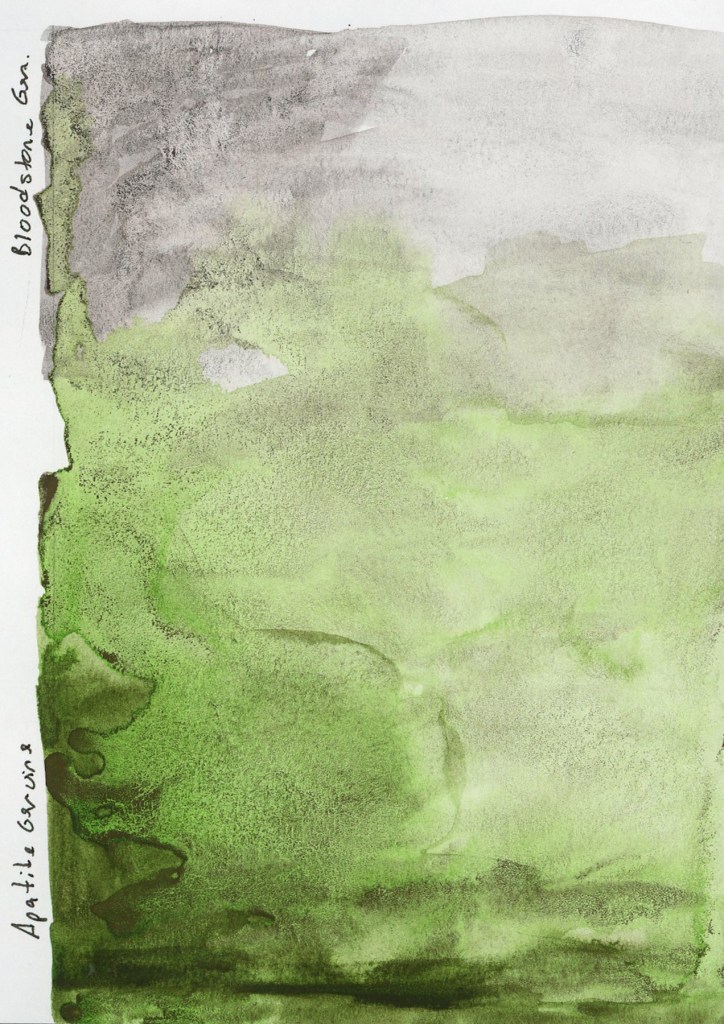
A large vertical watercolor swatch on white sketchbook paper showing two pigments applied together. The upper portion is Bloodstone Genuine in a cool dark granulating grey, labeled at the top left. The lower portion transitions into Apatite Genuine, a luminous granulating grey-green, labeled at the lower left. The granulation of both genuine pigments is visible as the particles settle unevenly into the paper tooth, creating a rich textured surface. Stillman and Birn Alpha sketchbook.
Bloodstone Genuine and Apatite Genuine — Stillman & Birn Alpha, 27 April 2026

Speaking of the landscape potential, both Bloodstone Genuine and Apatite Genuine granulate beautifully. I’m loving this texture of the genuine pigment paints, where the particles settle unevenly into the paper tooth and create something that looks almost geological. The Apatite Genuine is that luminous grey-green, softer and cooler than anything I could mix. Together on the page they look like a landscape seen from a great distance.

May has the Darks theme for the Patreon group, and the Travel Sketching course is running live. I’m excited for both, and hope to really dive in. I also want to get back to sketching the everyday things. It feels good to have more energy, and more enthusiasm again!

Leave a Comment